Found in a barn cleanup. It’s a heavy iron tool with a hinge and jagged teeth on the inside curve. It opens and closes but I have no idea what it’s me.
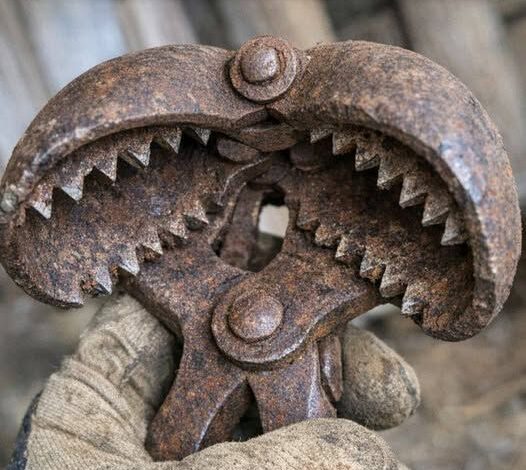
Tucked away in the shadows of aging barns and weathered tool sheds, the forgotten implements of a bygone era often serve as quiet, stoic reminders of rural ingenuity. During the routine clearing of a family estate or an old farmstead, one might stumble upon an object that appears utterly puzzling at first glance: a solid iron device featuring a central hinge and sharp, evenly spaced teeth lining its curved interior.
Heavy in the hand and forged for extreme durability, the tool’s distinct, plier-like motion suggests a design born of rugged necessity rather than mere decoration. While it may appear mysterious, perhaps even menacing, to modern eyes accustomed to plastic and automation, its anatomical structure offers vital clues about its indispensable role in the daily rhythms of early farm life.
A closer examination of those jagged inner teeth provides the necessary breakthrough for the amateur historian. These teeth are not positioned for slicing or cutting, but rather for the dual purpose of gripping and stripping. Their consistent spacing and curved alignment indicate a repetitive motion intended for a rounded surface. This specific engineering strongly identifies the object as a handheld corn sheller—a quintessential practical tool once used to manually remove kernels from dried corn cobs. Long before the roar of large-scale mechanical equipment became a staple of the American landscape, farmers relied on these handheld devices to process harvests efficiently, preparing their crops for winter storage or the local market.
The process of utilizing a traditional corn sheller is as straightforward as it is effective. The operation begins with a fully dried cob; moisture is the enemy here, as firm, desiccated kernels detach with far greater ease. The user positions the cob securely between the hinged arms of the device, ensuring the iron teeth press firmly against the rows of kernels. By applying steady, rhythmic pressure while simultaneously rotating the cob, the teeth act as a mechanical wedge, dislodging the kernels in clean sections until the cob is stripped bare.