Billionaire Star Hiding in Plain Sight The Hollywood Icon Worth More Than Taylor Swift and Oprah Combined
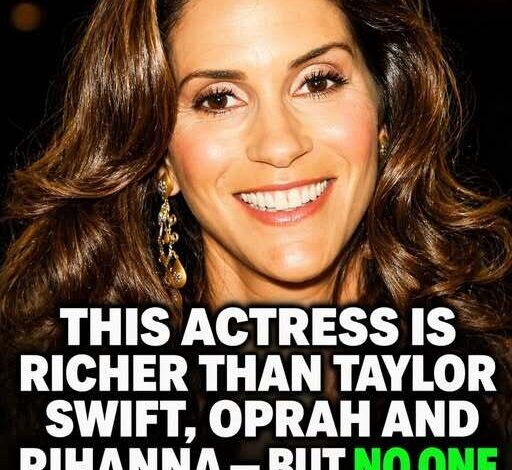
Names like Jennifer Aniston, George Clooney, and Tom Cruise typically come to mind when discussing the highest levels of Hollywood riches. We see the profitable perfume lines, the expansive houses in the Hollywood Hills, and the enormous salaries from summer blockbusters. But among the best, there is a quiet titan who has surpassed nearly every well-known figure in the field. She doesn’t spend her days chasing viral social media trends or appear on the front of every tabloid. Her name is Jami Gertz, and she is officially the richest actor in the world with an estimated net worth of $3 billion.
This news is shocking to many. How could someone who isn’t a regular on the A-list circuit have a fortune that surpasses that of pop stars like Taylor Swift and Rihanna or moguls like Oprah Winfrey? Jami Gertz’s story is not just about her acting prowess; it’s also a master class in high-stakes investing, strategic placement, and the importance of leaving a lasting legacy away from the paparazzi’s flashing lights.
The Basis for a Career in Hollywood
The film industry of the 1980s and 1990s must be examined in order to comprehend the lady behind the billions. An iconic figure of that time was Jami Gertz. She was an integral part of the “Brat Pack” generation, not only a supporting cast member. She is instantly recognizable to fans of cult classics as Star, the enigmatic love interest in the 1987 vampire blockbuster The Lost Boys. Her place in pop cultural history was solidified by her performance beside Jason Patric and Kiefer Sutherland.
In Sixteen Candles, another staple of the decade’s filmography, she was negotiating the uncomfortable hallways of high school before she started hunting vampires. Gertz moved into more adult parts as the years went by, and in 1996 he starred in the fast-paced catastrophe movie Twister. Respectable performances, consistent effort, and a familiar yet grounded presence were the hallmarks of her career.
But as Gertz herself has noted in a number of interviews, she was never only “waiting for the phone to ring.” She was financially independent and had a keen sense of business even in her early years. Gertz is careful to tell the audience that she was a successful, independent professional long before she became a billionaire, despite the media frequently attributing her enormous riches to her marriage. She entered her partnership as an equal contributor to their early life together, paid for herself, and accumulated her own savings.
The Turn to Exceptional Wealth
The transition from “millionaire actor” to “billionaire mogul” happened through the realm of high finance, even though performing offered a pleasant and prosperous life. Gertz’s spouse, Tony Ressler, is the pivotal figure in her financial story. Ressler, a titan of the private equity industry, co-founded Apollo Global Management and then Ares Management.
A single income or a fortunate break did not cause the couple’s riches to soar overnight. Rather, it was the outcome of decades of varied investments and skillful capital management. Through their ownership of the NBA’s Atlanta Hawks, Gertz and Ressler rose to prominence in the world of professional sports. They own sizable shares in the Milwaukee Brewers as well.
What distinguishes Gertz from her contemporaries is this shift from the screen to the boardroom. The majority of performers try to get wealthy through “lifestyle brands,” such as clothing lines, liquor companies, or perfumes. Even though these can be extremely profitable, they hardly ever reach the multibillion-dollar size found in the realms of professional sports teams and private equity. Gertz has institutional wealth. It is linked to the foundation of American entertainment and business.
The Low-Profile Art
Jami Gertz’s relative anonymity may be the most intriguing feature of her life. Gertz has opted for absolute privacy in a time when celebrity is frequently viewed as a commodity to be exchanged for attention. She doesn’t participate in the public drama that characterizes contemporary celebrity culture. She won’t engage in a public dispute on social media or sell access to her personal life in order to be “relevant.”
This “low visibility” is a deliberate decision. She has maintained a sense of normalcy that is nearly unheard of for someone of her financial status by taking a break from the Hollywood grind. She has made a smooth transition from being a familiar face on a movie poster to a quiet power broker in the corporate world. Her priorities are demonstrated by the contrast between being the richest person in her field and being among the least well-known by the typical adolescent.
A Philanthropic Legacy
Such wealth frequently entails a substantial social duty, and Gertz and Ressler have made philanthropy a key component of their public personas. They are regularly mentioned as some of the most giving donors in the business and entertainment sectors. Their contributions go toward systemic advancements in healthcare, education, and the arts rather than vanity projects.
Tens of millions of dollars have been contributed by the Ressler-Gertz Family Foundation to a variety of causes, such as medical research and initiatives to give impoverished kids chances. For Gertz, money is a tool for impact rather than merely a scoreboard for achievement. Her financial tale gains a deeper significance from her humanitarian perspective, which takes it beyond simple “riches” and into the domain of “legacy.”
Redefining the Contemporary Celebrity
Our basic notion of what it means to be a “successful actor” is called into question by Jami Gertz’s experience. We are taught to measure success by Oscar wins, box office totals, or the number of followers an individual has. Gertz suggests a different metric: the ability to use one’s career as a springboard into much larger, more stable arenas of influence.
She represents a new archetype of the celebrity—one who views the entertainment industry as just one facet of a much broader portfolio. Her journey proves that the most substantial “Hollywood stories” often happen off-camera, in the quiet negotiations and long-term investments that build generational wealth.
In a world obsessed with the “next big thing,” Jami Gertz remains a fascinating outlier. She is a reminder that you don’t have to be the loudest person in the room to be the most powerful. While the public continues to debate who the biggest movie star in the world is, Gertz is content to let them wonder, quietly sitting atop a $3 billion empire that she helped build, proving that sometimes, the greatest success is the kind that doesn’t need to be shouted from the rooftops.
Concluding Thoughts on an Unseen Empire
As we look at the landscape of 2026 and beyond, the “Gertz Model” of wealth is likely to become more common. More sportsmen and performers are focusing on team ownership and venture capital as their main objectives. However, Gertz was a pioneer in this space, making the move long before it was the trendy thing to do.
She remains the “richest actor you’ve never heard of” not because she failed to capture the public’s imagination, but because she moved beyond the need for it. Her $3 billion fortune is a monument to a life lived with intention, proving that in the game of life and finance, the most impressive wins are often the ones the world never sees coming.