Reports Claim Tension Erupted During Alleged Trump–Xi Meeting, Sparking Online Reactions
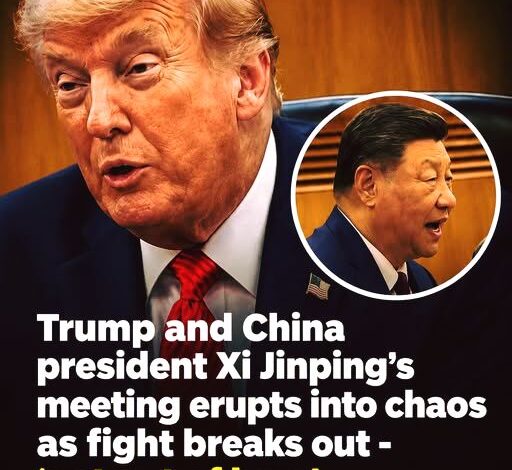
The atmosphere inside high-level diplomatic meeting rooms between major global powers is often described as carefully controlled, where every gesture, pause, and phrase is shaped by protocol and strategy. Behind closed doors, however, these meetings are not simply ceremonial exchanges but intense negotiations shaped by decades of geopolitical rivalry, economic interdependence, and security concerns. When leaders from the United States and China meet, the stakes are particularly high, as both nations represent the largest economic and strategic forces in the modern world.
Every interaction is closely observed by international markets, allied governments, and global media. Even the smallest shift in tone can influence diplomatic momentum. These meetings are rarely spontaneous, yet they often carry underlying tension that reflects broader global uncertainty. At the center of such engagements are two contrasting leadership styles that have defined recent years of U.S.–China relations. On one hand, American diplomacy under President Donald Trump has often emphasized direct negotiation, personal rapport, and public messaging that highlights economic priorities.
His approach has frequently involved framing relationships with foreign leaders in terms of personal chemistry and deal-making potential. On the other hand, Chinese President Xi Jinping represents a highly structured, state-centered diplomatic style, focused on long-term strategy, national sovereignty, and geopolitical stability. When these two approaches meet, the result is not only a negotiation over policy but also a contrast in worldview and diplomatic philosophy.
Public statements following these meetings are often carefully crafted, designed to signal progress while avoiding escalation. Leaders may use language that emphasizes cooperation, shared interests, and the potential for improved relations, even when underlying disagreements remain unresolved. In the case of U.S.–China discussions, topics such as trade policy, technology restrictions, military presence in the Asia-Pacific region, and the political status of Taiwan are typically central points of tension.
These issues are deeply sensitive for both sides, and even minor phrasing differences in official statements can carry significant diplomatic weight. As a result, much of the true negotiation occurs behind closed doors, away from public scrutiny. One of the most persistent and complex issues in these discussions is Taiwan. For China, Taiwan is viewed as an inseparable part of its territory under the “One China” principle, a position it consistently emphasizes in international diplomacy.
For the United States, the policy is more nuanced, involving strategic ambiguity and a commitment to regional stability without formal recognition of Taiwan as an independent state. This difference in interpretation creates an ongoing source of tension that surfaces repeatedly in diplomatic exchanges. It is often referenced indirectly in official statements but remains one of the most sensitive and potentially destabilizing issues in the relationship between the two countries.
Another recurring theme in U.S.–China dialogue is the concept of global power transition. Analysts often refer to historical frameworks such as the “Thucydides Trap,” a theory suggesting that rising and established powers are prone to conflict when shifts in global influence occur. While not an official policy position, this idea is frequently discussed in academic and strategic circles as a way to understand the structural pressures between Washington and Beijing. Both sides are aware of this narrative, and it influences how each nation approaches long-term strategy.
The United States seeks to maintain its global leadership role, while China continues to expand its economic and diplomatic influence across Asia, Africa, and beyond. Despite these structural tensions, both nations also share significant areas of mutual interest. Economic interdependence remains a defining feature of the relationship, with extensive trade flows, investment ties, and global supply chain connections linking the two economies.
Climate change, global health, and financial stability are also areas where cooperation is considered necessary, even during periods of political disagreement. This dual reality—competition combined with interdependence—creates a complex diplomatic environment where confrontation and collaboration exist simultaneously. As a result, every high-level meeting carries both risk and opportunity. In many cases, the public perception of these meetings is shaped more by interpretation than by the actual closed-door discussions. Media coverage, analyst commentary, and political messaging often highlight moments of tension or symbolic gestures, sometimes amplifying their significance.
Meanwhile, the actual negotiations tend to be more procedural, focusing on specific policy details rather than dramatic exchanges. Nevertheless, the symbolism of leadership interactions remains powerful, as it reflects broader international dynamics and domestic political narratives in both countries. Leaders are aware that their behavior is not only being evaluated diplomatically but also politically at home.
Over time, U.S.–China relations have moved through cycles of engagement and friction, cooperation and competition. Periods of trade negotiation have often been followed by disputes over tariffs, technology access, and strategic influence in key regions. Despite these fluctuations, communication channels have generally remained open, reflecting the importance of maintaining stability between the world’s two largest economies.
Even during times of heightened tension, both sides typically avoid complete breakdowns in dialogue, recognizing the global consequences that would follow. This pragmatic approach underscores the importance of diplomacy even in an environment defined by rivalry.
Ultimately, high-level meetings between global powers are less about immediate resolution and more about managing long-term relationships. They serve as platforms for signaling intent, testing boundaries, and reaffirming national priorities. While public narratives may focus on dramatic moments or sharp disagreements, the underlying reality is more complex and gradual. Diplomatic progress is often measured in incremental shifts rather than decisive breakthroughs. In the case of U.S.–China relations, this process continues to evolve, shaped by economic interdependence, strategic competition, and the shared responsibility of managing global stability in an increasingly interconnected world.