I was walking along the beach with my dog when we suddenly noticed this near the shore.
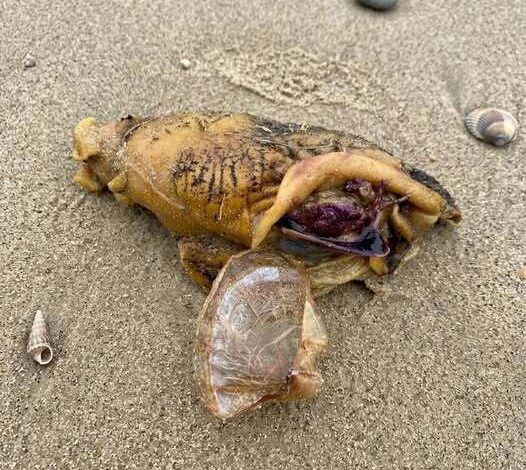
It looked wrong the second I saw it.
The kind of wrong that hits your stomach before your brain even understands what you’re looking at. I had been walking along the shoreline expecting the usual things beaches leave behind—shells, driftwood, seaweed tangled in the sand. The waves were calm, the air smelled salty and clean, and everything about the morning felt peaceful.
Then I noticed it half-buried near the edge of the grass.
At first, my brain couldn’t make sense of the shape. It looked swollen and distorted, with torn, rubbery skin stretched awkwardly across parts of it. One section looked almost inflated, while another appeared ripped open completely. Nearby lay a hard shell-like fragment separated from the rest, as if something massive had been torn apart and scattered across the shore.
I stopped walking immediately.
Every instinct in my body told me something about it was deeply wrong. The closer I looked, the less recognizable it became. It didn’t resemble any animal I could immediately identify. My mind started racing through increasingly disturbing possibilities: some kind of diseased sea creature, a badly mutated animal, or something dragged up from deeper water that humans were never really supposed to see up close.
The silence around it somehow made everything worse.
The ocean kept moving peacefully behind me, waves rolling in gently as though nothing unusual sat rotting only a few feet away. Birds circled overhead normally. The beach itself looked calm and beautiful. But right in front of me was this bloated, twisted thing that seemed completely disconnected from the peaceful scenery around it.
The longer I stared, the more unsettling it became.
Parts of the body looked strangely stretched and collapsed at the same time. The exposed areas looked almost alien beneath the sunlight. My brain kept trying to force the shape into something recognizable, but decomposition had distorted it beyond anything familiar. For a moment, I genuinely wondered if I was looking at something dangerous.
I didn’t move closer at first.
Honestly, I didn’t even want to breathe too deeply near it. There’s something uniquely disturbing about encountering death in nature unexpectedly, especially when the body no longer resembles the living creature it once was. It forces your imagination into places it doesn’t want to go.
But eventually, curiosity overcame fear.
I started searching online, comparing images, trying to understand what I had actually found. Slowly, the horrifying mystery became something more understandable—though not much less unsettling.
It was a dead sea turtle.
Not some mutant creature.
Not an unknown species.
Just a sea turtle in an advanced stage of decomposition.
Up close, though, decomposition had transformed it into something almost unrecognizable. As marine animals break down, gases build up inside the body, causing severe bloating. Skin loosens and tears apart. Limbs can separate. Even sections of shell may detach or crack away as tissues collapse underneath. The strange shell-like piece lying nearby hadn’t been evidence of some violent attack—it was simply part of the turtle separating naturally during decay.
What I thought were exposed inner organs or bizarre body parts were really tissues collapsing inward as nature slowly reclaimed the body.
Understanding it didn’t erase the discomfort.
If anything, the truth made the scene feel heavier in a different way. Standing there listening to the calm rhythm of the waves while looking at the remains of such a large animal created a strange emotional disconnect. Beaches usually feel associated with life, relaxation, vacations, sunlight. But moments like that remind you the ocean is not gentle simply because it looks beautiful from shore.
The sea carries life endlessly through its currents.
But it also carries death.
Sometimes it returns things quietly.
As I stood there, I started thinking about how many hidden stories exist beneath the surface of the water—storms, injuries, pollution, fishing nets, predators, exhaustion, migration. Creatures disappear into the ocean constantly without anyone ever witnessing what happened to them. Occasionally, though, the sea gives one back.
And when it does, it can force you to confront nature in a way that feels raw and impossible to ignore.
Eventually I walked away, but the image stayed with me long afterward. Every peaceful sound around me—the wind, the waves, the distant birds—felt slightly different after seeing that body on the shore. The coastline no longer seemed like just a beautiful place to relax. It felt older, harsher, more honest somehow.
Because the ocean doesn’t only bring shells and sunsets onto the sand.
Sometimes, it returns what it can no longer keep.