A Christmas-like scene unfolded on the highway when thousands of reindeer appeared out of nowhere, blocking traffic completely. But once the truth about their destination and escape became clear, witnesses were left speechless.
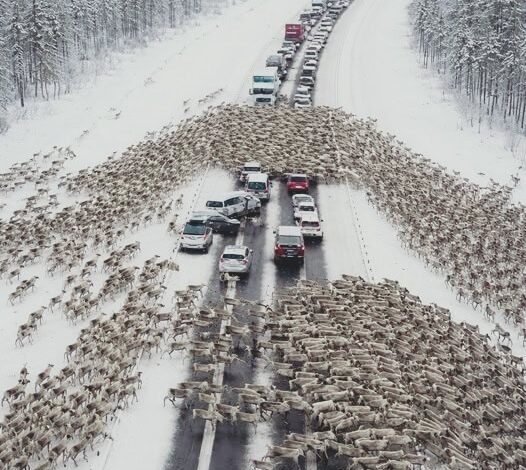
It began like something lifted from a winter postcard, the kind of scene people assume only exists in carefully edited memories. A cold, pale afternoon light stretched across a long stretch of highway cutting through a dense forest. The road was busy but calm, filled with families, commuters, and travelers returning home for the holidays. Engines idled patiently, headlights flickered against drifting snow, and the air carried that quiet anticipation that often comes with winter journeys.
For a while, everything felt ordinary. People scrolled through phones, sipped coffee from travel mugs, and watched snow settle gently along the roadside trees. The forest stood still on both sides of the highway, thick with evergreens weighed down by frost. Nothing suggested that anything unusual was about to happen. Then, without warning, that calm was broken by a distant vibration, faint at first, almost mistaken for thunder rolling somewhere far away.
The sound grew quickly, deepening into something heavier and more physical, until it seemed to pass through the ground itself. Drivers began to notice movement at the edge of the forest. At first it was just shadows shifting between the trees, then shapes, then motion too fast and too coordinated to ignore. Suddenly, the forest seemed to open, and a wave of animals burst forward onto the highway.
Thousands of reindeer surged out of the treeline in a sudden, overwhelming stampede. Their hooves struck the frozen ground in chaotic rhythm, steam rising from their bodies in the cold air. Antlers swayed and collided as the herd poured onto the road, forcing every vehicle to stop instantly. Horns blared briefly, then fell silent as drivers realized there was nowhere to go and nothing to do but watch.
At first, confusion filled the moment. Some people assumed it was a rare migration disrupted by weather or noise. Others stepped out of their cars, pulling out phones to record what looked almost surreal against the winter landscape. There was even a brief sense of wonder, as if nature had staged an unexpected performance across the highway, turning an ordinary traffic jam into something unforgettable.
But that feeling did not last. The behavior of the herd carried something different, something urgent and unmistakably real. The animals were not wandering or grazing. They were fleeing. Their movements were erratic yet directed, driven by a fear so intense it was visible in every motion of their bodies. Heads stayed low, breaths came in sharp bursts, and their pace never slowed, even as they crossed the frozen asphalt.
Then came the sound that changed everything.
A low, powerful rumble began rising from the mountains beyond the forest. It was not distant for long. It grew rapidly, echoing across the valley with increasing force until it became impossible to ignore. Birds lifted suddenly from the trees. The air itself seemed to tighten. And then the source became visible.
High above the tree line, the mountain had begun to break apart.
A massive avalanche tore through the slopes, collapsing layers of snow and ice in a violent, unstoppable wave. Entire sections of the mountainside fractured and slid downward with terrifying speed. The sound was immense, like the earth itself was splitting open. Trees vanished under white pressure, and the slope transformed into a rushing wall of destruction heading directly toward the valley.
The realization spread through the highway in seconds. The reindeer had not simply crossed the road by chance. They were running from the avalanche. The highway was not a destination or obstacle to them—it was an escape route. And now the same road that had seemed like a safe pause in travel had become a critical line between survival and catastrophe.
Panic replaced curiosity instantly. People rushed back into their vehicles, slamming doors and gripping steering wheels. Those who had stepped outside scrambled to safety. The earlier sense of fascination disappeared, replaced by disbelief and fear. Through windshields and windows, everyone watched as the herd continued to pour across the road in endless waves, never slowing, never hesitating.
The avalanche drew closer with terrifying speed. Snow clouds expanded across the mountain face, swallowing trees whole. The ground trembled beneath the highway as the pressure of the approaching mass increased. For a moment, everything felt suspended in a fragile balance between escape and impact.
Then, just as suddenly, the leading edge of the avalanche reached the forest boundary. Trees snapped and disappeared beneath the snow. The sound was overwhelming, a crushing force that echoed across the entire valley. But the highway itself, by sheer chance of terrain and timing, remained just beyond the direct path of destruction.
The reindeer continued to cross until the last of the herd cleared the road. Only then did the movement begin to slow. On the far side, they gathered in scattered groups, breathing heavily, turning their heads back toward the forest that had nearly consumed them. The highway behind them was left untouched, but the landscape beyond was transformed completely.
Silence followed. Not the silence of calm, but the silence that comes after overwhelming noise and danger. Drivers remained inside their cars at first, unable to fully process what had just happened. Then slowly, doors opened again. People stepped out, not to film or laugh this time, but to look in stunned disbelief at the scale of what they had witnessed.
The snow-covered valley had changed in minutes. Where dense forest had stood, there was now a carved, uneven path of destruction. The avalanche had reshaped the mountain’s edge, leaving behind a vast white scar stretching into the distance. The highway, by contrast, remained intact, suspended between survival and disaster like a thin line spared by timing alone.
Strangers began speaking to one another in quiet, shaken voices. There was no excitement anymore, only disbelief and relief. Some pointed toward the reindeer standing in the distance, finally still, as if understanding had settled into the moment. Others simply stared at the mountain, trying to comprehend how quickly the world had shifted around them.
As time passed, the tension softened into something more reflective. People began to realize that what they had witnessed was not a miracle in a traditional sense, but a chain of natural events that aligned in a way that saved lives. The reindeer had unknowingly acted as a warning, forcing humans to recognize danger before it fully reached them.
By the time the sun began to lower behind the mountains, the scene had changed again. The herd had moved away into the forested distance, and emergency crews began arriving to assess the damage and clear the road. The travelers, now able to continue their journeys, did so more slowly, more quietly, each carrying the weight of what they had seen.
The highway returned to motion, but the memory of that moment did not fade. It lingered in conversations, in thoughts, and in the uneasy understanding of how fragile control over nature truly is. What had begun as a simple winter drive had become a reminder that the world is far larger, louder, and more unpredictable than it often appears.
And long after the road was cleared and traffic resumed, those who had been there remembered the same truth: sometimes survival does not come from control or certainty, but from recognizing the warning signs hidden in chaos—and having just enough time to move out of the way.