The Mysterious New Word That Is Changing Everything For People Who Felt They Were Doing Sexuality Wrong
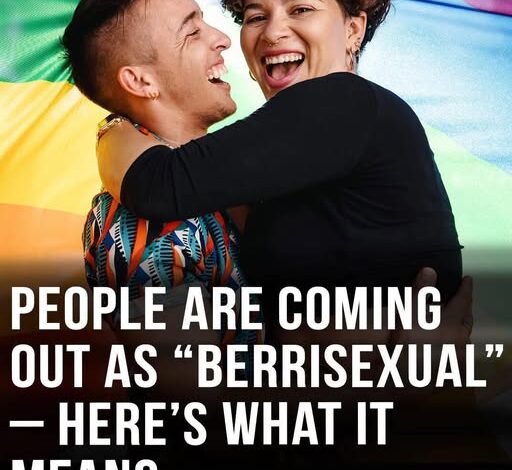
Language is a living, breathing entity, constantly evolving to capture the nuances of human experience that once remained locked behind the barriers of inadequate vocabulary. Occasionally, a single term emerges that feels less like an invention and more like a long-awaited homecoming. Lately, a new word has been circulating through online communities, whispered in the quiet corners of social media and celebrated on niche wikis with a fervor that borders on the spiritual. That word is berrisexuality, and for thousands of people, it has become a beacon of relief, providing a name for a pattern of desire that has been quietly carried in the shadows for years.
For a significant portion of the population, the labels of bisexual or pansexual—while useful and broad—have often felt like wearing a suit that does not quite fit. They are descriptors that carry weight and history, yet for many, they have left a persistent, nagging feeling of being an impostor in their own romantic narratives. People have spent years twisting themselves into these existing categories, constantly performing mental gymnastics to justify why their attractions felt lopsided or uneven. They have wondered if their preferences made them less valid or if they were somehow failing to perform their identity correctly. Berrisexuality, by contrast, offers a specific, elegant refinement of that experience.
At its core, berrisexuality describes an attraction to all genders, but with a distinct, persistent, and undeniable tilt toward women, feminine-aligned people, and those who identify as androgynous. It is not an exclusion of men or masculine-aligned people—those attractions remain real, valid, and present—but they are experienced as softer, rarer, or simply less central to the overall architecture of one’s romantic life. For many, this tilt toward the feminine was a constant presence, a background hum that they had long since stopped questioning. It was so woven into the fabric of their daily lives that it faded into the background, often treated as a quirk of personality rather than a defining feature of their orientation.
The discovery of the word berrisexual has triggered a widespread, collective exhale. On platforms like Reddit, where users frequently dissect the complexities of identity, stories of profound revelation have become common. People describe the visceral shock of seeing their own internal experiences mirrored back at them by a term they had never heard before. It is a moment of cognitive resonance—a sudden, clear understanding that they are not “doing bisexuality wrong.” They are simply experiencing a version of attraction that has finally found its name. The term acts as a lens, sharpening a blurry image into something recognizable and concrete.
What makes this development particularly compelling is how it functions within the broader landscape of queer identity. Berrisexuality does not seek to replace or dismantle broader, established labels; instead, it functions as a tool for precision. It allows individuals to honor the exact geometry of their desire, stripping away the need for apology or distortion. In a world that often demands simple, binary answers to complex questions, this tiny, soft-sounding label offers something radical: permission to be complicated. It provides a sanctuary where one can embrace the intricacies of their heart without feeling the pressure to flatten their experience to make it more palatable or easier to categorize for others.
The cultural impact of such a word cannot be overstated. When we lack the language to describe our lives, we often feel alienated, even from ourselves. We become our own harshest critics, pathologizing our internal landscapes because we assume that if a feeling isn’t commonly talked about, it must be inherently flawed or nonexistent. Berrisexuality provides the validation that many have been seeking in the dark. It acknowledges that human attraction is not a monolithic experience, but a spectrum of infinite variety. By naming this specific pattern, the community is asserting that the nuances of our private lives deserve to be seen, recognized, and understood.
Furthermore, the rise of this term highlights a fundamental shift in how we engage with self-identification. We are moving away from a top-down model where identity is dictated by rigid societal buckets, and toward a bottom-up model where individuals actively define the terms that best describe their existence. It is an act of reclaiming power. When someone adopts the label of berrisexual, they are declaring that they are the primary authority on their own heart. They are rejecting the demand to perform an identity that is “close enough” in favor of one that is authentic. It is a quiet, powerful assertion of self-truth in an age that often demands performative conformity.
This evolution is particularly vital for younger generations, who are growing up with a vocabulary for identity that previous generations could only dream of. By normalizing the idea that our labels can be refined, updated, and made specific, we are creating a culture that is more resilient and more compassionate. We are teaching ourselves and each other that it is perfectly okay to outgrow a label, to find a more precise one, or to hold multiple descriptions simultaneously as we navigate the changing tides of our lives. We are fostering a sense of belonging that is based not on uniformity, but on the celebration of our unique, individual patterns.
Ultimately, the emergence of berrisexuality is a testament to the fact that we are still in the early stages of understanding the full depth of human potential for connection. Every time we find a new way to describe how we love, we open a door for someone else to feel a little less lonely. We provide a bridge across the gap of human isolation. Whether or not someone chooses to adopt this specific label is less important than the freedom the conversation provides. The real victory is the permission to be understood. As we continue to refine our language, we move closer to a society where the complexity of the human spirit is not something to be feared or suppressed, but something to be marveled at, honored, and deeply, truly known. In a world that so often feels chaotic and demandingly simple, the ability to find a word that feels like home is, perhaps, the most human thing we can do.