Protest Inside Minneapolis Church Sparks National Debate Over Limits of Demonstration
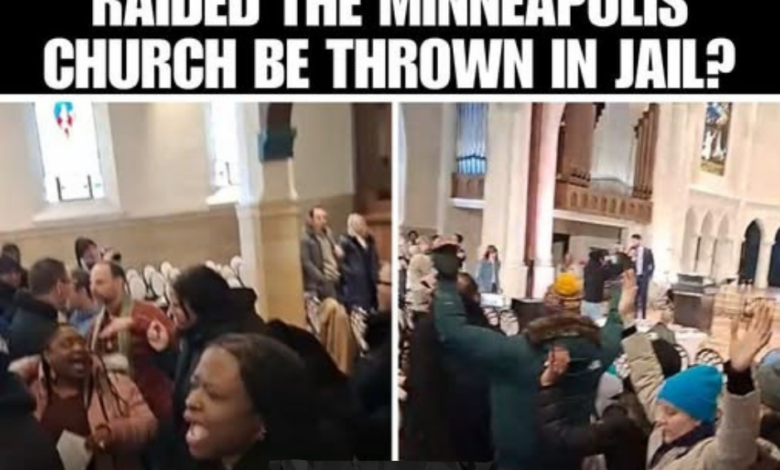
A recent protest inside a Minneapolis church has ignited a heated debate across social media and beyond, raising questions about the limits of public demonstration and the protection of religious spaces.
According to reports and circulating footage, a group of protesters entered a church during an event, interrupting proceedings and confronting attendees. The incident quickly drew attention online, with videos showing raised voices and tense exchanges between protesters and individuals inside the church.
Details about the protest’s specific message vary depending on the source, but the disruption itself has become the central focus of public discussion. Some argue the action crossed a line by interfering with a religious gathering. Others defend it as an expression of political or social dissent.
Religious institutions in the United States are generally considered private property, even when open to the public for services or events. As such, legal consequences for disruptive behavior typically depend on local trespassing laws, disturbance ordinances, and whether any criminal acts occurred.
Law enforcement has not publicly confirmed all aspects of the situation, and it remains unclear what charges, if any, will ultimately be filed. Investigations are ongoing as authorities review footage and statements from those involved.
Supporters of the church say places of worship should remain protected spaces where individuals can gather peacefully without interruption. They argue that protest, while protected in many contexts, should not intrude upon religious services.
On the other hand, civil liberties advocates note that the First Amendment protects both freedom of religion and freedom of speech. When those rights intersect, the legal and ethical boundaries can become complex.
The broader issue has sparked nationwide debate: Should protests inside religious institutions result in criminal penalties? Or should such acts be considered part of protected free expression, depending on the circumstances?
Legal experts point out that each case is highly fact-specific. Whether a protest becomes unlawful often depends on factors such as intent, disruption level, property rights, and whether individuals were asked to leave.
Social media reactions have been sharply divided. Some users call for strict enforcement and possible jail time. Others caution against criminalizing protest, emphasizing the importance of free speech in a democratic society.
Community leaders in Minneapolis have urged calm while investigations continue. They emphasize the importance of dialogue and peaceful engagement rather than escalation.
Historically, religious institutions have sometimes served as sites of protest and political expression, particularly during moments of national tension. However, such actions often generate strong reactions due to the sacred nature of the space.
The situation also highlights a larger conversation about protest tactics in modern America. As activism grows more visible, debates continue about where expression ends and disruption begins.
At this stage, authorities have not released a final legal determination regarding the individuals involved. Any potential charges would depend on formal findings by investigators.
For now, the Minneapolis incident remains under review, with public opinion continuing to shape the conversation around it.
Whether viewed as an overreach or a legitimate protest, the event has forced communities to confront an important question: How should society balance religious freedom and the right to protest?
As more information becomes available, officials are expected to clarify the legal outcomes. Until then, the debate shows no sign of slowing down.