A Young Boy Approached My Wheelchair in a Busy Café and Said Something I Couldn’t Ignore — What Happened Next Changed My Life
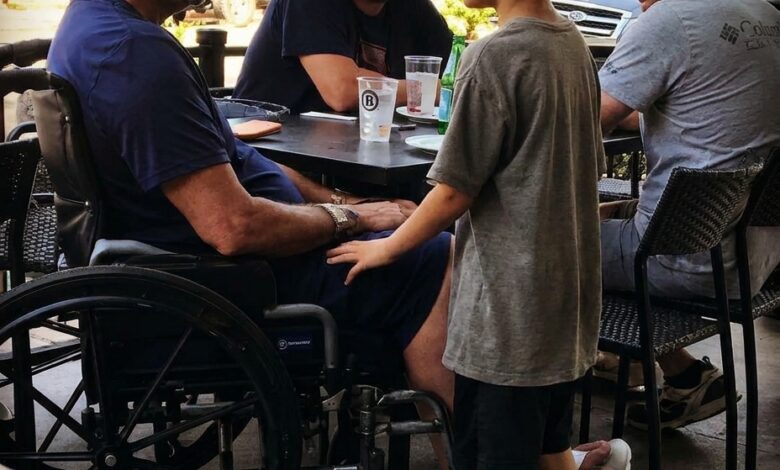
The café was alive with morning chatter and the soft clink of espresso cups when a stranger interrupted a conversation I had held a thousand times before. I sat at my usual marble table discussing contracts with business partners, pretending to focus while my thoughts drifted somewhere twenty years behind me. Most people who knew my story called me brave — the man who had suffered a devastating neck injury while saving a child from drowning. I smiled whenever they said it, but privately I carried quieter emotions: grief, frustration, and the exhausting ache of wondering who I might have become if that day had ended differently. Then, in the middle of that ordinary morning, a young boy stopped beside my wheelchair, looked directly at my motionless foot, and calmly said, “I think I can help you.” I almost laughed — until the next few minutes forced me to question everything I thought I knew.
The accident had shaped nearly every chapter of my adult life. Two decades earlier, a dive beneath a lakeside dock had ended with a spinal injury that changed my future in an instant. Doctors worked tirelessly to stabilize me, and over time I built a successful business and learned how to navigate life differently. My physician, Dr. Voss, became more than a specialist. He had treated me since those early days and eventually became a trusted presence in my family’s life. Because of that trust, I rarely questioned the medical conclusions I had been given. Recovery, I was told, had reached its limit. I accepted those words, even when small pieces of hope tried to survive beneath them.
The boy standing beside me that morning introduced himself as Eli. He looked no older than ten, carrying a worn backpack and an unusual certainty that drew the attention of everyone nearby. My business partners chuckled when he claimed he could help my legs, and I joined their laughter because it seemed kinder than dismissing him. But Eli didn’t retreat or ask for attention. Instead, he crouched beside my chair and quietly asked me to count with him. Something about his confidence unsettled me enough to play along. Then, while the café watched in growing silence, I felt the faintest movement inside my shoe. It lasted only a second — a slight motion in my toes — but it was enough to stop the room cold. Before I could fully process what had happened, a woman stepped forward and introduced herself with words that shook me even more. She claimed to be the little girl I had saved twenty years earlier — and she believed my medical story had never been fully explored.
Her name was Sarah, and the rescue that altered my life had inspired her to become a rehabilitation physician. During professional research, she had unexpectedly come across my medical records and noticed details that troubled her. According to her review, earlier scans suggested signs of limited nerve recovery — not certainty, not a miracle, but enough to justify additional testing and rehabilitation years ago. I resisted her claims at first. The idea felt impossible, especially because it raised difficult questions about someone I trusted deeply. Yet curiosity and doubt stayed with me long after we left the café. Eventually, I arranged an independent evaluation, convinced I needed clarity more than reassurance. What those tests revealed forced me to confront painful possibilities about overlooked information and missed opportunities.
The months that followed were not defined by anger alone but by rediscovery. Independent specialists confirmed that my condition contained more potential than I had ever been encouraged to believe, and a new rehabilitation journey began. Progress was slow, demanding, and filled with setbacks, but it was real. My wife Claire stood beside me through every exhausting session, while Sarah and Eli remained unexpected sources of encouragement. One afternoon, standing between rehabilitation bars installed beside my garden roses, I heard Eli’s familiar voice counting softly: “One… two… three.” This time, I let go and took several careful steps forward. It wasn’t a perfect ending or a dramatic miracle. It was something quieter and perhaps more powerful — proof that hope can survive longer than we expect, and that sometimes the truth waiting to change our lives arrives from the most unlikely place.