A Single Text Message Revealed a Family Secret No One Expected
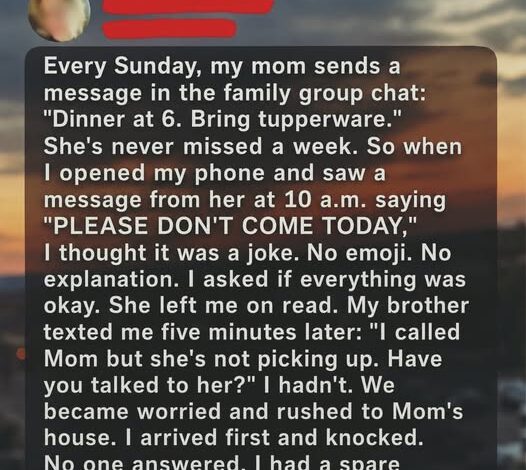
Every family develops its own rhythms and rituals, the quiet routines that define home life and bind generations together. In my family, the heartbeat of our week was always Sunday dinner, without fail or exception. Even during busy weeks, when commitments seemed endless and the world pressed us from every side, we honored Sunday evenings. Weather or errands never deterred us from gathering at our mother’s house, seated around the familiar kitchen table.
The table itself had become more than furniture; it was a repository of memory. Years of laughter, arguments, shared milestones, and even silent contemplation had layered onto its worn wooden surface. When my father passed away three years ago, the importance of these weekly dinners intensified. They became anchors, grounding our family amidst grief and reminding us of love that persisted despite loss and change.
For my mother, Sunday dinner was a statement of continuity. Each dish prepared, each chair filled, reaffirmed that our family endured, that our bonds had survived both tragedy and ordinary life alike. It was her unspoken message: life changes, circumstances shift, people depart—but love remains resilient, unwavering, and present even in subtle, quiet ways that words cannot always convey.
That’s why the text message she sent one Sunday afternoon was so jarring, so unlike her usual warmth. It simply read: “Please don’t come today.” Five stark words. No explanation, no comfort, no trace of familiarity. I stared at my phone repeatedly, rereading the message as if by repetition another line would appear. Nothing came. My brother and I shared a glance across the room, instantly sensing the undercurrent of unease between us.
Something was wrong. That feeling settled deep in our chests, a silent alarm that we could not ignore. Our instincts told us that we could not wait for further messages or explanations. We grabbed our coats, hearts heavy with apprehension, and drove to her house. The streets were quiet in the early evening, the sky turning muted shades of blue and grey as we approached the familiar neighborhood.
Pulling into the driveway, the soft glow of the porch light might have been comforting under normal circumstances. Instead, its gentle illumination made the house appear almost unreal, as if time had shifted in subtle, troubling ways. We knocked. Silence answered. I retrieved the spare key from my coat pocket and unlocked the door, calling her name softly as we entered, our voices bouncing off the walls of the eerily still home.
The house was unnaturally quiet. The usual hum of activity, the faint sound of music, the low murmur of conversation were absent. In their place was a heavy, expectant silence that pressed against our chests. And then I saw him. A man sitting at the kitchen table, his back to us. Broad shoulders, a posture that seemed almost uncannily familiar, and hands resting folded in a way that felt oddly reminiscent.
For a split second, my breath caught. From behind, the figure resembled my father. The tilt of his head, the relaxed yet purposeful curve of his shoulders, the quiet aura—it was as if a ghost had taken flesh. My brother froze behind me. His confusion radiated without words, shared silently in a look we exchanged, the weight of history and recognition pressing on both of us simultaneously, impossible to ignore.
Our mother was at the counter, slicing carrots with precision. Her hands moved deliberately, but her face was drained of color, pale and fragile-looking. She did not turn as she spoke, her voice quiet, controlled, almost apologetic. “Why didn’t you listen?” she asked softly. Her words were both rebuke and confession, a mixture of regret and inevitability that hung in the air like mist. My brother and I exchanged another glance, uncertain how to respond.
The man turned slowly to face us. His features were not identical to our father’s, but the resemblance was undeniable: the eyes, the subtle lines around the mouth, the presence that seemed to fill the room as though it remembered us. Finally, my mother set down the knife. Tears traced slow lines down her cheeks. She exhaled deeply and began to explain, her voice quivering yet steady, revealing a truth we had never suspected or imagined.
“This is James,” she said. “My first love, your father’s twin brother.” We stared. The words seemed to ripple through the room, challenging everything we thought we knew about our family history. We had never heard the name before. Not in stories, not in childhood recollections, not even in passing mentions. Our family history, meticulously chronicled through years of memory and conversation, had never included this man.
She explained how she had known James long before meeting our father. How they had been inseparable, intense, deeply connected. And then, without explanation, he had disappeared, leaving her confused, hurt, and without closure. Years later, she met our father. Steady, kind, dependable, he built a life with her gradually, carefully, providing love that was quiet but unwavering. Over time, their relationship became the stable foundation that shaped our lives.
Eventually, she had told our father about James. The disclosure, while difficult, did not fracture their relationship. My father forgave her, but he never forgave his twin brother, whose abandonment had cut deeply, leaving scars in both her life and the family they would build. A condition was set: James was never to be part of our lives. And she honored it. Decades passed. Life moved forward. We were raised in love, security, and normalcy, never suspecting the past that lingered in shadows.
Until now. James had returned. Older, tempered by time, softened by years, carrying the regret of choices that had long ago separated him from the family he never knew. He had come seeking forgiveness, connection, perhaps a place he had lost. Our mother’s voice wavered as she described the past, our own emotions twisting and turning. Compassion mingled with resentment. Curiosity intertwined with loyalty. And for a moment, the room felt impossibly full of history, memory, and weight.
We confronted the reality of our father’s absence and the moral responsibility he had entrusted to us. His presence had been constant, shaping who we were. But here was a man who had broken that trust, now quietly asking for acceptance.
We told him the truth. We could not welcome him—not now, perhaps not ever. Our father’s wishes, the integrity of the family he had built, mattered more than our curiosity or desire for reconciliation at that moment. James nodded. No argument, no pleading. Just acknowledgment of the boundary we had drawn, the consequences of long-forgotten choices. He rose, thanked us quietly, and walked from the house, leaving a silence that was both heavy and empty.
Once the door clicked closed, my mother collapsed in tears, releasing decades of guilt and buried memories. We wrapped our arms around her, offering the comfort we knew she deserved, grounding her in the love that had sustained us all these years. That evening, Sunday dinner took on a new form. No careful preparation, no meticulously arranged plates. Instead, we ordered pizza, set mugs of tea in our hands, and simply sat together, sharing silence, warmth, and presence.
Slowly, conversation returned, gentle and tentative. Stories and memories intertwined with reflections on the present. The weight of revelation settled, softened, and began to become part of our shared understanding rather than an unbearable burden. Before we left, our mother sent a message to the family group chat: “Dinner next Sunday, 6 p.m. Bring containers. And maybe a hug.” Five simple words, echoing resilience, love, and continuity.
In that moment, I understood something profound: even the most startling truths need not destroy a family. They can, instead, illuminate the strength already present, the bonds formed through shared life, love, and memory. Through fear, uncertainty, and confrontation with the past, we found that our family could adapt, embrace imperfection, and honor both history and loyalty. That Sunday dinner, ordinary yet extraordinary, became a testament to our enduring connection.
And as we drove home, full but reflective, I realized that life’s surprises, no matter how unexpected, could deepen understanding, strengthen ties, and reveal the depth of care woven quietly into our family fabric. Even in moments of revelation, loss, or unspoken history, love remained our constant. And with that, we carried both the lessons of the past and the hope for future Sundays, knowing our family could withstand the weight of truth.