My Son Came Home Hurt, and the Sheriff Laughed It Off — So I Found Another Way to Make Them Listen
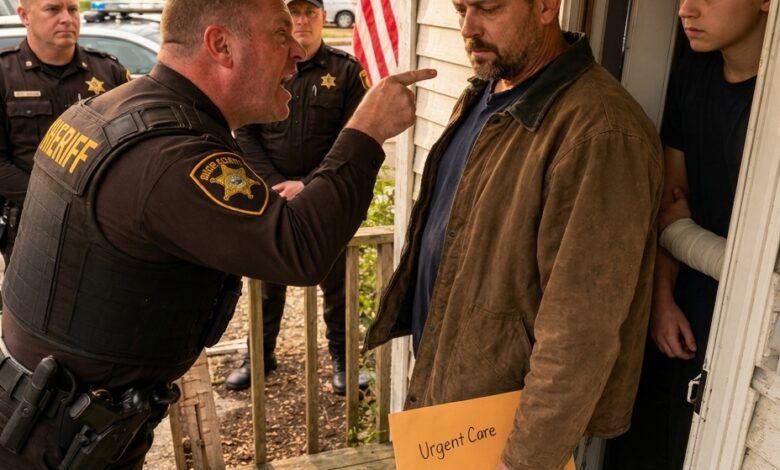
The morning I saw the bruise along my son’s jaw, I knew he was not telling me the whole truth. Drew sat in the passenger seat with his backpack held carefully against his side, staring through the frosted windshield like he was trying to disappear into the glass. When I asked what happened, he gave me one word: “Practice.” But I had spent twenty years as an Army Ranger, and I knew the difference between an answer and a rehearsed excuse. By that afternoon, when he climbed back into my truck holding his arm close to his chest, pale and silent, I understood that whatever was happening at school had gone far beyond teenage conflict.
At urgent care, the X-ray confirmed what my father’s instinct already feared: Drew had a fractured arm. The nurse asked what happened, and for the first time, his voice cracked as he said it happened at school. Slowly, the truth began to take shape. A boy named Neil Gaines had been involved — the sheriff’s son, a student known for taking up space in hallways and making others move around him. In our small Montana town, the Gaines name carried weight. Sheriff Carl Gaines had been in office for years, and people had learned that challenging him often came with consequences. Still, I took the medical papers and drove straight to his office, believing that even power had limits when a child was hurt.
The sheriff did not take the complaint seriously. He glanced at the X-ray, leaned back, and dismissed it as boys being rough. When I pressed again, he suggested kids today were too sensitive. My son stood behind me, listening to an adult with authority reduce his injury to a joke. I could feel the anger rising, but I also knew the trap. Men like Sheriff Gaines expect outrage because they know how to use it. Instead of giving him what he wanted, I collected the papers, walked out, and made a decision. If he refused to document the truth, I would document it myself.
That night, I built a file. Medical records, timelines, names, dates, past incidents, and every detail Drew had quietly shared over the previous months. Then I started making calls — not emotional ones, but precise ones. State agencies, school contacts, parents who had gone silent for too long. What I found was larger than one incident. Other families had stories too: students pushed aside, complaints minimized, teachers looking away, parents afraid to challenge the sheriff’s son. One by one, people began sharing what they knew. Some were scared. Some wanted their names withheld. But each statement added weight to a truth the town had spent too long avoiding.
Within days, state investigators arrived in Milwood Creek, and the story began moving through town faster than rumor could control it. The sheriff came to my porch angry, accusing me of causing trouble, but this time he was not standing in an office he controlled. Drew stood beside me with his cast visible, and when the state investigators stepped out of their vehicle with a folder thick with statements, the balance shifted. The investigation did not undo what happened to my son, and it did not erase the fear he carried into school. But it taught him something important: being hurt is not the same as being weak. Later, when people asked what I did after the sheriff mocked my son, I told them the truth. I didn’t shout. I didn’t threaten. I made people look.