Scientists Tracked an Eagle for 20 Years—What They Learned
For years, scientists thought something was wrong.
The data simply didn’t make sense.
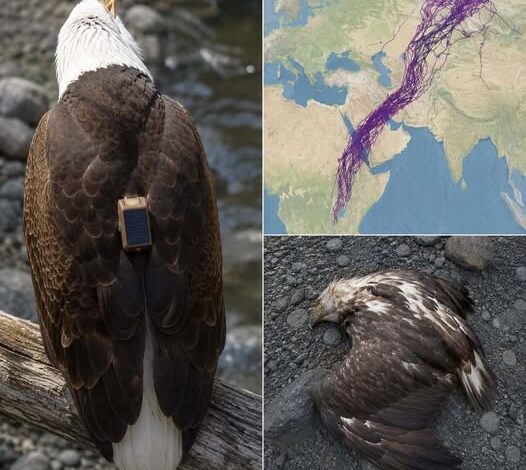
An eagle fitted with a GPS tracker kept producing migration routes that looked impossible. Instead of following predictable seasonal pathways, its movements zigzagged across mountains, deserts, coastlines, and open plains in a pattern that seemed almost random.
Researchers checked the equipment.
Then checked it again.
Maybe the tracker was malfunctioning.
Maybe the bird was injured.
Maybe it was lost.
Nothing else explained the strange route.
Each new season only deepened the mystery.
The eagle would travel hundreds of miles in one direction, suddenly veer away, circle back, pause for days, then continue along another unexpected path.
The GPS map looked less like migration and more like someone had scribbled across a globe with a marker.
Scientists argued.
Models failed.
Predictions collapsed.
The bird became an obsession.
Because if the tracker was accurate, then the eagle was doing something nobody fully understood.
Years passed.
Then a small group of researchers decided to stop studying the route itself.
Instead, they studied the environment surrounding the route.
Weather patterns.
Wind currents.
Thermal updrafts.
Mountain elevations.
Atmospheric pressure.
Storm systems.
Slowly, the chaos began to organize itself.
What once looked random started revealing a hidden logic.
Every unexpected turn matched a rising thermal current.
Every detour corresponded with favorable wind conditions.
Every pause occurred in areas that offered protection from approaching storms.
The eagle wasn’t wandering.
It was calculating.
Not consciously in the human sense.
But through instincts refined across thousands of generations.
The bird was reading information invisible to human eyes.
Columns of warm air rising from sunlit earth.
Pressure changes signaling distant weather shifts.
Wind highways stretching across valleys and oceans.
Natural pathways hidden within the sky itself.
The GPS trail that once appeared chaotic suddenly looked brilliant.
The eagle wasn’t following a fixed route.
It was constantly adapting.
Continuously negotiating with a changing world.
Every movement balanced energy, safety, opportunity, and survival.
Where researchers expected straight lines, the eagle found efficiency.
Where scientists searched for consistency, the bird embraced flexibility.
And that realization changed everything.
The researchers discovered that their models were built on assumptions.
Human assumptions.
The belief that the shortest path is always best.
The belief that consistency equals intelligence.
The belief that predictability reflects success.
The eagle exposed the limits of those ideas.
Nature wasn’t operating according to human expectations.
It was operating according to realities humans could barely perceive.
What looked inefficient from a computer screen was often the smartest possible decision in the sky.
The bird wasn’t lost.
The researchers were.
Lost inside their own understanding of how movement should look.
The more they learned, the more humbled they became.
Because the eagle had never been making mistakes.
The mistake belonged to the people interpreting the map.
In the end, the most important discovery wasn’t about migration at all.
It was about perspective.
The world is full of systems, signals, and forms of intelligence we do not immediately recognize.
We often label something as wrong simply because we do not yet understand it.
The eagle offered a quiet lesson.
Adaptability can look like confusion.
Wisdom can look like inconsistency.
And sometimes the path that appears most chaotic from a distance is actually the most intelligent route of all.
What began as a mystery ended as a reminder:
Nature does not need our approval to be brilliant.
Sometimes it is we who must learn how to read the map.