Snoop Dogg Delivers Fiery, Unfiltered Commentary on Law, Order, and Media Narratives During Panel Appearance, Sparking National Discussion on Politics and Safety -th
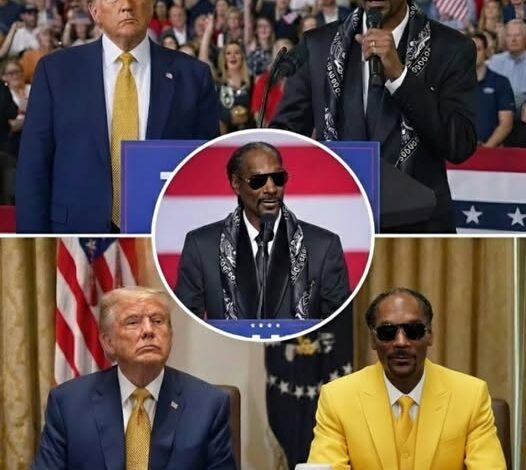
Snoop Dogg, the iconic rapper whose career spans decades, is renowned not only for his music and cultural influence but also for his willingness to speak openly on social issues, politics, and societal concerns. On a recent televised panel discussion, he captured national attention once again, delivering a message about law, order, and media narratives that was both unflinching and deeply analytical. The discussion became an instant topic of debate across social media, news outlets, and political commentary programs, highlighting the unusual but increasingly influential role of celebrities in public discourse.
From the very beginning of the panel, it was clear that Snoop’s presence would shift the tone. His calm, deliberate demeanor contrasted sharply with the often hyperbolic and performative style of the other participants. Early in the segment, he directly addressed panelists, challenging prevailing narratives about public safety, political priorities, and the framing of disorder in the media.
“Are you really not seeing what’s happening, or are you just pretending not to?” he asked, his voice steady, measured, and resonant. The pause that followed was almost cinematic — cameras captured the intensity, the studio lights reflected off the polished desks, and the audience leaned forward, fully engaged. His question was not rhetorical; it was a prompt for reflection, a call to examine whether society was truly grappling with reality or being led to fear and division by selective reporting.
As the segment progressed, Snoop elaborated on his perspective, framing his comments around the intersection of societal disorder, political messaging, and media amplification. He explained that incidents of chaos in public spaces are often “amplified, weaponized, and used for political gain.” These were not idle words — he carefully unpacked how coverage of crime, protests, and civil unrest can be selectively highlighted or exaggerated, and how this, in turn, shapes public perception and influences policy debates. By emphasizing the beneficiaries of certain narratives, Snoop challenged viewers to consider who gains from public anxiety, who benefits from portraying society as unstable, and how these stories might distract from larger structural issues.
When one panelist attempted to interject, Snoop raised a hand, a subtle but firm signal that his focus was on clarity and substance over argumentation. He cited examples of law enforcement exercising restraint, neighborhoods experiencing inconsistent policing, and the gradual erosion of public order in some areas. According to Snoop, these trends have ripple effects that extend beyond isolated incidents, influencing elections, local governance, and the broader public sense of safety.
“Not Donald Trump,” he added at one point, preempting misinterpretation of his remarks. He emphasized that his critique was not about individual politicians but about systemic issues and the importance of leadership that prioritizes public safety. By clarifying this distinction, Snoop positioned his message as a call for accountability and transparency rather than partisan attack.
Critics quickly seized on portions of the segment, describing them as controversial and, in some cases, politically charged. Some commentators suggested that his words could be read as implicit advocacy for specific political agendas. Snoop, however, addressed these critiques directly during and after the broadcast, emphasizing that measures such as law enforcement, border security, and citizen protection are not synonymous with authoritarianism. Instead, he framed them as fundamental components of functional democratic societies — prerequisites for maintaining trust, safety, and societal stability.
Media analysts and political commentators have since dissected the rhetorical strategy Snoop employed. Unlike many celebrity interventions that rely on spectacle, Snoop’s approach combined composure, deliberate pacing, and careful articulation. He paused strategically between points, addressed both panelists and viewers, and consistently returned to the central theme of accountability and societal benefit. By structuring his argument in this way, he maintained authority and focus, ensuring the discussion remained substantive rather than devolving into partisan theater.
The segment’s impact extended far beyond the studio walls. Clips quickly circulated on social media, sparking intense debate across platforms such as X, Instagram, and TikTok. Viewers engaged with hashtags, commentary threads, and video reactions, generating thousands of responses in just hours. Supporters lauded Snoop for his clear articulation and for speaking plainly about issues they felt were often ignored or misrepresented. Critics, however, argued that the conversation simplified complex societal challenges, reducing nuanced debates about crime, public policy, and media influence to digestible soundbites.
Political analysts noted that Snoop’s intervention represents a growing trend of entertainers leveraging public platforms to address social and political issues. While he has long advocated for criminal justice reform, community development, and youth empowerment, this particular appearance stood out for its direct critique of media-driven narratives and its focus on systemic accountability. By highlighting the ways in which disorder can be exaggerated, Snoop underscored the broader societal responsibility of both leaders and media institutions to provide accurate, context-rich information.
Importantly, observers highlighted that Snoop’s message was not rooted in partisan allegiance. Instead, it raised systemic questions about societal responses to disorder, leadership responsibility, and the role of media in shaping public perception. His remarks suggested that public figures — even those outside formal politics — have the ability to influence national conversations on law, order, and civic responsibility in meaningful ways.
The panel concluded with Snoop reiterating his central message: Americans need transparency, truth, and leadership willing to confront disorder without fear. “America doesn’t need more fear-driven narratives. It doesn’t need apocalyptic monologues. It needs truth, accountability, and leaders who aren’t afraid to say that order is not the enemy of freedom,” he stated, leaving the studio in a moment of thoughtful silence.
In the days following the broadcast, reactions continued to flow. Social media users praised Snoop’s courage, calm, and clarity, while opinion writers and columnists analyzed the deeper societal themes he raised. Some commentators framed the discussion as a reflection of broader anxiety about crime, governance, and media framing, while others emphasized the potential for civic engagement and critical evaluation of public narratives.
Ultimately, Snoop Dogg’s appearance demonstrated the power of celebrity commentary when delivered with composure, thoughtful reasoning, and careful framing. Whether viewers agreed with every point or not, the segment succeeded in provoking reflection, encouraging critical engagement, and emphasizing the importance of examining both the source and the impact of narratives about public safety and societal stability. For many, his calm, deliberate, and authoritative delivery became a model for how complex societal issues can be discussed effectively on public platforms.
As this appearance reverberates through news cycles and social media, it underscores the increasing influence of cultural figures in national discourse. Snoop’s message — focused on truth, accountability, and the necessity of maintaining order — is likely to remain a reference point in conversations about celebrity influence, civic responsibility, and the interplay between media, politics, and public safety. His segment demonstrates that even in a polarized and fast-moving media environment, measured, principled discourse can spark meaningful dialogue and leave a lasting impression on public consciousness.