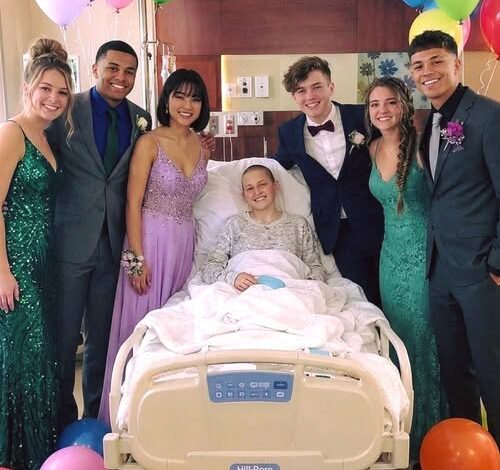
A Group of Classmates Organized a Special Prom Visit for a Student in Hospital
Watching my seventeen-year-old daughter battle leukemia became the most emotionally exhausting experience of my life. Each morning began with hope that the day would bring better news, and each night ended with silent fear about what the next day might hold. Life slowly transformed into a cycle of hospital corridors, medical updates, treatment plans, and long hours of waiting for results that shaped our world. Before illness entered our lives, my daughter Carol had been full of energy and dreams.
She was like any other teenager, imagining her future with excitement and confidence. She often talked about college plans, friendships, and special events she looked forward to experiencing. Among all her dreams, prom held a special place in her heart. For years, she collected images of dresses she liked, carefully pinning them on her mirror as if preparing for a night she had already lived in her imagination. She would often turn to me with a smile and say, “Promise me you’ll help me get ready for prom.
You’ll do my hair, right?” And every time, I would reassure her without hesitation, never imagining that life would change so drastically before that moment arrived. When chemotherapy began, it became clear that many of those ordinary teenage dreams were now uncertain. Months passed, and our lives became centered around treatment schedules and hospital routines.
Carol spent more time in a hospital bed than at home, her strength slowly fading with each round of therapy. Despite everything, she held onto small pieces of normal life. Her journal remained close to her, filled with thoughts, feelings, and quiet reflections she rarely spoke aloud.
One afternoon, I sat beside her as she rested. The room was quiet except for the soft sounds of medical machines. Her face looked tired, and her hands rested weakly on the blanket. I noticed her journal lying near her pillow, slightly open, as if she had been writing before she fell asleep. She was always private about what she wrote, often closing it quickly when she noticed anyone nearby.
When she woke up and saw me looking, she gently pulled the journal closer and smiled. “It’s just my thoughts,” she said softly, trying to brush it off. Even in her weakest moments, she still found ways to maintain a sense of normal teenage privacy. Not long after, her phone lit up with a message from her best friend, a boy named Daryl, who had been part of her life since middle school.
Their friendship was steady and simple, built on kindness, shared school memories, and quiet support during difficult moments. He often checked in on her, sending messages that made her smile even on her hardest days. Watching their friendship gave me comfort, as it reminded me that Carol still had connections to a world beyond hospital walls.
As prom approached, the reality of her condition weighed heavily on both of us. One afternoon, she asked me a question I was not ready to answer honestly. She asked whether she would be well enough to attend prom. The question stayed in the air between us, heavy and painful. I chose to respond with hope rather than certainty, even though deep inside, I was unsure what the future would bring.
Her condition changed rapidly over the following days. Treatments left her weaker, and her energy continued to decline. There were moments when she stared quietly at the wall, asking questions that no parent ever wants to hear. I tried to stay strong for her, even when I felt like everything around us was falling apart.
Then, one evening, something unexpected happened that changed everything. I was outside her room when a nurse asked me to step into the hallway. At first, I felt a wave of anxiety, unsure of what I would see. But when I opened the door, I was met with an overwhelming sight that I will never forget.
The hospital hallway had been transformed. Teenagers filled the space, dressed in formal clothes, holding decorations, balloons, and food. Soft music played in the background, and the entire atmosphere felt completely different from the sterile environment of a hospital. Standing among them was Daryl, along with several of Carol’s friends, all gathered with a shared purpose.
They explained that they had received permission from hospital staff to create something special for Carol. They called it “bringing prom to her.” For a moment, I was unable to speak, overwhelmed by emotion. I had not expected such effort, care, and love to be organized in such a difficult place.
They carefully brought Carol into the room, and the moment she saw everything, her reaction was immediate. Her eyes widened in disbelief, followed by laughter and tears at the same time. She could not believe what her friends had done for her. Slowly, they helped her change into something festive over her hospital gown, turning an ordinary medical room into something filled with celebration.
Music played softly as food was shared and photos were taken. For the first time in a long time, Carol was not defined by her illness. She was simply a teenager experiencing a moment she had always dreamed of. The room felt lighter, filled with laughter, warmth, and emotional connection that went far beyond the hospital setting.
As I stepped into the hallway to gather myself, Daryl followed me. His expression was serious, and I could sense that something deeper was about to be said. He handed me an envelope, explaining that Carol had asked him to give it to me that night. My hands trembled as I opened it, not knowing what to expect.
Inside were several letters written by Carol. One was addressed to her friends, and one was for me. As I read my letter, I began to understand that she had been aware of more than she had shared with me. She had overheard conversations and quietly understood that her treatment was not progressing as hoped. She had chosen not to tell me in order to protect me from constant fear and sadness.
The realization was overwhelming. She had carried that knowledge alone while still trying to create moments of happiness for those around her. It became clear that the prom was not just a celebration, but a carefully planned moment of joy she wanted to give us while she still could.
When I returned to her room, the music was still playing softly. Carol looked at me and immediately understood that I had read the letter. Tears filled her eyes as she admitted that she only wanted to give us a happy memory instead of constant sadness. She had believed she was protecting me by hiding her fears.
I walked over to her and took her hands, telling her that we would no longer face anything alone. I told her that every fear, every treatment, and every moment would be shared together. The room grew quiet as her friends watched, unsure of what would happen next.
Then, in a moment that none of us expected, I asked her to dance. Slowly, she stood up with help, and the room filled with emotion. Music continued playing as we gently moved together in the center of the room. It was not about perfection or celebration anymore, but about connection and presence in a moment that mattered deeply.
Her friends watched quietly, many of them crying as they witnessed something so simple yet so meaningful. In that moment, there was no illness, no hospital equipment, and no fear. There was only a mother and daughter sharing a dance that neither of us would ever forget.
Weeks later, doctors shared that her condition had stabilized slightly, offering a bit more time than expected. It was not a cure, but it was enough to give us more moments together. And sometimes, more time is the most meaningful gift a family can receive.
Looking back now, I understand that the night of prom in that hospital room changed everything for us. It reminded us that honesty, love, and shared moments matter more than fear. Even in the darkest circumstances, human connection has the power to create light.
We continue to live each day with gratitude, not knowing what the future holds, but appreciating the time we are given. And every time I think of that night, I am reminded that even in the hardest moments, compassion can turn pain into memory, and fear into love.