My Son Banned Me From Family Dinner After Taking My Money for Years—What Happened When I Cut Him Off Changed Everything
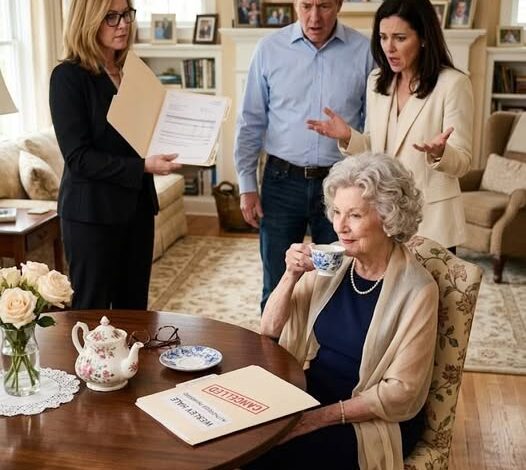
I was halfway through buttoning my favorite navy-blue cardigan when my phone buzzed.
At seventy-seven years old, I didn’t receive many messages that surprised me anymore.
This one did.
It was from my son, Wesley.
At first, I assumed he was checking whether I needed a ride to dinner. After all, his family had invited me earlier that week. I had even baked Lily’s favorite apple pie.
Instead, I read a message that made my hands go cold.
The invitation had been canceled.
Wesley explained that Serena, his wife, thought it would be better if I didn’t attend.
No explanation.
No apology.
No attempt to soften the blow.
Just a polite rejection disguised as a practical decision.
For several minutes, I sat alone in my kitchen staring at the screen.
The pie cooled on the counter.
The table remained empty.
And a painful realization slowly settled over me.
This wasn’t really about dinner.
It never was.
This was simply the latest chapter in a story that had been unfolding for years.
I had spent most of my adult life helping Wesley.
When he struggled in college, I paid tuition.
When he couldn’t afford rent, I covered it.
When unexpected medical bills appeared, I wrote checks.
When he married Serena, I contributed to the wedding.
When they bought their first home, I helped with the down payment.
When financial emergencies arose, somehow I always became the solution.
I never complained.
I never kept score.
At least, that’s what I told myself.
But sitting alone that evening, I opened an old filing cabinet and discovered the truth.
Part of me had been keeping score all along.
Inside were decades of records.
Canceled checks.
Mortgage payments.
Insurance contributions.
Emergency transfers.
College tuition statements.
Hundreds of thousands of dollars spread across years of quiet sacrifice.
The deeper I dug, the more shocked I became.
Not because of the amount.
Because of what it represented.
Every document was evidence of my presence in Wesley’s life.
And yet somehow, despite all of it, I had become optional.
I looked around the silent house and thought about my late husband, Arthur.
He used to tell me something I never fully understood.
“Love should be given freely,” he would say. “But never at the expense of your own dignity.”
That night, his words finally made sense.
The next morning, I made an appointment with my banker.
Lydia Chen had worked with me for years.
She greeted me warmly and assumed we were reviewing retirement accounts.
Instead, I handed her a folder.
“I need to stop every recurring payment connected to my son’s household.”
She looked surprised.
Then concerned.
Then understanding.
Together, we reviewed everything.
Mortgage assistance.
Insurance premiums.
Utility contributions.
Educational funds.
Automatic transfers.
The list seemed endless.
Some of the payments had been active so long that I barely noticed them anymore.
They had become part of my routine.
Part of my identity.
Part of how I remained relevant.
One by one, I canceled them.
When the final signature was complete, I expected guilt.
Instead, I felt relief.
Not because I wanted Wesley to struggle.
Because for the first time in years, I felt honest.
A week later, my front door flew open.
Wesley and Serena stormed into my living room.
They looked panicked.
Confused.
Angry.
“What happened to the mortgage payment?” Wesley demanded.
“And the insurance?” Serena added.
“Why are accounts suddenly missing money?”
Lydia happened to be present that day finalizing paperwork.
She quietly remained in the room while I answered.
For the first time in years, I didn’t apologize.
I didn’t explain.
I didn’t soften my words.
I simply told the truth.
I explained how much support I had provided.
How often I had rearranged my life to solve their problems.
How painful it felt to be useful when money was needed but unwelcome when family gathered.
The room grew silent.
Wesley’s expression slowly changed.
The anger disappeared first.
Then the defensiveness.
Then something else took its place.
Recognition.
For perhaps the first time, he saw the full picture.
Not isolated favors.
Not occasional assistance.
An entire system holding parts of his life together.
A system he had started taking for granted.
“I’m not doing this to punish you,” I told him quietly.
“I’m doing this because you don’t need me to pay your bills anymore.”
Neither Wesley nor Serena responded immediately.
Because there wasn’t much to say.
The truth had finally been spoken aloud.
The weeks afterward were difficult.
There were no phone calls.
No visits.
No messages.
The silence hurt.
More than I expected.
For years, helping them had given me purpose.
Without that role, I felt strangely lost.
Then something unexpected happened.
I started living again.
I joined a bridge club at the local library.
I attended community events.
I met people who knew nothing about my financial history.
People who liked me simply because they enjoyed my company.
I started gardening again.
Started reading more.
Started laughing more.
Little by little, I stopped waiting for someone else to need me.
And started asking what I needed.
Then one afternoon, a letter arrived.
Handwritten.
From Wesley.
I recognized his handwriting immediately.
My hands trembled while opening it.
Inside were several pages.
No excuses.
No blame.
No requests.
Just honesty.
He admitted he had become dependent.
He admitted he had taken my support for granted.
He admitted he had failed to recognize how much of his life rested on sacrifices I never discussed.
Most importantly, he apologized.
Not because the money stopped.
Because he finally understood the loneliness behind it.
Months later, Wesley visited alone.
No Serena.
No agenda.
No financial emergency.
Just my son.
We sat at the kitchen table for hours.
Talking.
Really talking.
About mistakes.
About responsibility.
About family.
About the kind of man he wanted to become.
The conversation wasn’t perfect.
Healing rarely is.
But it was real.
And that mattered more.
A year later, Wesley and my granddaughter Lily came for dinner.
Nothing extravagant.
Just family.
Laughter filled the house again.
At one point during the evening, Lily reached into her pocket and handed me a cookie she had been saving all afternoon.
It wasn’t expensive.
It wasn’t dramatic.
It wasn’t life-changing.
Yet somehow it meant more than every check I had written over the previous twenty years.
Because it wasn’t given out of obligation.
It was given out of love.
As I watched my son helping clear the dishes, I realized something important.
For years, I believed supporting my family meant solving every problem.
Paying every bill.
Removing every obstacle.
But real love isn’t measured by how much you give.
It’s measured by what remains when the giving stops.
The boundaries I established didn’t destroy my family.
They revealed it.
And once the transactions disappeared, something far more valuable finally had room to grow.
Respect.
Honesty.
Responsibility.
Connection.
For the first time in a very long time, I wasn’t sitting at the table because of what I provided.
I was there because I belonged.
And that was all I had ever wanted.