“Can You Locate the Hidden Dog? Only Sharp-Eyed Observers Will Find It!”
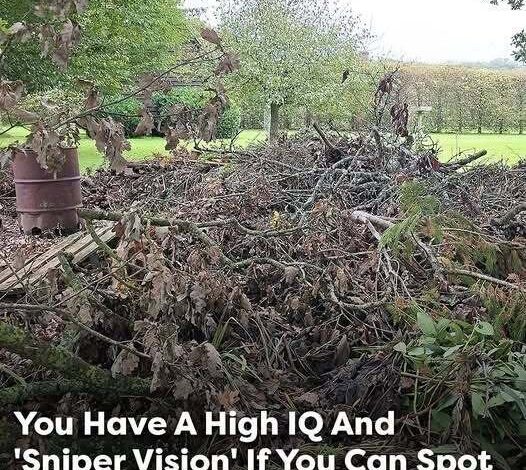
What appears to be an ordinary photograph has become the source of widespread fascination online, leaving thousands of people staring at their screens in frustration while questioning whether they are missing something obvious.
The image, which quickly gained attention through online communities dedicated to visual puzzles, challenges viewers to locate a cleverly hidden spaniel concealed within a dense maze of tree branches and foliage. At first glance, the picture seems to contain nothing more than a chaotic collection of limbs, twigs, and leaves. Yet somewhere within that visual clutter sits a dog so perfectly camouflaged that many viewers struggle to spot it even after several minutes of searching.
The challenge has rapidly become one of the internet’s latest obsessions, drawing in casual users and optical illusion enthusiasts alike.
For many people, the first reaction is confusion. The image appears overwhelmingly busy, packed with overlapping branches and natural textures that compete for attention. Instead of immediately noticing a dog, viewers often find themselves scanning the photograph repeatedly without success.
Some have even admitted feeling convinced that the image contains no animal at all.
Comments from users attempting the challenge reveal a common experience: disbelief, frustration, and determination. Many describe staring at the picture for extended periods before finally spotting the hidden spaniel, while others confess they needed hints or assistance before locating it.
The difficulty lies in the way human perception works.
Our brains are designed to recognize familiar shapes and patterns, particularly faces and animals. However, when an object shares similar colors, textures, and outlines with its surroundings, the brain may fail to distinguish it from the background. This is one reason optical illusions are so effective—they exploit the shortcuts our minds use when processing visual information.
The hidden spaniel is an excellent example of natural camouflage in action. Its fur blends remarkably well with the surrounding bark, dried leaves, and branches. Rather than standing out, the dog’s shape becomes fragmented by the complex environment around it, making it difficult for the eye to separate animal from scenery.
Even when viewers know exactly what they are searching for, many continue overlooking the dog multiple times before finally recognizing it.
For those attempting the challenge, a systematic approach often works best. Instead of scanning randomly, focus first on the center of the image and slowly work outward. Look for subtle inconsistencies in the patterns created by the branches. Pay particular attention to shapes that appear softer or more rounded than the surrounding wood.
Many successful viewers report finding the dog slightly left of center, where the outline of its head and ears becomes visible once the brain recognizes the correct pattern.
Interestingly, once the spaniel is spotted, it becomes nearly impossible to miss. This phenomenon reflects a principle of visual perception in which the brain suddenly organizes scattered visual clues into a recognizable object. What seemed invisible moments earlier now appears obvious.
The spaniel puzzle belongs to a broader category of internet challenges often referred to as “find the hidden object” or “sniper” challenges. These puzzles place animals, people, or objects within highly detailed scenes and invite viewers to locate them. Similar images have featured leopards hidden among rocks, owls disguised within tree trunks, and foxes blending perfectly into autumn landscapes.
Part of their appeal comes from the emotional experience they create.
Initially, viewers feel challenged and often frustrated. As they continue searching, attention becomes increasingly focused. Then, when the hidden object is finally discovered, a powerful sense of satisfaction follows. This reward encourages people to share the puzzle with friends and test whether others can solve it more quickly.
The social element plays an important role as well. Online communities frequently exchange hints, compare search times, and discuss different techniques for locating hidden objects. Some people zoom into the image, while others intentionally blur their vision slightly to focus on larger patterns instead of fine details.
These varying approaches highlight an important fact: people process visual information differently. What appears immediately obvious to one person may remain invisible to another for a surprisingly long time.
Beyond simple entertainment, optical illusions offer valuable mental exercise. Researchers studying visual cognition have noted that such puzzles engage skills related to pattern recognition, concentration, memory, and attention to detail. In an era dominated by rapid scrolling and constant distractions, these challenges encourage viewers to slow down and observe more carefully.
The viral success of the hidden spaniel demonstrates something deeper than a simple fascination with puzzles. It reflects a universal human desire to uncover secrets, recognize patterns, and experience the thrill of discovery. Thousands of people around the world can look at the exact same image, struggle with the same challenge, and share the same moment of triumph when the hidden dog finally emerges from the chaos.
In the end, the photograph is more than just a picture of a dog hidden among branches. It is a reminder that sometimes the most interesting things are not immediately visible. They require patience, focus, and a willingness to look a little closer than everyone else.