Family’s Headstone Tribute Sparked Outrage Across an Entire Town—Then People Learned the Hidden Message Behind It
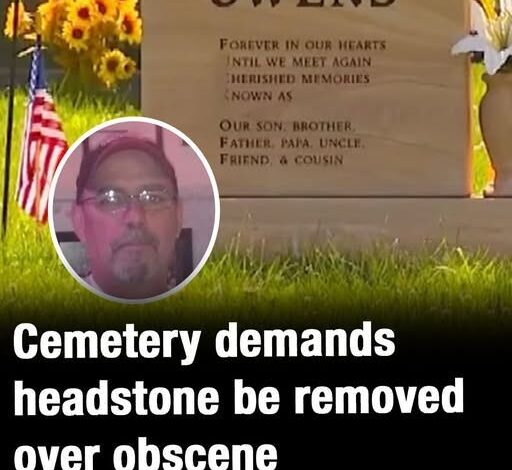
Visitors walked past the headstone for years without noticing anything unusual.
It stood quietly among hundreds of other memorials in a peaceful Iowa cemetery, blending into the landscape of polished stone, fresh flowers, and cherished memories. Families visited loved ones. Caretakers maintained the grounds. Life continued much as it always had.
Then someone noticed the message.
What happened next transformed a simple memorial into the center of a controversy that spread far beyond the cemetery gates.
Suddenly, people who had never met the man buried there were debating whether the inscription was touching, inappropriate, humorous, or offensive. Community members took sides. Social media discussions exploded. Local officials found themselves answering questions they never expected to face.
At the heart of it all was a single question.
Who gets to decide how a person is remembered?
For the family of Steven Paul Owens, the answer seemed obvious.
The memorial they created was never intended to provoke controversy.
It was intended to celebrate a life.
Like many families grieving the loss of a loved one, they wanted a headstone that reflected the person they remembered, not simply a collection of dates carved into stone.
To them, Steven was more than a name and a lifespan.
He was a husband.
A father.
A friend.
A man with a distinctive personality and sense of humor.
The inscription chosen for his memorial was meant to capture that spirit.
They believed it represented him perfectly.
Every word carried meaning.
Every detail reflected memories shared by those who knew him best.
What they did not anticipate was how differently others would interpret it.
As more visitors noticed the message, opinions quickly began to divide.
Some people viewed the inscription as a refreshing reminder that memorials do not have to follow rigid traditions.
They argued that every person is unique and that headstones should reflect individuality rather than conform to a standard template.
To them, the memorial felt authentic.
Personal.
Human.
Supporters believed cemeteries should contain stories, not just names.
After all, they argued, the purpose of a memorial is to remember the person behind the stone.
If humor, personality, or unconventional expression accurately reflected someone’s life, why should those qualities disappear after death?
Others saw the situation very differently.
Some visitors questioned whether certain messages belonged in a public cemetery shared by hundreds of families.
They argued that memorial grounds serve a broader purpose than honoring individual lives.
They are also places of reflection, mourning, and remembrance for entire communities.
From this perspective, maintaining common standards helps ensure that visitors from all backgrounds feel comfortable while paying respects to their own loved ones.
For cemetery officials, the issue was especially complicated.
Their responsibility extended beyond a single family.
As caretakers of a public resting place, they had to consider how decisions affected everyone who visited the property.
While they recognized the family’s desire to honor Steven in a meaningful way, they also faced questions about consistency and long-term standards.
If one unusual inscription was allowed, where should future lines be drawn?
What kinds of messages would be acceptable?
Which would not?
The controversy quickly evolved beyond one headstone.
It became a larger conversation about personal freedom, community values, and the changing ways people choose to remember those they have lost.
For generations, cemetery traditions remained relatively consistent.
Most memorials followed familiar patterns.
Names.
Dates.
Religious symbols.
Brief messages of love and remembrance.
Modern memorials, however, are becoming increasingly personalized.
Families now include photographs, engraved artwork, favorite sayings, career achievements, hobbies, and even humorous messages that capture the deceased’s personality.
As society changes, so do attitudes about remembrance.
Many people no longer view cemeteries solely as places of mourning.
Instead, they see them as places where lives are celebrated and stories are preserved.
That shift has created new challenges.
Balancing personal expression with shared expectations is not always easy.
The debate surrounding Steven’s memorial illustrates how deeply emotional those questions can become.
For his family, criticism felt personal.
They were not defending a piece of stone.
They were defending a tribute created from love.
A tribute designed during one of the most painful periods of their lives.
Grief affects everyone differently.
Some families find comfort in traditional memorials.
Others seek creative ways to reflect the individuality of the person they lost.
Neither approach is inherently right or wrong.
Both emerge from the same desire: to keep memories alive.
As discussions continued, many community members began reflecting on their own experiences with loss.
People shared stories about loved ones whose personalities could never be summarized by a conventional inscription.
Some remembered relatives known for their humor.
Others thought about family members who spent their lives breaking rules and challenging expectations.
The conversations revealed something important.
Memorials are not really about stone.
They are about memory.
And memory is deeply personal.
What feels meaningful to one family may feel unusual to another.
What feels respectful to one person may feel inappropriate to someone else.
These differences are often impossible to eliminate completely.
Years after the controversy first emerged, Steven’s memorial continues attracting attention.
Visitors still discuss it.
Families still debate it.
And people continue asking the same question.
How should we remember those we have lost?
There may never be a perfect answer.
Every generation approaches remembrance differently.
Every family carries unique traditions.
Every life leaves behind a different story.
Perhaps that is why the debate resonates with so many people.
Because beneath the disagreement lies a universal truth.
Everyone wants to be remembered.
Not just for when they lived.
But for who they were.
The controversy surrounding one Iowa headstone ultimately became about much more than a memorial.
It became a reflection of how society balances individuality with tradition, personal expression with community standards, and private grief with public spaces.
Most importantly, it reminded people that behind every monument stands a family trying to honor someone they loved.
And while opinions may differ about the best way to do that, the desire itself remains something nearly everyone can understand.
Long after the arguments fade, that simple human need to remember—and to be remembered—will continue shaping how communities honor those who came before them.