RFK Jr claims circumcised boys are more likely to be autistic – here’s why
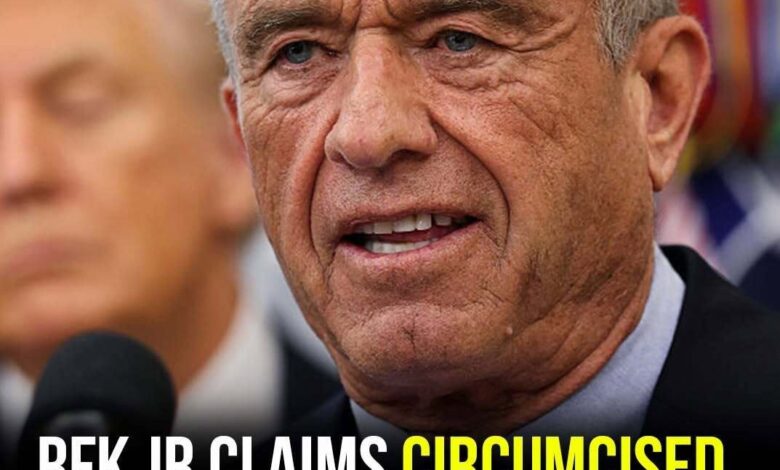
The controversy surrounding Robert F. Kennedy Jr.’s comments extends far beyond a single Cabinet meeting.
At the center of the debate is a question that public health officials have spent decades trying to answer: how do leaders communicate uncertainty without creating unnecessary fear?
Medical science advances by asking questions.
Researchers investigate possibilities.
They test hypotheses.
They challenge assumptions.
But there is a critical difference between scientific investigation and public speculation.
Experts emphasize that extraordinary claims require extraordinary evidence.
In the case of autism, decades of research have examined countless potential factors, including genetics, prenatal influences, environmental exposures, and developmental processes. While scientists continue to study autism extensively, no credible body of evidence has established a direct causal relationship between routine Tylenol use during pregnancy and autism.
That distinction matters.
When public figures suggest connections that have not been proven, many people hear certainty where none exists.
For expectant parents already navigating a flood of conflicting information, even casual remarks can trigger enormous anxiety.
A mother experiencing pain or fever during pregnancy may suddenly question decisions that medical professionals have long considered reasonable and safe.
A father may begin searching for explanations where none have been demonstrated.
Fear fills the vacuum left by uncertainty.
That is precisely why many researchers reacted so strongly.
Their concern is not simply about one statement.
It is about the broader erosion of trust.
Public health depends on confidence.
People must believe that recommendations are based on evidence rather than ideology, personal belief, or political calculation.
When confidence weakens, confusion grows.
And confusion can have real consequences.
The debate also touches on another sensitive issue: how society discusses autism itself.
Many autism advocates argue that conversations focused exclusively on causes and prevention risk overlooking the humanity of autistic individuals living meaningful and productive lives.
For them, autism is not merely a medical topic.
It is a personal reality.
A community.
An identity.
Reducing autistic people to the subject of speculative warnings can feel deeply dehumanizing.
Meanwhile, supporters of Kennedy argue that questioning established narratives should not automatically be dismissed.
They contend that science progresses through inquiry and that unpopular questions should not be forbidden simply because they challenge prevailing views.
Critics respond that inquiry is valuable only when paired with rigorous evidence and responsible communication.
The disagreement reflects a larger tension that has become increasingly visible in modern society.
Who should people trust?
Government agencies?
Independent researchers?
Elected officials?
Personal experience?
Social media influencers?
The answer seems less clear to many Americans than it once did.
As polarization intensifies, even medical issues become political battlegrounds.
Facts themselves are often filtered through partisan loyalties.
One side sees courageous skepticism.
The other sees dangerous misinformation.
The result is a climate where consensus becomes increasingly difficult to achieve.
For health professionals, the stakes could not be higher.
Every major public health challenge—from vaccinations to disease prevention to maternal care—depends upon the public’s willingness to accept evidence-based guidance.
When that trust fractures, the effects ripple outward.
Patients delay treatment.
Parents become overwhelmed by contradictory messages.
Healthcare workers find themselves spending as much time correcting misinformation as they do providing care.
In the aftermath of Kennedy’s remarks, scientists continue to stress a simple principle.
Questions deserve investigation.
Claims require proof.
Until compelling evidence exists, speculation should never be confused with established fact.
That principle is not political.
It is the foundation upon which modern medicine is built.
As the debate continues, millions of Americans are left trying to navigate a landscape where information moves faster than verification and where public officials possess enormous influence over how risks are perceived.
The challenge facing the country is not merely deciding whom to believe.
It is preserving a culture where evidence remains stronger than fear and where public trust is earned through facts rather than fueled by uncertainty.
Because when health policy becomes entangled with speculation, the consequences extend far beyond politics.
They reach into doctors’ offices, family homes, maternity wards, and classrooms.
And ultimately, it is ordinary people who are left to live with the results.