The Terrifying Secret About Snakes In Your House And Exactly What You Must Do Immediately
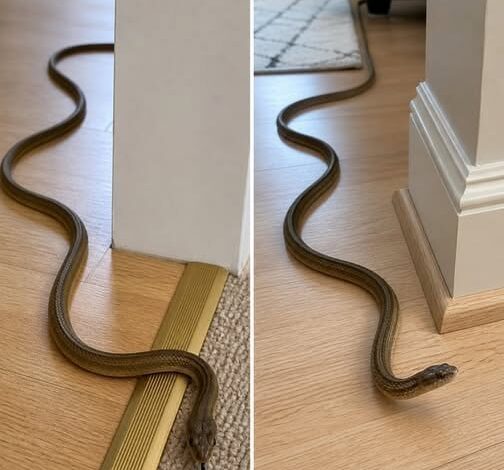
You can’t stop snakes from existing—but you can stop inviting them in.
That realization came too late for one homeowner.
The encounter happened on an otherwise ordinary evening.
The house was quiet.
A television hummed softly in the background while dinner cooled on the kitchen counter. Nothing felt unusual. Nothing hinted that a wild animal had already crossed the threshold and disappeared somewhere inside.
Then came the movement.
At first, it was barely noticeable.
A slight shift near the baseboard.
A dark shape where no dark shape should have been.
The homeowner froze.
For several seconds, the brain searched desperately for another explanation.
A loose cable.
A shadow.
A trick of the light.
Then the shape moved again.
Slowly.
Deliberately.
And suddenly there was no doubt.
A snake.
The adrenaline arrived instantly.
Every instinct screamed to get away.
The familiar living room transformed into unfamiliar territory. The distance between the couch and the hallway suddenly felt enormous. Every corner seemed suspicious. Every pile of boxes looked capable of hiding something alive.
Yet experts say this reaction, while understandable, often leads to the biggest mistakes.
People rush forward.
Attempt to trap the animal themselves.
Swing brooms.
Throw objects.
Try to force the snake outside.
Unfortunately, panic can make a manageable situation far more dangerous.
Most snakes encountered inside homes are not actively seeking confrontation. In fact, they are usually trying to do the exact opposite.
Avoid attention.
Avoid conflict.
Find shelter.
The snake does not view the house as a battlefield.
It views the house as an opportunity.
Food.
Water.
Protection.
These are the resources drawing it inside.
And often, the snake is merely the visible symptom of a larger hidden problem.
Rodents.
Mice.
Rats.
Small pests that may already be living unnoticed within walls, attics, crawl spaces, or storage areas.
Where prey thrives, predators eventually follow.
This connection surprises many homeowners.
They focus on the snake itself while overlooking the conditions that attracted it.
Removing one animal solves today’s problem.
Eliminating the food source prevents tomorrow’s.
Wildlife specialists frequently point out that snakes are remarkably effective hunters. Their presence often indicates an ecosystem functioning exactly as nature intended.
Unfortunately, nature’s intentions do not always align with human comfort.
The psychological impact can linger long after the snake is gone.
Many people report checking under beds.
Inspecting closets repeatedly.
Turning on lights before entering rooms.
Some even experience anxiety weeks after a single encounter.
The fear is understandable.
Snakes trigger something ancient within the human brain.
For thousands of years, recognizing them quickly could mean the difference between life and death.
That instinct remains powerful even in modern homes.
Yet knowledge often reduces fear.
Understanding why snakes enter buildings makes their behavior seem less mysterious.
Less personal.
Less sinister.
The animal is not targeting anyone.
It is responding to environmental conditions.
Heat.
Cold.
Rain.
Food availability.
Simple survival.
After removal, prevention becomes the real priority.
Professionals recommend inspecting foundations, repairing damaged screens, sealing utility openings, and reducing dense vegetation near structures. Wood piles, debris, and overgrown landscaping can create ideal hiding places close to the home.
Indoor cleanliness matters too.
Rodent control remains one of the most effective deterrents.
A house with fewer pests offers fewer reasons for snakes to stay.
Perhaps the most important lesson is this:
The sight of a snake inside your home feels extraordinary.
For the snake, it is entirely ordinary.
It is not plotting.
It is not hunting people.
It is simply following the oldest rule in nature.
Go where survival is possible.
And sometimes, that path leads through a tiny gap beneath a door and into a place we mistakenly believed belonged only to us.
The shock of that discovery may never completely disappear.
But understanding transforms fear into action.
And action is always more useful than panic when something unexpected slithers out of the shadows.