The Final Post: How a Young Woman’s Playful Joke Became a Chilling Death Prophecy
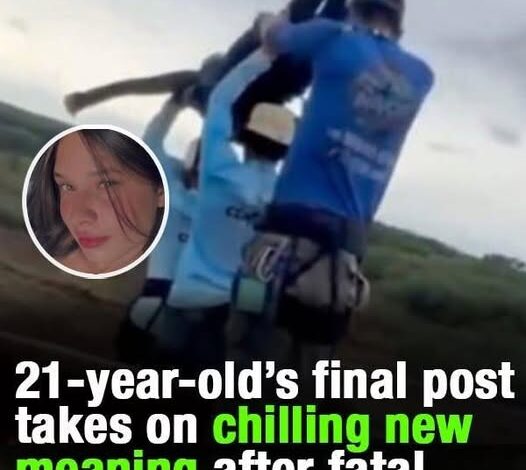
The camera captured her smile—radiant, carefree, and filled with the infectious excitement of youth. Hours before her world ended, 21-year-old Maria Eduarda Rodrigues de Freitas posted a photo to social media, her wrist adorned with the ID bracelets of an adventure seeker. With a lighthearted, almost prophetic laugh, she captioned the moment: “Who was the crazy person who let me jump off a bridge?” That innocent jest would soon curdle into a nightmare beyond comprehension. Within hours, the bridge would become a tomb, and the “crazy person” she joked about would be at the center of a horrific, preventable tragedy.
The scene of the catastrophe was the Ponte do Esqueleto—the “Skeleton Bridge”—in Limeira, Brazil. What should have been a standard weekend outing for thrill-seekers transformed into a scene of carnage that has left a nation mourning. Maria, like so many young people, was looking for a rush, a moment of exhilaration to break the monotony of daily life. She placed her absolute trust in the commercial operators of the event, paying for the promise of a safe, guided experience. But behind the scenes, that trust was being met with a level of negligence so profound it borders on the criminal.
Videos that have since surfaced online paint a sickening picture of the final moments leading up to her death. They show Maria being guided toward the precipice by staff members who were supposed to be the guardians of her safety. Every movement was calculated, every step choreographed, yet the most critical element of the jump was entirely ignored. Reports and eyewitness accounts confirm the nightmare: the safety rope, the singular piece of equipment standing between Maria and a 40-meter freefall, was never secured to her harness. She was guided to the edge and allowed to leap into a void where no safety net existed.
The transition from thrill to terror was instantaneous. As Maria stepped into the air, the collective realization among onlookers that the rope was still dangling uselessly on the ground ignited a chorus of frantic, desperate screams. It was a cry of helplessness that echoed through the ravine as she plummeted 131 feet to the earth below. The gravity of the failure—the sheer, unforgivable oversight of a professional staff failing to click a single carabiner—has sparked a fury that reaches all the way to the offices of local government.
Emergency responders, including fire crews and paramedics, arrived at the site with sirens wailing, but they were greeted by the silence of a life already extinguished. There was no miraculous recovery to be made; there was only the grim task of declaring a young woman dead at the scene of an activity that was marketed as safe, controlled, and expert-led. The aftermath was characterized by immediate, panicked confusion, with staff members reportedly scrambling as the reality of their gross negligence began to set in.
The legal fallout began almost before the emergency vehicles had left the site. Authorities have launched a full-scale criminal investigation, zeroing in on the private adventure company that orchestrated the event. Six individuals who were connected to the operation have been detained, their testimony now the focus of a probe into possible criminal negligence and a total disregard for established safety standards. The Mayor of Limeira and other local officials have expressed their absolute shock, publicly questioning how an operation of this nature could function without the basic, mandatory oversight required for such high-risk activities.
The tragedy has prompted a wider national conversation about the “adventure industry.” In the rush to capitalize on the public’s desire for viral moments and adrenaline-spiking experiences, have we fostered a culture where safety is treated as a secondary concern to profit? In Maria’s case, the answer appears to be a devastating yes. The “crazy person” she joked about in her final post was not a metaphor; it was a looming reality in the form of a poorly trained, unmonitored staff. The irony of her final words is a burden that the investigators and the public are now forced to carry.
For Maria’s family, the loss is an absolute, immutable void. The photos she shared—the ones where she was so full of life, so ready to take on the world—are now agonizing mementos of what could have been. Their grief is compounded by the knowledge that this was not an “accident” in the true sense of the word. An accident is a freak occurrence, an unforeseen event that cannot be mitigated. This was a failure of duty. It was the result of a system that allowed individuals to operate with the lives of others in their hands without the necessary training, supervision, or basic adherence to safety protocols.
As the legal proceedings grind forward, the community of Limeira is left to grapple with the haunting memory of that day. The Skeleton Bridge, once just a local landmark for the brave and the bold, now carries the weight of a preventable death. It serves as a grim monument to the necessity of regulation. Every thrill-seeker, every tourist, and every company that sells the promise of adventure must understand that safety is not a negotiable aspect of the business; it is the entire foundation upon which that business must rest.
When a young woman goes to a bridge and takes a leap based on the instructions of those who are paid to keep her safe, she is engaging in an act of faith. To betray that faith so fundamentally is a stain that no legal defense or corporate apology can ever wash away. The investigation into the Ponte do Esqueleto disaster will eventually provide the technical answers—who failed, which protocol was ignored, and what oversight was missing. But the emotional answer is already clear. A vibrant life was stolen, a final joke became a tragedy, and the world is left with a sobering reminder: behind the excitement of the jump, there must always be the cold, hard assurance of professional competence. May the memory of Maria Eduarda Rodrigues de Freitas serve as the reason why no one else ever has to experience such a horrific, preventable end.