The Explosive Prediction: Is Donald Trump Poised to Resign by Easter 2027?
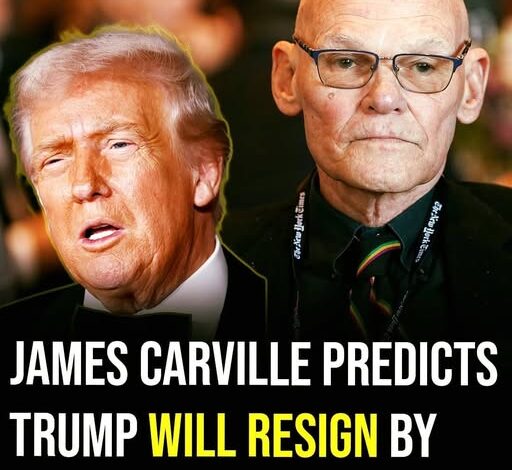
The political world is reeling from a bombshell prophecy that suggests the White House could face its most shocking transition in history within months. Legendary Democratic strategist James Carville has just lobbed a verbal grenade into the national conversation, predicting that President Donald Trump is not merely losing his grip—he is actively spiraling toward a pre-determined exit. According to Carville, the current administration is a ticking time bomb, and the date of the final explosion is already set on the calendar. Could we be witnessing the final chapter of the Trump presidency, and is Easter 2027 the day the curtain finally falls?
James Carville has never been one to shy away from provocative rhetoric, but his latest assessment goes far beyond the usual political mudslinging. Speaking on his podcast, the political veteran painted a vivid, almost cinematic portrait of a leader who is effectively sleepwalking through a gathering storm. In Carville’s estimation, Donald Trump is a man isolated by his own narrative, shielded by an inner circle that filters out the encroaching darkness, and fundamentally bored by the mundane machinery of governance. This detachment, he argues, is the precursor to a catastrophic political collapse that will be fueled by forces far beyond the President’s control.
The core of Carville’s prediction rests on the looming specter of the 2026 midterm elections. He posits that these elections are destined to become a tidal wave of political retribution, delivering a result so overwhelming that the political landscape will be permanently altered. He envisions a scenario where a newly empowered opposition unleashes a torrent of subpoenas and revelations that will make previous investigations look like mere preamble. For a presidency already struggling with its public standing, the pressure of such a confrontation, Carville believes, will be the breaking point. He describes the President as being physically and mentally numbed by the relentless nature of the office, suggesting that when the reality of his declining influence truly hits, Trump will choose a swift, strategic escape over the indignity of a drawn-out struggle.
The narrative of “escape over endurance” is a recurring theme in Carville’s analysis. He characterizes Trump as a man for whom self-preservation has always been the primary instinct. When faced with the choice between fighting a multi-front war against a hostile Congress and the mounting pressures of legal and political scrutiny, Carville believes the path of least resistance will become the only viable option. The idea that a president might simply walk away, handing over the reins to avoid the glare of an increasingly aggressive opposition, is a scenario that has sent shockwaves through Washington.
Predictably, the reaction from the White House was swift and vitriolic. The administration dismissed Carville as a “deranged loser” whose influence has long since evaporated, framing his latest comments as the desperate grasping of an out-of-touch relic of the past. They insist that the President remains as defiant as ever, his focus fixed on his agenda and entirely unfazed by the noise of the media. For the administration, Carville is a caricature of the “establishment” that they have successfully defied for years, and his prediction is nothing more than wishful thinking amplified by a podcast microphone.
Yet, the intensity of the White House’s response speaks volumes. It highlights the stark, unbridgeable divide that defines the current political era. On one side, we have critics who view the administration as a fragile structure held together by denial, prone to an imminent and spectacular collapse. On the other, we have an administration that maintains an unwavering, almost religious belief in their own untouchability. This collision of worldviews has created an environment where every political event is viewed through a lens of existential crisis. Every polling dip, every legislative hurdle, and every public statement is magnified until it becomes the primary indicator of the President’s longevity.
Carville’s focus on Easter 2027 as a potential pivot point is a calculated rhetorical choice. By attaching a specific, symbolic date to his prophecy, he has ensured that the prediction will remain in the public consciousness, acting as a countdown clock for political observers. Whether or not that date holds any true significance remains to be seen, but the narrative it creates is powerful. It turns every passing month into an audition for the President’s survival. If the administration successfully navigates the next year without the calamity Carville predicts, the prophecy will fade into the graveyard of incorrect political prognostications. However, if the political climate turns as hostile as he suggests, Easter 2027 could indeed become a date of historical significance—the moment when the noise of the current era finally gives way to a new reality.
The debate surrounding this prediction also reflects a broader frustration with the predictability—or lack thereof—in our political system. Citizens are increasingly looking for explanations for the chaotic state of the nation, and strategists like Carville offer a compelling, albeit highly opinionated, roadmap for how it might all end. Whether one agrees with his assessment or finds it utterly detached from the reality of the Trump base, his comments force a conversation about the nature of power, the limits of endurance, and the fragility of the presidency.
As we move toward the midterms, the temperature of the nation will only continue to rise. We are entering a phase of the political cycle where the stakes are elevated and the rhetoric is sharpened. Carville’s forecast may be the minority opinion, but it serves as a litmus test for the anxieties currently permeating the political discourse. For now, the presidency continues, the arguments rage, and the world watches to see if Easter 2027 will be just another day in the calendar, or if we are truly witnessing the final, slow-motion act of a political era that has redefined the nation. One thing is certain: in the high-stakes theater of modern American politics, no one has the luxury of being a passive observer, and the only certainty is that the drama is far from over.