The Principal’s Mic Drop: Why the Graduation Ceremony Stopped Dead When the Coal Miner Walked In
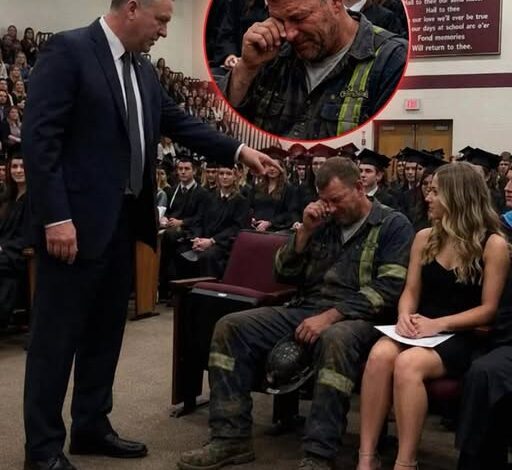
The auditorium was filled with the elite of our small mining town, their designer suits and pressed dresses creating a wall of judgment against the empty seats. I stood in the doorway, my face smeared with black coal dust, my work boots caked in the grime of the tunnel, and my chest heaving from a desperate, frantic run. I was late. I knew the whispers were already starting, the “polite” society members already sharpening their tongues to mock the father who couldn’t even clean up for his own daughter’s graduation. But then, the principal did the unthinkable—he grabbed the microphone and silenced them all.
For twelve years, since my wife Sarah passed, my life had been measured in shifts, chores, and the singular, burning promise I made at her hospital bedside. She had been thin and cold, her eyes fixed on our six-year-old Emily, when she extracted my vow. “Show up for her,” she had whispered. “Not just for the big things. The small ones, too. Parent meetings. Bad days. School plays. All of it… even when you’re tired. Especially then.” I had kept that promise through a decade of double shifts, broken appliances, and the crushing loneliness of a house that felt too big. I had scrubbed until my knuckles bled to give Emily the life Sarah dreamed of, even when I smelled like the mine, no matter how hard I washed.
Emily was eighteen now, and Friday was the day. The principal, Walter—a man as punctual and stern as a grandfather clock—ran his graduation ceremonies like military parades. Emily had begged me to be on time, her eyes filled with the specific, anxious love of a daughter who knew her father was stretched to the breaking point. I had promised. I had the gray jacket Sarah bought me twelve years ago hanging in the closet, ready to be worn. But fate, as it often did in the mines, had other plans.
At 11:35 a.m., I received a text from Emily: “See you soon?” I typed back, “Wouldn’t miss it,” and prepared to leave. At 11:40 a.m., the world collapsed. A support beam in tunnel four buckled, pinning two of my crew beneath tons of rock and debris. My foreman shouted for every able-bodied man to stay, and I didn’t hesitate. I worked the rubble with my bare hands for hours, hauling debris and praying for the trapped men, my heart hammering against my ribs as I watched the clock tick past noon, then 1:00 p.m. I thought of Emily in her cap and gown, but I knew what Sarah would have said: You show up for the people who need you.
When the second man was finally pulled free, the foreman shoved me toward the exit. “Jack, go! Go now!” I didn’t wash. I didn’t change. I sprinted to the truck and drove as if the devil were chasing me, arriving at the school auditorium with my face a mask of coal dust and my heart in my throat. I slipped through the side door just as the ceremony was reaching its peak. The room, which had been buzzing with the quiet chatter of parents taking photos, went deathly silent. Heads turned, eyes widened, and the judgmental whispers began like dry leaves skittering across pavement.
Diane, the head of the parent committee—a woman whose expensive coat and thinning smile had been a constant thorn in my side—sighed audibly. “Some people just have to make a scene, don’t they?” she whispered, loud enough for those around her to hear. She looked at me with a mixture of pity and smug superiority, likely relishing the moment I had finally “failed.” She had tried to “help” by offering to pay for Emily’s gown, a gift I had refused because I wanted to honor Sarah’s memory by doing it myself. Diane had called my pride “expensive.” She was right, but she had no idea what the cost actually was.
I pressed my back against the rear wall, trying to disappear into the shadows, hoping to simply witness Emily’s moment without drawing further heat. But then Walter, the stern principal who had stood at the gate for twenty years, raised his hand. He hadn’t called for the next graduate. He was looking at me. The silence stretched for an eternity, thick with the unsaid judgments of every parent in that room. Diane leaned forward, a predator sensing a kill, her mouth curling into a smile. She was waiting for the public rebuke.
Then Walter spoke. His voice wasn’t booming; it was quiet, deliberate, and carried the weight of a judge passing sentence. “Some of you are about to ask how this man could possibly be late to his own daughter’s graduation,” he began, his gaze scanning the rows of judgmental faces. “I could have asked the same. If I didn’t know Jack.”
He began to recount the years—the times I showed up to fundraisers covered in dirt, the times I had stacked every chair in the gym alone, the way I had refused charity to fulfill a vow to a dying woman. He looked at Diane, and for the first time, her smirk vanished. “Today isn’t just about grades,” Walter said. “It’s about who shows up when no one is watching.”
Then, he turned his gaze to the crowd. “Jack didn’t miss this ceremony because he didn’t care. He missed it because, two hours ago, he was deep underground, pulling two men out of a tunnel collapse with his own bare hands. He came straight here, still covered in the evidence of what it cost him to keep his word.”
The gasp that swept through that room was a physical force. Diane shrank back into her seat, the woman beside her pointedly moving her chair away. Rosa, my neighbor, stood up first. Then the teachers. Then the parents who had been whispering moments before. The entire auditorium rose in a standing ovation that shook the rafters. Emily stood up from the front row, tears carving tracks through her makeup, and walked toward me, taking my soot-stained hand in hers.
When she crossed the stage, she didn’t just accept her diploma; she leaned into the microphone. “This is for my dad,” she said, her voice clear and brave. “And for my mom, who knew he’d keep his promise.”
As we walked home later, the coal dust finally washing away, I realized the promise I made wasn’t just to Sarah—it was to the father I had become. The applause was nice, but the look in Emily’s eyes was everything. We had lived the promise, not just by showing up, but by surviving the darkness to get there.