THE IMPOSSIBLE SOLVE: She Stared at the Board for Two Seconds and Shattered the Record—Leaving the Host Speechless!
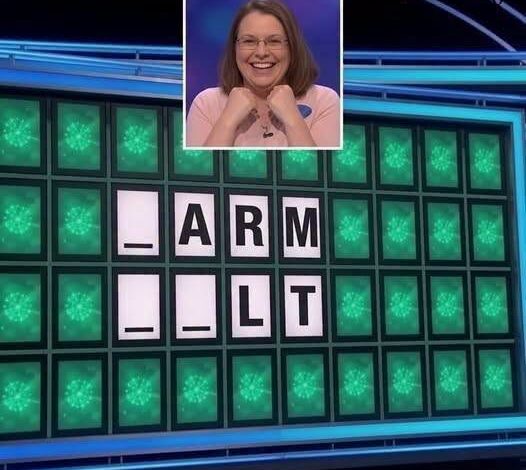
The studio lights hummed with an almost unbearable tension as the contestant stood center stage, staring at a $65,000 puzzle that seemed entirely impenetrable. With almost no letters revealed on the board, the audience braced themselves for a grueling, hour-long battle of attrition. It was the kind of puzzle designed to break even the sharpest minds. But then, in a blink-and-you-miss-it moment of pure, calculated brilliance, she glanced up, offered a faint, knowing smile, and changed the trajectory of the game forever. The air left the room. She hadn’t just solved the puzzle; she had dismantled the very concept of the game.
The crowd sat in stunned, collective silence, struggling to process what they had just witnessed. In a world where contestants typically labor over every consonant and agonizingly deliberate over every vowel, this woman bypassed the struggle entirely. She didn’t hunt for clues or hedge her bets; she stood in the glow of the monitors as if she were reading a sentence she had written herself. The puzzle, which had been presented as a formidable test of logic and nerves, was treated by her with the casual indifference of someone reciting a memory.
Witnesses on the set later described the atmosphere as if time itself had fractured. The board, cluttered with just a handful of cryptic characters, remained a mystery to every human being in the studio—until it wasn’t. She didn’t show the hesitation that usually defines the game-show experience. Instead, she stood poised, her gaze sweeping across the screen with a laser-like focus that suggested she wasn’t looking at scattered fragments of a word, but at a complete, realized image. To her, the puzzle was not a series of blanks waiting to be filled; it was an invisible outline that had snapped into perfect, crystalline focus the moment she walked onto the stage.
What happened next became an instant legend in the world of competitive television. Viewers at home were left frantically replaying the clip, scrubbing through the footage frame by frame, trying to catch the exact millisecond her expression shifted from calm observation to absolute, unshakable certainty. Her solve was not merely a highlight reel; it was a masterclass in the strange, often terrifying power of the human mind under extreme pressure. She demonstrated that when the subconscious is firing on all cylinders, the gap between confusion and total clarity can be crossed in a fraction of a heartbeat.
The beauty of the moment lay in its defiance of logic. In the high-stakes world of televised puzzles, players are conditioned to believe that success is a product of process—of carefully eliminating the wrong options until the right one remains. They are taught to build their answer one brick at a time. This contestant, however, possessed a different kind of intuition. She seemed to tap into a reservoir of mental processing that operated entirely in the background, assembling the disparate pieces into a cohesive whole while the rest of the world was still struggling to identify the first letter.
In those fleeting two seconds, she proved a profound truth about human potential: the boldest moves are rarely the ones that require the most effort. Often, the most powerful solutions are the ones that have already been constructed by the mind, waiting in the wings for the exact moment the conscious brain is ready to claim them. It wasn’t a gamble; it was an act of supreme trust in her own cognitive hardware. She didn’t need to see the whole path because she had already arrived at the destination.
The aftermath was a surreal blend of chaos and awe. The host, usually the master of the stage and the orchestrator of the drama, stood visibly shaken, his prepared banter forgotten as he processed the sheer efficiency of the win. The audience, having prepared themselves for a long, drawn-out affair, erupted into a roar of confusion and excitement. For a few glorious moments, the boundaries of the game show seemed to dissolve, leaving only the image of a woman who had seen the impossible and simply named it.
Since the broadcast, the footage has been analyzed by enthusiasts, psychologists, and casual viewers alike, all trying to understand the “how” behind the “wow.” Was it a stroke of luck? Was it a bizarre coincidence of language patterns? Or was it, as many have suggested, a display of elite-level pattern recognition that bordered on the psychic? While the debate rages on, the reality remains unchanged: she looked at the board for barely two seconds, and in that time, she achieved what thousands of others had failed to do in decades of competition.
Her triumph serves as a reminder of the latent capabilities we all carry. We are often bogged down by the noise of the process, the fear of the mistake, and the over-analysis of the variables. We forget that underneath the conscious, struggling mind lies an intuitive engine capable of processing vast amounts of information in the blink of an eye. She didn’t win because she worked harder than the others; she won because she allowed her brain to bypass the noise and jump straight to the truth.
As the dust settles on the viral sensation, what lingers is not just the prize money or the fame, but the feeling of witnessing a rare, fleeting intersection of preparation and inspiration. It was a glimpse into the raw, unvarnished power of the mind when it is stripped of doubt. She proved that whether you are standing in front of a game show board, navigating a high-pressure career, or simply trying to solve the daily puzzles of life, the most important work is done before you ever speak a word. She trusted the solution her brain found before she even knew how, and in doing so, she reminded us all that the most extraordinary victories are the ones that happen when we stop trying to control the game and start trusting our own intuition.