I went to the store and bought some bacon, brought it home to eat…
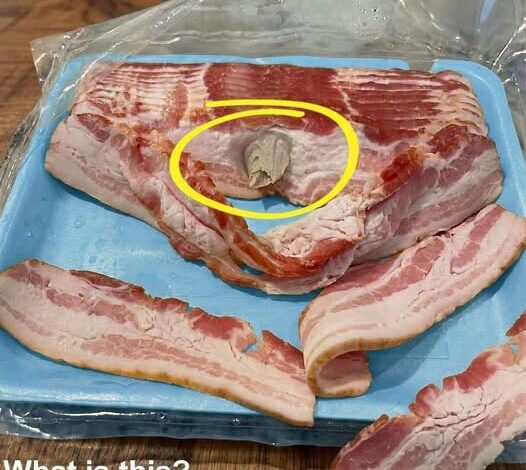
My heart nearly stopped the moment I noticed a strange lump running through a strip of bacon I was about to cook. For a split second, every horror story I had ever read about contaminated food came rushing into my mind. I immediately wondered if it was a parasite, a dangerous growth, or some kind of manufacturing defect that had somehow slipped through quality control. Standing there in my kitchen, staring at my cutting board, I questioned everything. Had I bought the wrong brand? Was the package unsafe? Should I throw the entire thing away? It only took a few seconds for my imagination to transform one unusual-looking piece of bacon into a full-blown food safety nightmare.
Like many people today, I’ve seen countless alarming posts online warning about hidden dangers in everyday foods. Social media is filled with dramatic photos, frightening headlines, and viral videos claiming that ordinary groceries contain shocking surprises. After seeing so many of those stories, it’s almost impossible not to assume the worst when something doesn’t look exactly as expected. My first instinct wasn’t curiosity—it was fear. Before cooking another slice, I grabbed my phone and began searching for answers, expecting to discover some disturbing explanation that would make me swear off bacon forever.
The more I researched, however, the more my panic slowly faded. Food experts explained that odd-looking lumps or thicker sections occasionally found in bacon are often nothing more than harmless folds of muscle or connective tissue created during processing. As pork bellies are cured, sliced, and packaged, natural variations in the meat can produce unusual shapes that appear alarming but are completely safe to eat. In many cases, these thicker sections are simply areas where muscle fibers overlap or where fat and lean meat naturally come together in irregular patterns. While they may look strange compared to perfectly uniform slices, they are usually just another reminder that meat comes from living animals, not identical factory-made molds.
That explanation completely changed how I viewed the situation. I realized my fear had been fueled far more by expectation than by actual evidence. Somewhere along the way, many of us have come to expect every piece of food to look perfectly symmetrical, flawlessly smooth, and completely identical to every advertisement we’ve ever seen. Real food rarely behaves that way. Fruits grow with unusual shapes, vegetables vary in size and color, eggs differ from one another, and cuts of meat naturally contain imperfections. Those differences don’t automatically signal danger—they often simply reflect the reality of nature.
Of course, that doesn’t mean people should ignore genuine food safety concerns. It’s always important to inspect food before preparing it. If meat has an unpleasant odor, feels unusually slimy, shows signs of mold, or displays discoloration that seems abnormal, throwing it away is the safest decision. Expired products, damaged packaging, or obvious signs of spoilage should never be ignored. But an unusual shape or an unexpected fold in otherwise fresh bacon is rarely cause for immediate alarm. Learning the difference between harmless irregularities and actual warning signs can save both unnecessary anxiety and perfectly good food.
The experience also reminded me how quickly misinformation spreads online. A single photograph taken without context can convince thousands of people that something ordinary is dangerous. Once fear enters the conversation, facts often struggle to catch up. Countless images of perfectly normal food variations are shared with dramatic captions suggesting contamination or hidden health risks, even when food scientists and inspectors later explain that nothing unusual has actually occurred. It’s a powerful reminder that not every frightening image tells the whole story.
Since that day, my relationship with food has quietly changed. Instead of immediately assuming the worst whenever I encounter something unexpected in my kitchen, I pause before reacting. I ask questions. I research information from reliable sources instead of relying solely on viral social media posts or sensational headlines. More often than not, there turns out to be a perfectly reasonable explanation rooted in biology, food science, or normal agricultural variation rather than hidden danger.
Ironically, the strange little lump in that strip of bacon ended up teaching me far more than I ever expected. It reminded me that food production, while not perfect, is also not the constant source of hidden horrors our fears sometimes imagine. Every apple isn’t perfectly round. Every tomato doesn’t look identical. Every slice of bacon won’t match the picture on the package. Real food carries the natural fingerprints of the animals and plants it comes from, and those small imperfections are often signs of authenticity rather than problems.
Today, my kitchen feels different. It’s no longer a place where every unusual detail triggers immediate panic. Instead, it’s become a place where caution exists alongside curiosity. I still pay attention to expiration dates, storage recommendations, and obvious signs of spoilage, but I no longer let fear dictate every decision. That simple moment over an oddly shaped piece of bacon taught me one of the most valuable lessons I’ve learned about food: informed awareness is far more powerful than unnecessary panic. Sometimes the scariest-looking discoveries turn out to be completely harmless, and taking a moment to seek trustworthy information can make all the difference.