A Teenager Shoveling My Walk Asked Why the Mailman Skipped My House — The Answer Was a Federal Crime
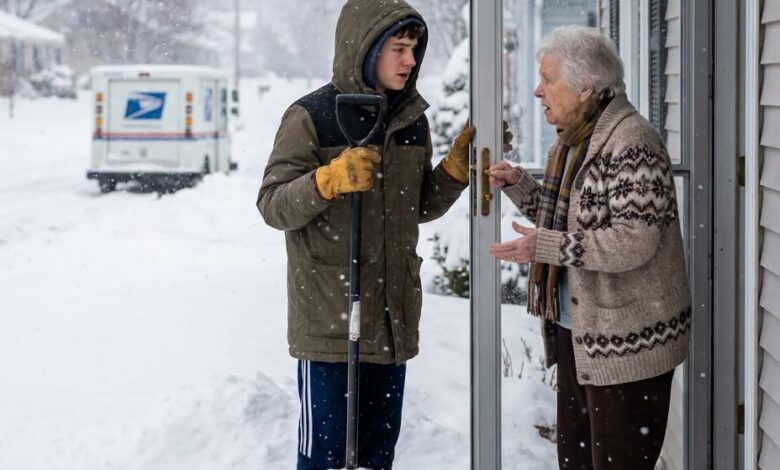
On the fourth day of the blizzard, at 10:15 in the morning, a sixteen-year-old boy named Malik knocked on my door with a snow shovel over his shoulder and a question that would end up involving a federal agency: “Ma’am, why does the mailman skip your house? He’s done it every day this week.” I’m 81 years old, I live alone, and at that moment my walkway was the least buried thing in my life — my furnace was coughing, my heart medication was down to four days, and my son Gary, twenty minutes away, had answered one of my nine calls that week to tell me to drink tea. But I hadn’t received mail in almost three weeks, and I’d blamed the weather. Malik hadn’t. He jogged through knee-deep snow, flagged down the carrier four houses on, and came back up my walk with his careful voice and his phone out: my mail wasn’t skipped, it was forwarded — a change-of-address filed eighteen days ago, rerouting everything to a P.O. box on Killdeer Avenue. I have never rented a P.O. box. Killdeer Avenue is two blocks from Gary’s house. And eighteen days ago was three days after I announced at Sunday dinner that my $47,000 insurance settlement check was approved and in the mail.
I raised Gary in this house on a bookkeeper’s salary after his father passed, and I want to be fair to the boy he was before I tell you about the man he became, because somewhere in between the two, money started mattering to him in a way I never taught him. The signs had been collecting like snow on a roof: the landscaping business “between contracts” for two years; the way he’d started coming by only after the first of the month; the Sunday he asked, too casually, whether my settlement would come “as a check or direct deposit, Ma?” — and I, proud that my accident hadn’t broken me, told him a check, and told him when. Three days later, according to the postal records, someone filed a change-of-address in my name, on a form requiring nothing but a signature the clerk would never check against anything, and my whole life — bank statements, pension stubs, the pharmacy’s refill reminders that would have flagged my dwindling pills, and one settlement check — began flowing to a numbered box two blocks from my son’s kitchen. Then the blizzard sealed me in with a struggling furnace, and my only child told me to drink tea. I don’t believe Gary planned the storm. I believe he simply didn’t mind it.
Malik’s aunt, Denise, had worked eighteen years at the main post office downtown, and her voice on speakerphone in my kitchen was the first thing in three weeks that sounded like solid ground: “Don’t call your son. Federal mail fraud is not a family discussion — it’s a case number.” She transferred us to a postal inspector, a calm man named Whitfield, who took my report while Malik — this child, God bless him — sat at my table writing dates on a napkin so I wouldn’t have to hold them all in my head: the change-of-address, filed eighteen days prior, in my name; the settlement check, delivered to the Killdeer box and signed for six days ago; the box itself, rented — Whitfield confirmed within the hour — under my name, with my identity, by someone presenting themselves as authorized on my behalf. Fraudulent change-of-address, mail theft, and forging an endorsement on a $47,000 check are three separate federal offenses, Whitfield explained, and the U.S. Postal Inspection Service does not consider “he’s my son” a mitigating circumstance so much as a common one. By 2:00, Denise had flagged the box for controlled monitoring; by 3:30, Whitfield had pulled the box rental’s ID scan; and at 4:10 he called back and asked me, gently, to sit down. The ID used was my own stolen driver’s license — the one missing since Christmas, which Gary had helped me search this very kitchen for — and the surveillance still from the retail counter showed the check being deposited through a teller by a man in a green parka I bought my son two winters ago, at a bank branch where the account was not Gary’s alone. It was joint. With his wife. Who processed the whole thing on her lunch break from — Malik read it off the napkin twice because we couldn’t believe it — the insurance company that issued my settlement.
The investigation moved with a speed that told me how tired federal inspectors are of this exact crime against this exact victim. The bank froze the joint account with $39,000 of my settlement still in it — $8,000 had already gone to a snowmobile trailer, an irony I refuse to dwell on while my furnace was failing — and the insurance company suspended my daughter-in-law the same afternoon its fraud unit matched her employee ID to the claim file she had accessed, without authorization, four times in the week before the check mailed. That access was how they knew the exact amount, the mailing date, and which box to rent. Whitfield’s report went to the U.S. Attorney’s office with charges recommended for mail theft, aggravated identity theft, and bank fraud; Gary and his wife surrendered the remaining funds, and their attorneys negotiated a pre-trial resolution whose terms required full restitution of all $47,000, a signed confession of the scheme, and — the condition I asked for myself — a permanent protective order keeping both of them from ever again acting in any financial capacity connected to my name, my accounts, or my mail. The change-of-address was reversed the day after Malik’s knock. My pharmacy refills arrived two days later, escorted up the unshoveled half of the walk by a mail carrier who has not skipped my house since, and who now waves at my kitchen window like a man personally invested, because he is: it was his scanner data, Whitfield told me, that timestamped the whole case.
Gary called me once, after the restitution cleared, and said the words “it was a loan, Ma, I was going to explain everything,” and I let the silence sit on the line until he heard it himself, and then I told him the truth: I could have forgiven a son who asked. I have $47,000 and no son who asks. The settlement is in a new account at a new bank with a fraud alert and a trusted-contact designation — Denise walked me through every form — and my heart pills sit full in the cabinet, and my furnace was replaced in March by a repairman who found the old one one bad night from failing, which is a sentence I don’t read out loud anymore. Malik shovels my walk every snowfall now, and mows in the summer, and he will not take a dollar for it, so I found another way: his aunt let it slip that he wants to be the first in his family to go to college, and my new will — the one my new attorney drafted — has a line in it that will one day make a certain young man sit down hard on somebody’s kitchen chair. He asked me once why I’d do that, and I told him what I’ll tell you. Eighty-one years teaches you exactly one thing worth engraving: when a storm comes — and it will come — family is not the name on your emergency contacts. Family is whoever looks at your empty mailbox and thinks it’s strange. Everything I own is going to people who knock.