Every Shop Told My Daughter She Was Too Big for Prom — Then Her Best Friend Made a Dress No One Could Ignore
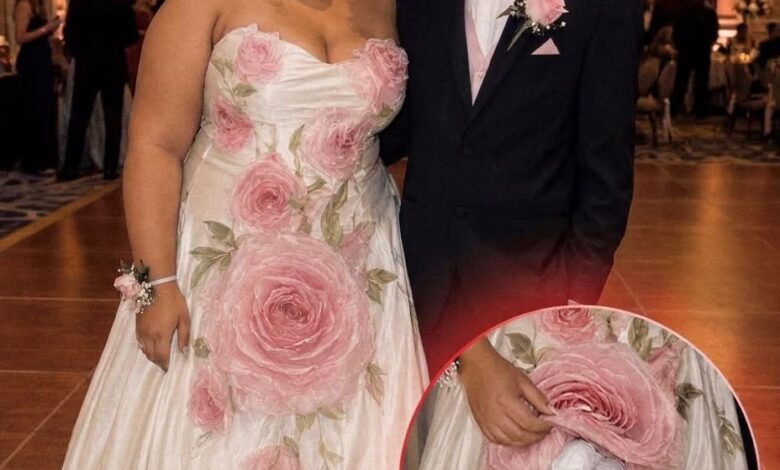
Hazel stood at the entrance of the school gym in an ivory gown covered in handmade silk roses, one hand gripping the doorframe, the other locked around her mother’s fingers so tightly it hurt. Inside, music thudded against the walls, colored lights swept over polished floors, and the same classmates who had whispered about her for years began turning one by one. Eli, her best friend, stood beside her in a thrifted suit, calm in the way only someone who had already chosen his courage could be. Two weeks earlier, a boutique clerk had looked Hazel over and said the gown in the window would not work because she was “too big.” Hazel had not cried then; she had gone silent, which frightened her mother more. Now she stood in a dress sewn by a seventeen-year-old boy who had stayed awake night after night, turning every cruel word that had wounded her into petals no one in that room could look away from.
Hazel had been disappearing for a year, ever since her older brother Mason died on a wet Tuesday on Route 9. Before that, she danced in the kitchen while her mother made pancakes, laughed too loudly, and rolled her eyes when Mason called her Hazelnut and promised to take her to prom himself if no boy was smart enough to ask. After the funeral, the house learned silence: closed doors, untouched plates, gray hoodies, and long hours where Hazel lived more like a shadow than a girl of seventeen. Eli, the quiet boy from two houses down, was the only friend she still allowed near her. He brought homework, sat on the porch without forcing conversation, and reported small victories to her mother, Mave, as if half a sandwich were a miracle worth announcing. When prom season came, Mave tried to coax Hazel toward one fragile attempt at life again, not realizing how much pain her daughter had been carrying beneath the grief.
The dress-shopping trip broke something open. Four boutiques offered polite excuses about limited inventory and sample sizes, but the fifth said the truth plainly, cruelly, and in public. Hazel asked to try the ivory gown in the window, and the saleswoman replied, “That’s not going to work for you, honey. You’re too big.” Hazel walked to the car without a word and locked herself in her room when they got home. Days later, Eli appeared on Mave’s porch with a notebook pressed to his chest and asked for Hazel’s measurements, promising he could make the dress if Mave trusted him and kept it secret. Then Mave found Hazel’s newer journal — pages filled with names, screenshots, and insults classmates had posted after Mason’s death — and sent the evidence to Eli. His answer came back simple and steady: I know what to do with them.
For two weeks, Eli’s bedroom light burned past midnight while he worked at his mother’s old sewing machine, sore fingers wrapped and unwrapped, chemistry tests missed, patterns revised, and ivory silk shaped into something stronger than a gown. The dress became a private archive, each rose hiding embroidered fragments of the words meant to shame Hazel, transformed into beauty by someone who understood that dignity sometimes requires documentation. On prom night, Eli brought the gown to Hazel’s room and used Mason’s old nickname — Hazelnut — because Mason had once made him promise to get loud enough for both of them if Hazel ever went quiet. At the dance, Eli took the microphone only long enough to ask Hazel to look beneath the largest rose. She pulled out a folded strip of embroidered silk, and Eli told the room that the dress was made from every word that had tried to break her, one petal at a time. The gym went silent as students recognized their own cruelty stitched into something they could no longer dismiss.
Hazel cried then, not from humiliation, but from the shock of being seen without being reduced. One girl approached first, whispering an apology into her ear, then another, then a boy who could barely speak through his tears. Mave watched from the parents’ section, understanding that prom had never really been about a dress, or a dance, or trying to bring back the girl Hazel used to be before Mason died. It was about giving her one night where pain did not get the final word. Later, Mave went home alone and stood in Mason’s old room, her palm pressed to his dresser, whispering that someone had kept his promise. The next morning, Hazel came downstairs for breakfast. She was not healed all at once; no honest grief works that way. But she sat at the table, wearing soft socks and tired eyes, and when Mave set pancakes in front of her, Hazel took a bite. Sometimes love does not drag a person back into the world. Sometimes it waits beside the door, holding out one hand and one impossible dress, until she is ready to step through.