The Mystery Gear: Why Your Old Car Had a Secret “E” Button That Could Save Your Life (and Your Wallet)
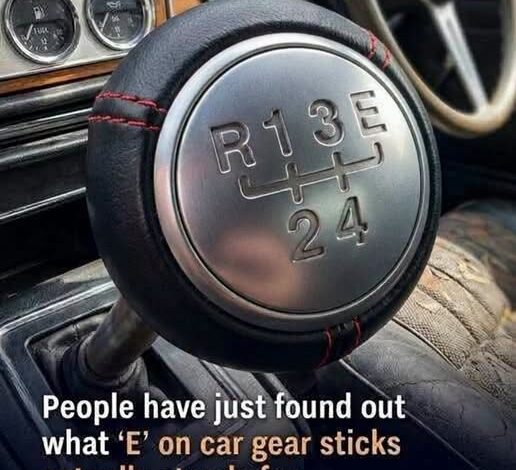
Most modern drivers have no idea that their vehicle’s dashboard is hiding a relic of a bygone era—a mysterious, single-letter command that vanished from gear shifters decades ago. If you ever found yourself in the cockpit of a 1980s or 90s classic, you might have noticed a lone, cryptic “E” staring back at you from the console. For the uninitiated, it was a button to be ignored, a strange marking that seemed to serve no purpose. But for the savvy drivers of that generation, that “E” was a gateway to a hidden performance mode, a secret weapon designed to revolutionize how a car interacted with the open road.
The letter stood for “Economy,” or “Efficiency.” Born from the ashes of the 1970s global oil crises, this feature was an automotive rebellion against the standard, fuel-thirsty driving patterns of the time. While today’s cars use complex computer algorithms to babysit every drop of gasoline, the “E” mode was a tactile, mechanical choice. It was the driver’s way of reaching into the machine and telling the engine to stop chasing raw power and start prioritizing a serene, methodical journey. It was a conscious decision to value mindfulness over momentum, and once you understood how to wield it, you never looked at your commute the same way again.
Depending on the architecture of your vehicle, this Economy mode operated through two remarkably different engineering philosophies. If you were driving an automatic, particularly in the refined luxury vehicles of the era like a classic Mercedes-Benz, the “E” was often a physical toggle switch placed near the gear shifter. When flipped, it didn’t just change the music; it fundamentally re-engineered the car’s hydraulic brain. The transmission would suddenly begin shifting into higher gears at significantly lower RPMs, preventing the engine from ever reaching that high-pitched, fuel-draining scream.
Furthermore, engaging this mode often activated a sophisticated feature: the second-gear start. By forcing the vehicle to bypass the high-torque, low-gear ratio of the first gear, the car would pull away from a stop with a gentle, hushed elegance. It resisted the urge to downshift when you tapped the throttle to pass, relying instead on the engine’s natural torque to build speed gradually. It turned a roaring, aggressive machine into a smooth, whisper-quiet cruiser, proving that efficiency didn’t have to be sluggish—it just had to be intentional.
For the manual transmission purists, the “E” was even more iconic, often found staring back at you directly from the shift knob itself. You would see the traditional 1, 2, 3, and 4 gates, followed by a lonely “E” in the place where a fifth gear usually lived. These vehicles, most notably the legendary Volkswagen Golfs and Rabbits of the 80s, utilized this gear as an extra-tall overdrive specifically designed for the highway. It was a mechanical commitment to the long haul.
Once you had exhausted your standard gears and settled into your cruising speed, you would pop the stick into that “E” position. The effect was immediate and physical: the engine’s RPMs would plummet, the cabin vibration would dampen, and the mechanical roar would dissolve into a soft, steady hum. It was pure bliss for long-distance highway travel. However, it came with a distinct trade-off. Because the gear ratio was so incredibly tall, the “E” offered almost zero acceleration. If a slow-moving truck blocked your path or a steep hill appeared on the horizon, you couldn’t just stomp on the gas and surge forward. You had to respect the machine, downshift into a standard gear, and reclaim your power. It was a driving experience that demanded you pay attention.
So, why did such a brilliant, tactile feature disappear? As we moved into the new millennium, the automotive industry underwent a digital transformation. The mechanical, driver-selected “E” was rendered obsolete not because the goal of efficiency vanished, but because the car became smart enough to handle the transition for you. Modern Electronic Control Units (ECUs) now monitor your throttle input, speed, engine load, and even the grade of the road in real-time. They optimize shift points and throttle response with a level of precision that human reflexes could never match.
The three-speed and four-speed transmissions of the past gave way to the eight, nine, and ten-speed gearboxes of today, which naturally hunt for the most efficient overdrive gear every second they are in motion. The physical “E” button was eventually swallowed up by the software-driven “Eco Mode” buttons that now occupy our modern dashboards. These digital switches are far more comprehensive than the old mechanical selectors; they don’t just adjust the transmission—they modulate your climate control, throttle sensitivity, and even the way your engine manages its power delivery.
The loss of the physical “E” marks the end of an era of mindful, mechanical interaction. It represents the transition from a world where the driver was a partner in the vehicle’s performance to a world where the driver is a passenger in an automated experience. There was something undeniably satisfying about sliding that lever or clicking that switch—a physical tactile confirmation that you were actively choosing to be more efficient. It was a quiet act of defiance against the rush, a deliberate choice to trade a bit of speed for a smoother, more deliberate journey.
While the digital “Eco Mode” of the 21st century is objectively more efficient, it lacks the soul of that forgotten “E.” It is a background process, an invisible algorithm working away in the dark, whereas the old “Economy” mode was a constant, tangible reminder of your impact on the road. It taught us to understand our engines, to feel the strain of high RPMs, and to appreciate the quiet, steady rhythm of a car cruising in its element. It was a forgotten relic of a time when driving was a skill, a conversation between human and machine, and a conscious decision to slow down and enjoy the ride.