The Deadly Killer Bug Spreading Fear Across the Nation: The Terrifying Threat That Is Wiping Out Entire Colonies
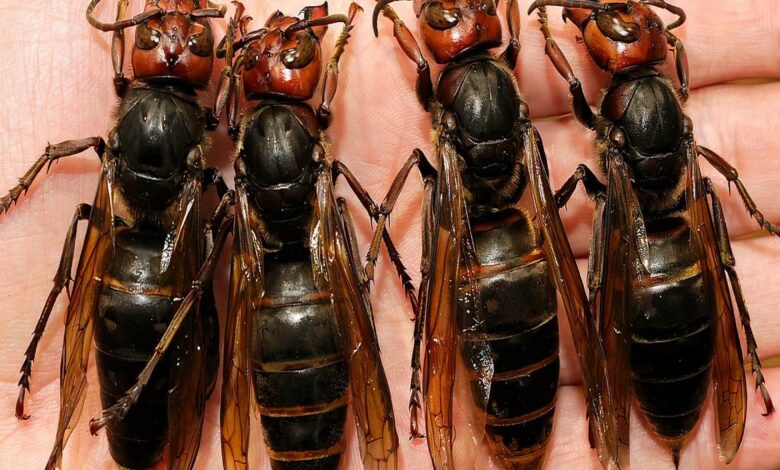
It strikes without warning, dropping from the sky like a nightmare resurrected from dark legends, leaving a trail of absolute carnage and terror in its wake. Imagine a monster insect so large, so relentless, and so armed with neurotoxic venom that a single encounter can plunge entire communities into panic. Across the country, alarm bells are ringing as whispers of this flying predator spread like wildfire. Authorities are desperately racing against the clock, setting live traps and deploying expert trackers to halt an unstoppable invasion before this lethal menace establishes a permanent foothold and brings ecological ruin right to your doorstep.
The insect in question—officially known as the northern giant hornet (Vespa mandarinia) and popularized in headlines as the “murder hornet”—is the largest hornet species on Earth. Originating from the temperate and tropical regions of East Asia, South Asia, and Mainland Southeast Asia, this formidable predator created widespread concern when confirmed sightings first emerged in North America in late 2019. Measuring up to nearly five centimeters in length with a striking yellow-and-black striped body, a large orange head, and a wingspan exceeding seven centimeters, its sheer size alone is enough to send a chill down anyone’s spine.
While the dramatic nickname implies a creature hunting humans, the primary casualty of the giant hornet’s invasion is actually the honeybee population. These invasive hornets are specialized apex predators of social insects, and honeybee hives are their ultimate targets. A small group of giant hornets can execute what entomologists refer to as a “slaughter phase.” Armed with powerful, razor-sharp mandibles, just a handful of these hornets can decipitate tens of thousands of honeybees in a matter of hours. Once the adult worker bees are slaughtered, the hornets occupy the hive, claiming it as their own territory. They rip open the comb to harvest the bee pupae and larvae, carrying this high-protein prize back to feed their own developing brood.
This systematic destruction poses a catastrophic threat to agriculture and local ecosystems. European honeybees, which are essential for pollinating billions of dollars worth of commercial crops, fruit orchards, and wild plants, have no natural evolutionary defenses against the northern giant hornet. Unlike Asian honeybees, which have developed a unique collective defense mechanism—swarming around an invading hornet and vibrating their flight muscles to raise the temperature and suffocate the predator—Western honeybees stand virtually helpless against an attack. The loss of honeybee populations directly imperils global food security, making the containment of this invasive hornet a top agricultural priority.
Beyond its devastating impact on pollinators, the northern giant hornet poses a genuine health hazard to humans and domestic animals. While these insects generally do not target humans unless their nest is disturbed or threatened, an encounter can be exceptionally dangerous. The hornet possesses a stinger nearly six millimeters long—capable of puncturing standard protective clothing, including typical beekeeping suits. Furthermore, its venom contains a complex cocktail of neurotoxins, tissue-destroying enzymes, and compounds that induce severe pain.
While a single sting from a northern giant hornet is rarely fatal to a healthy adult without severe allergies, multiple stings from an agitated group can lead to localized necrosis, acute kidney failure, anaphylactic shock, or cardiac arrest. In its native Asian habitats, dozens of deaths are recorded annually due to accidental nest encounters, making public awareness and swift containment crucial whenever a nest is reported.
In response to initial sightings near the border of Washington State and British Columbia, agricultural officials and entomologists launched an unprecedented, highly coordinated tracking and eradication campaign. State departments of agriculture, alongside dedicated volunteer networks, placed thousands of specialized live traps throughout high-risk forested areas. When live specimens were captured, researchers used micro-technology to equip the hornets with tiny radio transmitters. By tracking these tagged insects through dense forestry, teams were able to pinpoint the exact locations of concealed subterranean or tree-cavity nests.
Once located, eradication teams dressed in specialized, reinforced protective suits acted swiftly during the night when the hornets were inside the nest. Using vacuum extraction equipment, carbon dioxide gas, and expanding foam, crew members systematically eliminated the nests to prevent virgin queens from emerging, mating, and dispersing to establish new colonies in the spring. Thanks to these aggressive, science-driven containment efforts, agricultural authorities have successfully eradicated multiple nests, dramatically curbing the spread of the invasive population and demonstrating the power of early biosecurity intervention.
The saga of the giant hornet highlights the growing global challenge of invasive species. In an interconnected world of international trade and travel, non-native insects can easily hitchhike across oceans in cargo containers or wood packing materials. Once introduced to an environment lacking natural predators, these invasive species can disrupt delicate food webs, drive native species toward extinction, and cost economies billions of dollars in damage control and agricultural losses.
Combatting such biological threats requires constant vigilance, international cooperation, and public participation. Environmental agencies continue to urge citizens to report unusual insect sightings, avoid approaching potential nests, and support local pollinator conservation efforts. Protecting local ecosystems from destructive invaders ensures that honeybees can continue their critical work, safeguarding the food supply and preserving the natural balance of the environment for generations to come.