Early in the morning, I went outside to get some fresh air and found this.
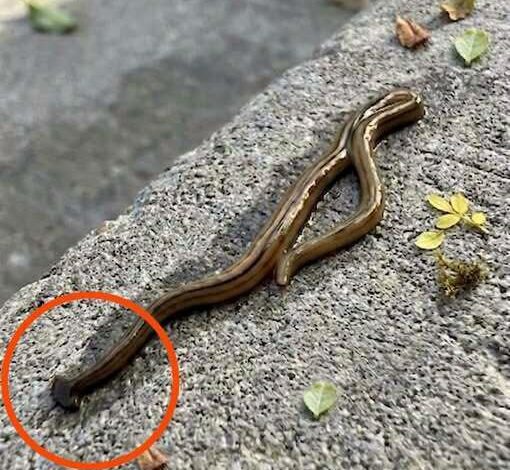
Early in the morning, I stepped outside for some fresh air and immediately froze. There, stretched across the damp ground, something long and glistening was slowly sliding over the soil. At first, I assumed it was an ordinary earthworm brought to the surface by moisture. But the longer I stared, the more obvious it became that this creature was different. Its body was unusually flat and glossy, with dark lines running along its length like carefully painted scars. And then I noticed its head—wide, flattened, and shaped like a tiny shovel or hammer. A chill ran through me as I watched it glide forward without the familiar wriggling movement of an ordinary worm.
I couldn’t shake the feeling that I was looking at something that didn’t belong there. The creature moved with an eerie smoothness, almost as though it knew exactly where it was going, while I stood several feet away, caught somewhere between fascination and unease.
Every instinct told me not to touch it.
Instead of contracting and stretching like the earthworms I was used to seeing after rain, it seemed to glide effortlessly across the ground. Its shiny body left a faint trail behind it, and that bizarre hammer-shaped head moved slowly from side to side as it explored the soil.
For a moment, it looked almost alien.
I leaned closer without getting within touching distance, trying to understand what I was seeing. The head was unmistakably different from anything I had encountered in the garden before. It looked less like the front of a worm and more like a miniature hammerhead shark flattened against the earth.
That strange appearance made the creature seem far more threatening than its slow movement suggested. It wasn’t chasing anything or behaving aggressively, yet there was something unsettling about watching an unfamiliar predator quietly navigating an ordinary patch of garden.
I took several photographs and decided to leave it alone until I knew exactly what it was.
Later, after searching online and comparing the photographs with identification guides, I found the answer: I had encountered what is commonly called a hammerhead worm, a type of terrestrial flatworm known for its distinctive widened head.
Suddenly, every unusual detail made sense.
The flattened body, the glossy surface, the smooth gliding movement, and especially that unmistakable hammer-shaped head were characteristic features of these unusual flatworms. They are very different from the familiar earthworms that gardeners regularly discover beneath leaves and soil.
What surprised me most was learning that hammerhead worms are predators.
Some species feed on earthworms and other small soil organisms. They locate prey using chemical and sensory cues, then use their specialized biology to consume it. That strange head I had found so disturbing wasn’t merely an unusual decoration—it was part of an animal adapted to searching its environment.
I also learned that hammerhead worms have been introduced outside their native ranges in various parts of the world, often transported unintentionally through soil, landscaping materials, and potted plants. That explained why seeing one could feel like encountering something that didn’t belong.
The advice I found made me glad I had resisted the temptation to pick it up.
Guidance commonly recommends avoiding unnecessary bare-handed contact with unidentified flatworms and washing thoroughly if contact occurs. Some hammerhead flatworms can produce tetrodotoxin, and they may also be associated with parasites, giving homeowners another reason to handle encounters cautiously rather than treating them like ordinary garden worms.
Another surprising warning concerned cutting them.
My first instinct might have been to chop the strange creature in half with a gardening tool. But flatworms are famous for impressive regenerative abilities, and simply cutting one into pieces is not considered a reliable way of dealing with it. Depending on the species and circumstances, portions may survive and regenerate.
That fact made the creature seem even stranger than before.
I also realized that keeping curious children and pets away was sensible. A dog investigating something unfamiliar with its mouth or a child picking up a strange worm could create unnecessary exposure. Until an animal has been properly identified, keeping some distance is often the easiest precaution.
Looking back, what struck me most was how ordinary the morning had been until that moment.
There had been no wilderness expedition, no exotic rainforest, no trip into some remote ecosystem. I had simply stepped outside my own home expecting a few quiet minutes of fresh air.
Instead, I discovered a predator gliding silently through the soil.
The encounter reminded me how much activity takes place beneath our feet without us ever noticing. Gardens that appear peaceful are filled with competition, hunting, feeding, decomposition, and survival. Most of it happens quietly enough that we walk past without realizing it exists.
That hammerhead worm was unsettling, certainly, but it was also fascinating.
Its strange body wasn’t monstrous or accidental. Every feature had developed around survival—the flattened shape, mucus-assisted movement, sensory structures, and remarkable ability to recover from injury.
What initially looked like something from another planet was simply another example of how unfamiliar nature can appear when we finally notice it.
And now, whenever I step outside after rain and see something moving through the damp soil, I look a little more carefully before assuming I know exactly what it is. That harmless-looking morning encounter taught me that sometimes the strangest creatures aren’t hiding in distant jungles or deep oceans.
Sometimes they’re quietly gliding across your own backyard.