Can You Spot All the Cats? A Fun and Challenging Visual Puzzle Awaits!
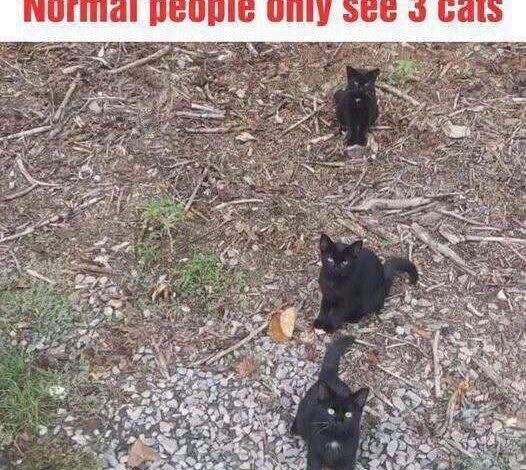
Some people give up after a few seconds. Others stare at the picture until their eyes begin to ache. And then there are the rare few who somehow manage to find all four hidden cats. At first glance, this picture puzzle looks completely harmless, almost too easy to be challenging. But once you start searching, you quickly realize that at least one tiny feline has been cleverly concealed where you least expect it.
Your attention suddenly becomes sharper.
Every cushion could hide a paw. Every shadow might contain a pair of eyes. A curve in the furniture could be a tail, while a strange shape in the background might turn out to be a cat’s ear.
The challenge is simple: find all four cats.
The first one or two may reveal themselves fairly quickly. You might notice a familiar pair of ears resting near the windowsill or a cat blending into the furniture. Once you find one, you become convinced the others will be just as obvious.
That confidence doesn’t last long.
The third cat usually requires a little more patience. It may be partially hidden behind an object, tucked into a darker section of the image, or positioned in a place your eyes naturally skip over.
Then comes the fourth.
This is where the puzzle becomes a real test of observation.
The final cat is often the one that makes people question everything they have already looked at. You may have examined the same corner several times without realizing that the answer was sitting right there.
That is what makes hidden-image puzzles so entertaining.
They force you to stop looking casually and start looking deliberately.
Instead of taking in the entire image at once, you begin dividing it into sections. You check the top, the bottom, the corners, the furniture, the shadows, and the background. You start noticing patterns and shapes that would normally disappear into the larger picture.
And the more you search, the more determined you become.
There is a strange satisfaction that comes from refusing to give up before seeing the answer. You know the cats are there. You know someone else created the puzzle with the intention of hiding them. All you have to do is find what your eyes keep missing.
Sometimes you think you’ve found the final one, only to realize that you were looking at part of a chair or another object.
Then you start again.
The puzzle becomes a battle between what you think you see and what is actually there.
That is also why these challenges can be surprisingly frustrating. Our brains are constantly trying to process visual information quickly. When we look at a familiar environment, we tend to recognize the overall picture rather than carefully inspect every individual detail.
A hidden cat takes advantage of that habit.
It blends into the surroundings just enough to escape immediate attention.
The fourth feline may have colors similar to the background or a body position that makes it look like part of another object. Until you know where it is, the image seems almost impossible.
Once you finally see it, however, everything changes.
You suddenly wonder how you could have missed it.
The answer becomes obvious because your brain now knows what pattern to look for.
That moment of discovery is the real reward.
You can also turn the challenge into a small competition. Send the image to friends or family and see who can find all four cats first. Someone may spot the first three immediately while another person somehow discovers the hardest one within seconds.
The different ways people see the same image can be surprisingly entertaining.
One person may focus on the center.
Another may immediately inspect the corners.
Someone else may notice tiny shapes in the background that everyone else overlooked.
And suddenly a simple puzzle becomes a conversation.
That’s part of the quiet magic of visual challenges like this.
They pull us away from autopilot.
For a few minutes, you aren’t thinking about emails, errands, deadlines, or whatever else is competing for your attention. You’re simply trying to solve a small mystery.
Your focus narrows.
Your eyes slow down.
You become more aware of details.
Even when you don’t find the answer immediately, the process encourages patience. Instead of giving up because something is difficult, you learn to approach it from another angle.
Look again.
Change your focus.
Try another section.
Step away for a moment and return.
Sometimes the answer appears only after you stop forcing yourself to find it.
And if you eventually find all four cats without looking at the solution, you have earned bragging rights.
The hardest part isn’t necessarily recognizing a cat.
It’s resisting the urge to scroll down and check the answer too soon.
So before you give up, take another careful look.
Check the shadows.
Examine the furniture.
Look for unusual shapes.
Pay attention to anything that seems slightly out of place.
The final cat may be hiding in a location you’ve already inspected several times.
That’s what makes these puzzles so addictive.
They remind us that seeing something and truly observing it are not always the same thing.
You may look directly at an object without actually noticing what is there.
Then, one small detail changes everything.
Whether you found all four cats in seconds or spent several minutes searching, the real value of the puzzle is the experience. It gives your mind a short break from routine and replaces passive scrolling with active observation.
And if you are solving it with friends, the solution can become even more enjoyable.
Someone will inevitably claim they found the hardest cat first.
Someone else will insist it was obvious.
And another person will probably stare at the image for five minutes before finally shouting, “How did I not see that?”
That shared frustration and laughter is part of the fun.
Because the real prize isn’t simply finding four hidden cats.
It’s the moment your brain suddenly recognizes what was hiding in plain sight.
So take one last look before checking the answer.
You might be closer than you think.
And remember: the fourth cat is probably the one that wants you to believe it isn’t there at all.