Shania Twain’s only son is making music—and fans can’t help but notice the resemblance

For more than two decades, Shania Twain has largely protected the privacy of her only child, Eja D’Angelo Lange, allowing him to grow up without the constant public attention that often surrounds the children of internationally famous entertainers. Born on August 12, 2001, Eja is the son of Twain and record producer Robert John “Mutt” Lange. His arrival came during an extraordinary period in his mother’s career, after she had become one of the world’s most successful country-pop performers.
Yet despite having two parents with major connections to the music industry, Eja’s childhood was intentionally kept relatively private. Motherhood represented a significant change in Twain’s life. Speaking about her son when he was still very young, she described becoming more emotional after his birth and experiencing an even greater sense of love. Eja was raised primarily in Switzerland during his early years, away from much of the entertainment-industry attention surrounding his parents.
Twain’s approach was not simply about keeping photographers away. She repeatedly explained that she wanted her son to understand ordinary responsibilities and develop qualities such as humility, honesty and appreciation despite growing up in circumstances very different from the financially difficult childhood she herself had experienced. That philosophy became especially clear in a 2007 interview in which Twain discussed the values she hoped Eja would develop.

She wanted him to become well-rounded, humble and honest without deliberately depriving him simply to teach those lessons. Because she understood that privilege could make appreciation more difficult to learn, she said the family made a conscious effort to keep him grounded rather than placing him inside a protective bubble. She even described teaching him ordinary household responsibilities, including picking up after himself. Her comments provided a rare glimpse into how she approached parenting while living with considerable fame and financial success.
Twain also kept celebrations surprisingly simple when Eja was little. Around his first birthday, she spoke about making him a homemade chocolate cake rather than organizing an extravagant celebrity celebration. The detail was consistent with the broader parenting philosophy she described over the years: financial security did not have to mean that every childhood experience needed to be luxurious. She wanted him to appreciate what he had while still enjoying a comfortable upbringing. That balance was particularly meaningful to Twain because her own childhood had involved significant financial hardship, family responsibilities and experiences very different from the circumstances into which her son was born.
Eja’s childhood also coincided with one of the most difficult periods in his mother’s personal life. Twain and Lange separated in 2008 after a marriage that had also been one of the most successful creative partnerships in modern country-pop music. Twain subsequently spoke publicly and wrote about the emotional consequences of the breakup. She later formed a relationship with Frédéric Thiébaud, whose former wife, Marie-Anne Thiébaud, had been close to Twain. Twain and Frédéric eventually married in 2011. In recent interviews, Twain has discussed reaching a place of forgiveness and maintaining a peaceful approach to co-parenting Eja with Lange.
Through those changes, Eja remained largely outside the celebrity spotlight. Twain occasionally discussed motherhood publicly, but her son did not become a regular presence at entertainment events or in celebrity media. As he grew older, however, one important similarity between Eja and both of his parents became increasingly apparent: music was becoming an important part of his life. Rather than seeking attention as a singer or stage performer, he developed an interest in the creative and technical side of making music. Twain has described him as passionate about creating, composing and orchestrating music while showing less interest in becoming a public performer himself.

His musical interests have also been described as broad rather than confined to the country-pop sound associated with his mother. Twain has previously spoken about Eja’s enthusiasm for electronic dance music and his interest in arranging and producing. She has said that film composer Hans Zimmer was among the musicians he admired, illustrating a musical curiosity extending into orchestration and cinematic composition. Instead of simply attempting to reproduce his mother’s career, Eja appeared interested in developing the skills involved in constructing music behind the scenes. For Twain, this distinction was important: she supported his creativity while recognizing that his ambitions did not necessarily involve standing under stage lights in front of thousands of people.
The clearest public evidence of Eja’s developing songwriting abilities arrived with Twain’s sixth studio album, Queen of Me, released in February 2023. The album contained a particularly meaningful family collaboration: Eja received a songwriting credit on “Number One.” Twain revealed that the song represented the first Twain/Lange songwriting credit on one of her albums in more than two decades, but this time the Lange involved was her son rather than her former husband and longtime producer. The collaboration represented an unusual intersection between Twain’s established musical career and the independent creative path Eja had been developing.
Twain later explained that she had incorporated material Eja created into “Number One” without initially telling him that it would end up on the finished album. The resulting track therefore became more than an ordinary songwriting credit. It marked a moment when mother and son were able to connect professionally through the creative process while maintaining their separate musical identities. For longtime listeners familiar with the importance of the Twain-Lange partnership during the 1990s, seeing another Lange name attached to a Shania Twain composition carried an additional layer of family history. Eja, however, was participating on his own terms rather than attempting to recreate his father’s career.
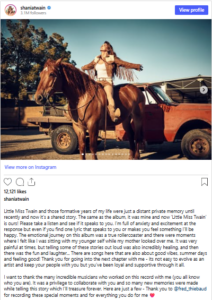
Their musical connection has continued. In 2026, Twain released Little Miss Twain, an album reflecting on her early life and the years before she became internationally famous. The record explores memories of her childhood and pays particular attention to her late mother, who strongly encouraged her musical ambitions. Eja is part of this new chapter as well: reporting surrounding the album confirms that he contributed backing vocals to the project. His participation provides another example of mother and son working together musically while Eja continues to maintain a much quieter public profile than his famous mother.
That privacy remains one of the defining characteristics of Eja’s public story. Unlike some children of famous entertainers who develop highly visible careers from an early age, he has generally avoided turning his family connection into a celebrity identity. Most information about his personality, musical interests and upbringing has come from occasional comments made by Twain rather than from Eja regularly speaking publicly about himself. That distinction matters because it leaves considerable parts of his adult life appropriately private. What can be established publicly is that music remains a meaningful interest and that his creative relationship with his mother has gradually become visible through actual recording and songwriting credits.
Twain’s comments about raising Eja also reveal how strongly her own upbringing influenced her decisions as a parent. She has spoken openly over the years about growing up with limited financial resources and taking on substantial responsibilities at a young age. After her mother and stepfather died in a vehicle collision in 1987, Twain helped care for her younger siblings before her recording career eventually transformed her circumstances. Those experiences made the enormous success that followed particularly dramatic, but they also shaped her concerns about raising a child who would never experience the same financial insecurity.
Instead of attempting to reproduce hardship artificially, Twain emphasized appreciation, responsibility and independence. Her earlier interviews contain small examples of that approach, from expecting Eja to help with ordinary tasks to keeping some family celebrations deliberately low-key. She also described participating in community efforts involving donated toys during the holiday season. These details suggest that her goal was not to deny her son the advantages available to him but to make sure those advantages did not become his entire understanding of life. It was a parenting philosophy built partly from lessons Twain believed she had learned through her own difficult experiences.
As Eja reached adulthood, the relationship naturally changed. Twain has acknowledged that her son has his own life, something that can be emotionally complicated for any parent after years of having a child at the center of everyday family life. Yet their shared interest in music has provided a distinctive way for them to remain connected. Their collaboration does not appear to involve Twain positioning Eja as a celebrity successor. Instead, the available evidence points toward a young musician interested primarily in songwriting, composition and production, with his mother supporting him while allowing him to determine the direction of his own career.
Eja also represents an unusual continuation of a remarkable musical family history. His father, Mutt Lange, became one of the most influential producers in popular music, while his mother built a recording career that transformed the boundaries between mainstream country and pop. Growing up around that level of musical experience could easily have created enormous expectations. Yet Twain’s descriptions of her son consistently emphasize individual choice. His musical interests belong to him, and his preference for creating rather than pursuing the same type of stage career as his mother demonstrates that inheritance does not necessarily mean imitation.
At 25 in 2026, Eja D’Angelo Lange remains a relatively private figure despite having been born into one of popular music’s most recognizable families. The public glimpses available over the years show a progression from the young son Twain worked hard to keep grounded to an adult who has begun contributing creatively to his mother’s music. His songwriting credit on “Number One” and his more recent backing-vocal contribution demonstrate that music has become more than simply a childhood interest. At the same time, there is no indication that he is seeking the degree of public recognition his parents experienced.
For Shania Twain, that may be one of the most meaningful outcomes of the parenting approach she described more than two decades ago. She wanted her son to have opportunities without losing humility, to understand independence without being deprived, and to discover his own interests instead of living entirely through his parents’ achievements. The details she has shared suggest that Eja has been given considerable room to do exactly that. His story is therefore less about becoming “Shania Twain’s famous son” and more about quietly developing his own relationship with music while maintaining the privacy his mother sought to protect from the beginning.
Today, the occasional collaborations between mother and son provide rare windows into that relationship without changing its fundamentally private nature. Twain remains the internationally recognized performer, while Eja continues to develop creatively away from much of the attention surrounding her career. Their work together demonstrates a shared musical language across generations, but it also highlights something Twain has emphasized throughout his life: her son does not need to reproduce her journey. He has the freedom to create his own. And after more than two decades of carefully balancing extraordinary privilege with an effort to preserve normalcy, that independence may be one of the clearest threads running through Eja Lange’s life so far.