She witnessed her mom killing her abusive father – she later moved to Hollywood and became an Oscar-winning actress
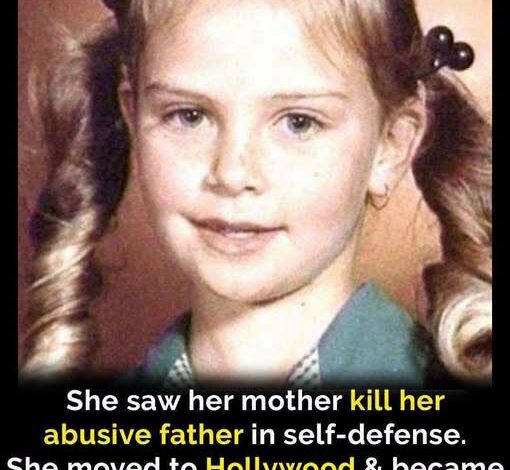
Before the red carpets, there was blood on the floor. Before the Oscar, there was a locked bedroom door and three bullets tearing through the wood. Charlize Theron’s rise from a frightened South African teenager to one of Hollywood’s most respected actresses was never a simple fairytale of fame and success. Behind the glamorous photographs, major awards, and unforgettable performances was a childhood marked by fear, instability, and a traumatic night that permanently changed the way she understood her family. Her story is ultimately not just about becoming a Hollywood star. It is about surviving something that could have destroyed her and then finding a way to build an entirely different life from the pieces that remained.
Theron’s story begins far from Hollywood, on a farm in South Africa where the beauty of the landscape existed alongside a deeply troubled home life. As a child, she struggled with insecurity and bullying. She wore thick glasses and often felt uncomfortable in her own skin, while the cruelty of other children made her feel even more isolated. Home was supposed to be the place where she could escape those pressures, but instead it was affected by her father’s alcoholism and unpredictable behavior.
The environment created a constant sense of uncertainty. Alcohol addiction can change the atmosphere inside a family, turning ordinary moments into situations filled with tension and fear. For young Charlize, the behavior of her father meant that the safety she should have associated with home was never guaranteed. She learned early that people could change quickly and that a peaceful moment could become frightening without warning.
Then came the night that would stay with her for the rest of her life.
Her father fired several shots through the door of the bedroom where Charlize and her mother were hiding. The bullets tore through the wood, transforming a familiar part of the house into a place of terror. In an attempt to protect herself and her daughter, her mother fired back and killed him. Theron has described the incident as an act of self-defense, and the trauma of that night became one of the defining experiences of her adolescence.
For a teenager, experiencing such violence inside the family home could have become an unbearable weight. There was no easy way to make sense of what had happened. There was grief, fear, confusion, and the knowledge that someone she had known as her father was also capable of becoming a threat. The event destroyed any remaining illusion that everything could simply return to normal.
Yet Theron did not allow that night to become the only story she would ever tell about herself.
Instead, she eventually chose to move forward.
At 19, she left South Africa and traveled to Los Angeles with a dream of becoming an actress. She did not arrive as an established performer with powerful connections or an obvious path into Hollywood. She was young, ambitious, and largely unknown, trying to build a career in an industry where thousands of people arrive every year hoping for the same opportunity.
The transition was difficult. Hollywood offered no guarantees, and Theron had to navigate rejection, uncertainty, and the challenges of building a new life in a completely different environment. But the determination that had helped her survive her childhood became an important part of her professional identity. She continued pursuing opportunities until the right ones began to appear.
Her early success eventually led to roles that allowed audiences to see much more than her appearance. Hollywood initially recognized her beauty, but Theron increasingly demonstrated that her abilities extended far beyond being a glamorous screen presence. She wanted difficult characters, complicated emotions, and roles that required her to disappear into someone else’s world.
That transformation became impossible to ignore with *Monster*, in which she portrayed serial killer Aileen Wuornos. The performance was physically and emotionally demanding, requiring Theron to completely alter her appearance and immerse herself in a deeply troubled character. Her work earned widespread critical acclaim and ultimately won her the Academy Award for Best Actress.
The Oscar was a remarkable achievement, but it also carried a deeper significance when viewed against everything that had come before. The frightened teenager who had once hidden behind a bedroom door had become one of the most celebrated actresses in the world. Her past had not disappeared, but she had transformed the pain into something creative.
That ability to draw emotional depth from difficult experiences continued throughout her career. In *Mad Max: Fury Road*, she portrayed Furiosa, a character defined by survival, determination, physical strength, and resistance. The role became one of her most iconic performances and reinforced her reputation as an actress capable of carrying physically demanding, emotionally complex films.
Furiosa was fictional, but audiences could recognize something familiar in the character’s determination. Theron has repeatedly gravitated toward women who are complicated, wounded, powerful, and unwilling to remain victims of the circumstances that shaped them. Her performances often contain a sense of resilience that feels deeper than simple toughness.
Her personal experiences have also influenced the causes she chooses to speak about. Rather than hiding the difficult parts of her past, Theron has discussed subjects including addiction, domestic violence, trauma, and the long-lasting effects of growing up around fear. She has used her public platform to draw attention to issues that are often surrounded by shame and silence.
That willingness to speak openly has helped challenge the idea that survival means simply forgetting what happened. Trauma can leave marks long after the immediate danger has passed. Healing does not necessarily mean pretending the past never happened. Sometimes it means understanding it, talking about it, and refusing to allow it to control every chapter that follows.
Theron’s story is especially powerful because her success did not arrive before her trauma. The trauma came first. The uncertainty came first. The fear came first. The career came later. Her accomplishments therefore cannot be separated completely from the resilience she developed during those early years.
But it would also be unfair to suggest that suffering automatically creates success. Many people experience terrible circumstances without receiving the opportunities, support, or resources needed to transform their lives. Theron’s story is remarkable because she combined determination with opportunity and used both to create a future that looked completely different from the one she had inherited.
Today, the image most people associate with Charlize Theron is not a frightened teenager standing behind a bedroom door. It is an accomplished actress walking onto a red carpet, accepting an award, leading a major action film, or speaking publicly about issues that matter to her. The distance between those two images is enormous.
Yet the younger version of her has never truly disappeared.
She is part of the woman who learned to survive.
Part of the actress who can portray pain without reducing it to weakness.
Part of the advocate who refuses to remain silent about violence.
And part of the mother and public figure who understands how important safety and stability can be after growing up without enough of either.
Charlize Theron’s life is therefore not simply a story about Hollywood success. It is a story about reclaiming ownership of a life that once seemed controlled by fear. The night of violence changed her forever, but it did not determine who she would become.
She chose to build.
She chose to leave.
She chose to create.
And eventually, she chose to speak.
The red carpets and awards may be the images the world remembers most easily, but behind them is a far more powerful story: a young woman who survived an unimaginable night and refused to let it become the ending of her life. Her greatest achievement may not be the Oscar or the blockbuster films, but the fact that she turned survival into a beginning—and then spent decades proving that the person who survives trauma still has the right to decide what comes next.