THE FIRST ANIMAL YOU NOTICE MAY REVEAL SOMETHING SURPRISING ABOUT YOUR THINKING STYLE
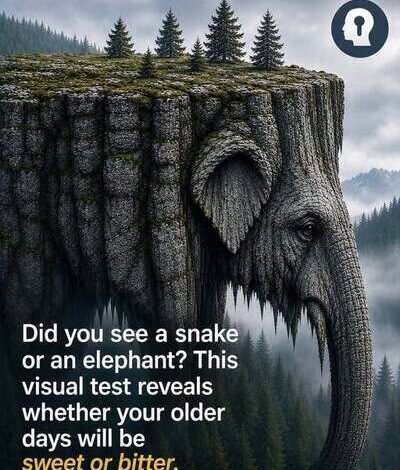
A still image shouldn’t feel this unsettling. Yet a single drawing of a snake and an elephant can spark arguments, personality diagnoses, and viral claims about who you “really” are. Friends insist that the first animal you notice reveals something hidden deep inside your personality. Social media posts promise shocking truths, suggesting that one quick glance can supposedly tell you whether you are intelligent, creative, anxious, emotional, or even secretly afraid of something. The claims can sound convincing, especially when thousands of people repeat them, but the reality behind the image is much more fascinating than the personality test suggests.
A single picture that can be seen as either a snake or an elephant does not secretly decode your soul. Instead, it provides a fascinating glimpse into how your visual system processes information. Ambiguous, or “bistable,” images are deliberately constructed so that the same lines, shadows, shapes, and contours can support more than one reasonable interpretation. Your eyes receive essentially the same visual information, but your brain has to organize that information into something meaningful.
That process happens incredibly quickly. Rather than simply recording every line exactly as it appears, the brain tries to determine what objects are present, where one object ends and another begins, and which parts of the image should be treated as foreground or background. When an image is ambiguous, there may not be one obvious answer. The brain can therefore settle on one interpretation and then, under the right conditions, switch to another.
That is why the image can appear to transform even though absolutely nothing on the page has changed. The lines remain exactly where they were. The colors remain the same. The drawing itself is completely motionless. Yet suddenly the animal you thought you were seeing can disappear and another shape can emerge.
For a moment, it may feel as though the picture has changed.
It hasn’t.
Your perception has changed.
That distinction is what makes these images so scientifically interesting. They demonstrate that seeing is not simply a passive process in which the eyes collect information and the brain displays it like a photograph. Instead, perception involves active interpretation. The brain is constantly organizing incomplete or competing information and attempting to construct the most useful understanding of what is in front of us.
Attention plays an important role in that process. Where you look first can influence what you notice. A particular contour may suddenly become important, while another part of the image fades into the background. Once your brain recognizes one possible object, that interpretation can also influence how the remaining shapes are understood.
Prior knowledge can matter as well. Your brain has spent your entire life learning what animals, objects, faces, and familiar patterns look like. When confronted with an ambiguous image, it draws on that enormous library of visual experience to make sense of the available information.
Context can influence perception too. If someone tells you to look for a snake, you may become more likely to notice shapes that support the snake interpretation. If someone tells you to search for an elephant, your attention may begin organizing the same lines differently.
This is where the viral personality claims become much less convincing.
Online quizzes often take a genuine scientific phenomenon—ambiguous perception—and attach dramatic conclusions to it. They may claim that people who see one animal first are more creative, while people who see the other are more analytical. Another version might suggest that one interpretation indicates confidence, fear, intelligence, emotional sensitivity, or a particular personality type.
Those claims can be entertaining, but entertainment is not the same thing as psychological diagnosis.
To establish that seeing a particular animal first reliably predicts a personality trait, researchers would need much more than a compelling image and a collection of viral reactions. They would need properly designed studies, appropriate samples, controlled conditions, reliable measurements, and evidence that the result can be reproduced by other researchers.
They would also need to demonstrate validity—meaning that the supposed test actually measures what it claims to measure. Without that evidence, a connection between “I saw the snake first” and “this is what your personality is like” remains an interesting story rather than an established scientific conclusion.
The temptation to believe these tests is understandable. People naturally enjoy discovering something about themselves, especially when the result feels surprisingly accurate. A vague personality description can sometimes seem deeply personal because people are good at recognizing themselves in broad statements.
But the image itself does not contain a hidden psychological code.
What it does contain is a remarkable demonstration of perception.
The most interesting question is therefore not necessarily why one person saw the snake and another saw the elephant. It is how two people can look at exactly the same collection of lines and experience different visual realities.
Even more fascinating is the fact that the same person can sometimes experience both interpretations. Look at the picture one way, and the snake seems obvious. Keep looking, and suddenly the elephant emerges. Once you notice the second interpretation, it can become difficult to understand how you ever failed to see it.
That experience reveals something important about the relationship between the physical world and our subjective experience. The external image remains stable while the internal experience changes dramatically.
Nothing moved.
Nothing was added.
Nothing disappeared.
Yet what you saw was different.
That is why ambiguous images have fascinated scientists, artists, psychologists, and the public for generations. They provide a simple visual demonstration of a complicated truth: perception is constructed by the brain from information received through the senses.
So if you saw the snake first, you saw the snake first. If you saw the elephant, you saw the elephant. Neither answer secretly determines your personality, intelligence, or emotional character.
The real wonder is much more modest—and much more extraordinary.
A few lines on a page can cause the brain to build one interpretation, then another, without the outside world changing at all. Your experience can shift dramatically while the physical image remains completely identical.
That may not tell you who you “really” are.
But it does reveal something genuinely fascinating about how you see the world.