SOTD – Did You Know That If a Hummingbird Comes to Your Home, It Means Something Special?
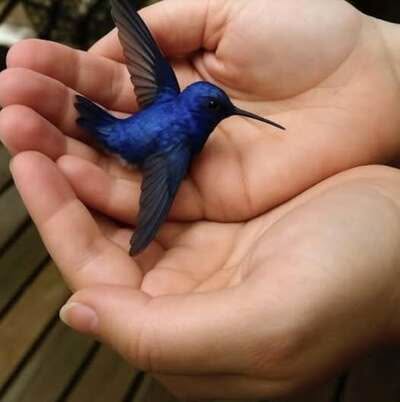
The moment it appears, the world seems to stop breathing. A sudden flash of color moves through the air, a tiny body hovers almost impossibly still, and for a few seconds, everything ordinary seems to disappear. The noise of the day fades into the background, conversations pause, and attention is drawn toward a creature so small that it can somehow make an entire moment feel enormous. People often say that hummingbird visits never feel completely random. They can feel like messages, signs, or quiet reminders that something in life is shifting, even when there is no simple explanation for why the bird appeared at that particular moment.
When a hummingbird arrives at your home, it can break through the numbness of routine and demand your full attention. This impossibly small creature, moving with extraordinary speed and hovering with delicate precision, can seem almost like a living ember suspended in the air. Its sudden appearance creates a moment that feels completely different from everything that came before it.
For some people, that moment becomes a symbol of renewal. After a long period of difficulty, disappointment, or uncertainty, seeing something so vibrant can feel like a reminder that beauty can return even after life has felt gray for a long time. The hummingbird does not solve anything, but its presence can create a brief sense of possibility—a feeling that difficult seasons do not necessarily last forever.
Its appearance can be especially meaningful for someone who has been carrying emotional weight for a long time. A person may be struggling with sadness, exhaustion, or uncertainty when suddenly a bright hummingbird appears near a window, garden, or porch. For those few seconds, the mind may stop focusing on everything that hurts and simply watch.
That interruption can matter more than people realize.
For others, particularly people experiencing grief, a hummingbird’s visit may carry a deeply personal meaning. Across different cultures and traditions, birds have sometimes been associated with loved ones, spirits, messages, or transitions between life and death. There is no scientific evidence that a hummingbird is literally carrying a message from someone who has passed away, but that does not make the emotional experience meaningless.
Grief often makes people especially sensitive to reminders of the person they have lost. A familiar song, a scent, a photograph, or an unexpected animal can suddenly bring memories rushing back. When a hummingbird appears at exactly the moment someone is thinking about a loved one, the experience can feel profound.
For some, its nearness can feel like a thin doorway between worlds—as though love itself has briefly taken wing and returned for a moment of reassurance. It may become a private symbol shared between family members, something they remember whenever a hummingbird appears again.
Whether someone interprets the experience spiritually, emotionally, or simply as a beautiful encounter with nature, the effect can still be powerful.
The hummingbird itself does not need to know what meaning humans attach to its presence. It continues doing what hummingbirds do: searching for nectar, moving between flowers, defending territory, and navigating the world with astonishing speed and precision. Yet watching it can awaken something inside the person observing it.
That may be where its real power lies.
A hummingbird forces you into the present. It is almost impossible to watch one closely while simultaneously thinking about a dozen other problems. Its movement is so quick and delicate that you naturally become focused on the moment.
For a few seconds, there is no email, no argument, no deadline, no unanswered question.
There is simply a tiny bird hovering in front of you.
That kind of attention can be surprisingly restorative. Modern life encourages people to move constantly from one task to another, often without pausing long enough to notice what is happening around them. A hummingbird can interrupt that pattern without saying a word.
Its presence asks you to stop.
To look.
To notice.
And perhaps to feel something again.
The colors can be part of that experience. Depending on the species and the light, a hummingbird’s feathers can appear to shift dramatically, flashing green, red, blue, purple, or other brilliant shades as it moves. What looks like a dull bird from one angle can suddenly become intensely bright when sunlight catches its feathers.
That transformation can feel almost symbolic in itself.
Something ordinary becomes extraordinary simply because the light changes and you are paying attention.
Perhaps that is why hummingbirds have become such powerful symbols of hope and resilience. Their bodies are tiny, yet their movements are energetic and determined. They travel extraordinary distances, survive difficult conditions, and return to places where they can find food and shelter.
For someone going through a difficult season, seeing such a creature can become a small reminder that survival and beauty can exist at the same time.
The visit does not have to predict anything.
It does not have to be supernatural.
It does not need to contain a secret message.
Sometimes its meaning comes from what the moment allows you to feel.
A person who has been grieving may feel connected to someone they miss. Someone beginning a new chapter may see the bird as a symbol of renewal. Someone simply having a difficult day may experience a few seconds of unexpected beauty.
All of those interpretations can coexist with the simple biological reality that the hummingbird was searching for food or passing through its territory.
Nature does not have to be supernatural to be meaningful.
Sometimes beauty becomes powerful precisely because it arrives without explanation.
The hummingbird appears, hovers for a few seconds, and then disappears almost as quickly as it came. You may never know why it chose that particular flower, window, or garden. You may never see the same bird again.
But the moment remains.
And sometimes a moment does not need to last long to matter.
A hummingbird’s visit may therefore be less of an answer than an invitation. An invitation to notice again after becoming numb. To care again after becoming tired. To look up after spending too much time staring down at problems.
It can be an invitation to believe—carefully, cautiously, and without needing proof—that life is still capable of surprising you with beauty.
Maybe the hummingbird is simply a bird.
Maybe it becomes something more because of what you were feeling when it arrived.
Either way, the experience can leave something behind: a pause, a memory, a sense of wonder, or a quiet reminder that even the smallest things can interrupt the heaviest days.
And sometimes, that is enough.
A tiny flash of color appears outside your window, the world seems to pause, and for one brief moment, you remember that there is still beauty moving through the world—even when you had almost forgotten to look for it.