I Brought My Newborn to Meet the Grandpa Who Raised Me — The Moment He Saw Her Face, His Eyes Filled With Tears
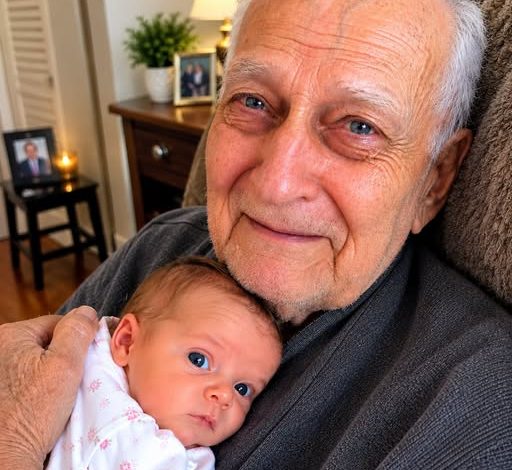
The hospital grew smaller in my rearview mirror as I drove away with my newborn daughter beside me. Nora had spent thirteen exhausting days in the neonatal intensive care unit, and bringing her home felt like crossing the finish line of a race I had barely survived. Every sound she made from the back seat caused me to glance into the mirror, checking that her tiny chest was still rising and falling beneath the pale blanket. I had spent nearly two weeks surrounded by monitors, nurses, doctors, and alarms, learning how quickly joy could turn into fear
. Now the road ahead was quiet, the afternoon sun was low, and for the first time since her birth, there was no medical professional standing a few feet away. I kept telling myself that the hardest part was finally over. Nora was beautiful in ways that made my heart ache. She had a soft head of dark curls that refused to lie flat, a tiny cleft in her chin, and two eyes that never failed to make people look twice. Her left eye was a clear blue, almost silver in bright light, while the other was so dark that it appeared nearly black.
The nurses had gently explained that unusual eye coloring could sometimes run in families. One of them had asked whether anyone else in our family had similar eyes. I had hesitated longer than I should have before finally answering that her father did. Saying even that much felt like reopening a door I had spent months trying to keep closed. Her father’s name was Caleb. For months, I had avoided saying his name whenever possible.
I could think it, dream it, and sometimes hear it in my head when Nora kicked before she was born, but speaking it aloud made everything too real. Caleb had disappeared on the same night I told him I was pregnant. There had been no dramatic argument, no slammed door, and no warning that he was about to leave my life. That was what had made his disappearance so difficult to understand. If he had shouted that he was not ready to become a father, perhaps I could have hated him and eventually moved forward. Instead, he had held my hand and told me we would figure everything out together.
I still remembered the exact expression on his face when I showed him the pregnancy test. He had stared at the two lines for several seconds before lifting his eyes toward me. I had been shaking so badly that I almost dropped the test on the bathroom floor. When he asked whether I was all right, I told him I did not know. Caleb sat beside me, took my hand between both of his, and said we would figure it out. I asked whether he was scared. He admitted that he was terrified, and somehow that honesty had made me laugh through my tears.
Before leaving that evening, Caleb kissed my forehead and said he would call the next morning. I went to bed believing that whatever happened next, we would face it together. Morning came without a call. By noon, my messages had not been opened. By evening, his phone was going directly to voicemail. I spent that first night convincing myself that something ordinary had happened, perhaps a dead phone, an emergency at work, or some other explanation that would seem obvious once I finally heard from him. By the following morning, fear had replaced irritation.
I drove to his apartment and knocked until my knuckles hurt. When no one answered, the building manager eventually let me know that Caleb had been seen leaving with several bags. Through the window, I could see enough of the bedroom to notice that part of his closet had been emptied. The realization hit harder than I expected. Caleb had not simply forgotten to call me. He had packed. He had made a decision. Whatever his reason was, leaving had not been an accident.
For weeks, I continued waiting for an explanation. Every unknown number made my heart race. Every car that slowed near the house caused me to look through the curtains. I imagined dozens of possibilities, some reasonable and others ridiculous. Perhaps he was ashamed. Perhaps his father had become involved. Perhaps he had decided that becoming a parent would destroy the life he wanted. The absence of an answer allowed every possibility to feel believable. Eventually, waiting became its own kind of exhaustion.
By the fifth month of my pregnancy, I stopped expecting Caleb to appear. My grandfather, Walter, was the person who helped me accept that life would continue whether Caleb returned or not. Grandpa had raised me since I was ten years old, after my parents died in a car accident. He had been my emergency contact, my protector, my mechanic, my financial adviser, and sometimes the only person willing to tell me when I was making a terrible decision. When he learned I was pregnant, he did not ask what I had done wrong. He simply asked what I needed.
He drove me to medical appointments whenever I was too tired or anxious to go alone. When the ultrasound technician announced that I was expecting a girl, Grandpa cried openly and then pretended something had gotten into his eye. He spent several weekends building a crib in his garage, sanding each piece until the wood was smooth enough that he could run his palm across it without finding a single rough edge. One afternoon, while applying the final coat of finish, he looked at me and said we would be fine. He told me that Nora would grow up knowing she was wanted, regardless of who had chosen not to stay.
My childhood had already taught me how quickly a family could change. My parents had died when I was ten, and after their deaths, most of my memories of the years before the accident became strangely fragmented. I remembered my mother’s perfume, the way she hummed while cooking, and the sound of my father’s keys when he came home. Other memories existed only as flashes without context. A large house. A garden. A red bicycle. A boy running beside me. A man shouting from a doorway.
I rarely asked Grandpa about those fragments because he always seemed uncomfortable whenever the conversation moved too close to my mother’s past. He would say that she had worked hard, loved me deeply, and deserved to be remembered for the good years rather than the difficult ones. I accepted that explanation because children often accept the stories adults give them. After my parents died, I depended on Grandpa completely. Questioning him felt almost like questioning the foundation beneath my feet.
The few belongings I had kept from my mother were stored inside an old cedar box at the back of my closet. There were photographs, folded scarves, cards, and several bundles of letters tied with faded ribbon. I had moved that box from apartment to apartment without fully opening it. Part of me feared that reading everything would make my parents’ absence feel new again. Another part believed that whatever mattered most about them was already inside me.
When Nora was finally discharged from the hospital, Grandpa had been waiting for us for nearly two weeks. He called every morning and every evening, pretending he was simply checking whether I needed anything while clearly counting the hours until he could hold his great-granddaughter. I turned onto his gravel driveway shortly after four in the afternoon and saw him sitting on the porch in his usual rocking chair. The moment he recognized my car, he stood so quickly that the coffee mug beside him fell and shattered on the wooden boards.
He came down the steps faster than I had seen him move in years. His face was glowing, and for a few seconds, everything felt exactly as I had imagined it would. I removed Nora carefully from the car seat and carried her toward him. Grandpa opened his arms before I even reached the porch. I joked that Nora was finally meeting the man responsible for spoiling her, and he laughed while taking her gently from me. His hands looked enormous around her tiny body.
At first, his reaction was pure joy. He stared at Nora as though he had been given something miraculous. Then he shifted her slightly toward the afternoon light. His gaze settled on her face. I watched his eyes move from the cleft in her chin to one eye and then the other. The smile disappeared. Within seconds, the color drained from his face.
I asked whether something was wrong.
Grandpa did not answer immediately. His hands began trembling slightly while he continued staring at Nora. When he finally looked at me, the expression in his eyes frightened me more than anything he could have said.
“Emily,” he asked quietly, “who is her father?”
I laughed nervously because the question made no sense. Grandpa already knew Caleb’s name. I had told him about the relationship long before I became pregnant, and he knew exactly who had disappeared. I reminded him that Nora’s father was Caleb.
The moment I said the name, Grandpa’s expression changed again.
He slowly lowered himself into the wicker chair while still holding Nora. I could see that he was trying to control his breathing. When he asked Caleb’s father’s name, my confusion turned into fear. I told him it was William.
Grandpa closed his eyes.
I asked him to explain.
For several seconds, he said nothing. Then he looked down at Nora and admitted that he had promised my mother something many years earlier. He said Sarah had made him swear that I would grow up without William’s family in my life.
I felt as though the porch had shifted beneath me.
My first terrible thought was that Caleb and I might somehow be related. I could barely force the question out. Grandpa immediately shook his head and told me no. There was no blood relationship between us. The relief was so immediate that I had to grip the railing.
But if we were not related, I wanted to know why my mother had been so determined to keep William’s family away from me.
Grandpa stared toward the yard before answering.
My mother, he explained, had once worked as a nanny for William’s family.
The name seemed to unlock something inside my memory.
I pictured a large house with tall windows. I remembered a garden behind it and a red bicycle leaning against a stone wall. I remembered a dark-haired boy chasing me along a path while I laughed.
Grandpa told me the boy had been Caleb.
I stared at him, unable to understand how a man I had met as an adult could have existed inside memories I had carried since childhood.
According to Grandpa, my mother had worked for Caleb’s family when Caleb was around seven years old and I was several years younger. She sometimes brought me with her, and Caleb and I played together often. After Caleb’s mother died, the atmosphere inside the home changed. William began treating my mother in ways that made her uncomfortable. She eventually refused his attention, and the relationship between them deteriorated badly.
Grandpa said William fired my mother after she rejected him. Worse, he allegedly used his influence within their social circle to make it difficult for her to find similar work nearby. Grandpa had confronted him about it. The confrontation became heated, and Caleb had been inside the house while the adults argued.
As Grandpa spoke, memories began returning in fragments.
A man yelling near a doorway.
My mother’s fingers wrapped tightly around mine.
The sound of someone crying behind us.
A small boy standing near a staircase.
I whispered Caleb’s name before Grandpa said it.
He nodded.
My mother had packed our belongings soon after the conflict and left. Grandpa said she wanted a complete break from William’s family. After my parents later died, he continued honoring that request. He never mentioned the family and assumed the past had been buried.
Then Caleb had somehow returned to my life.
I thought about the bookstore event where we supposedly met for the first time. I remembered the way he had turned toward me after hearing my name. At the time, I had thought his expression showed ordinary curiosity. Now it seemed possible that he had recognized me immediately.
I thought about strange questions he had asked during our relationship. Once, while we were lying on his couch, he casually asked whether I had owned a red bicycle as a child. I said yes and laughed about how much I loved it. Caleb had smiled quietly and changed the subject.
At the time, I thought nothing of it.
Now the memory felt completely different.
Grandpa insisted that Caleb’s disappearance proved his concerns about the family had been justified. He argued that William had hurt my mother and that Caleb had now abandoned me after learning I was pregnant. I understood why Grandpa saw a pattern, but something about the explanation felt incomplete.
Caleb had been with me for nearly two years.
If his only intention had been cruelty, why had he stayed so long?
Why had he asked questions about my childhood?
Why had he looked relieved when I mentioned the bicycle?
And if he had recognized me from the beginning, why had he never told me?
That night, after Nora finally fell asleep, I pulled my mother’s cedar box from the closet.
For the first time, I opened everything.
Beneath the scarves and photographs, I found an old picture of myself sitting on a red bicycle. Standing beside me was a dark-haired boy. Even though he was only a child, I immediately recognized the unusual eyes.
One was noticeably lighter than the other.
It was Caleb.
My hands began trembling.
Under the photograph was a stack of letters.
The earliest had been written in the uneven handwriting of a child. Caleb had asked my mother where “the little girl” had gone and whether I still had my bicycle. Another letter, written years later, contained a small amount of money he said he had saved from his allowance. He asked my mother to use it for me and wanted to know whether I was safe.
There were more.
As Caleb grew older, his handwriting changed, but the letters continued. One mentioned money his grandfather intended to leave him when he became an adult. Caleb wrote that his father controlled everything and that he hoped someday he would be able to help my mother without William interfering.
Then I found a note written in my mother’s handwriting on the back of one letter.
It said simply that Caleb was not like his father.
I sat on the floor beside Nora’s crib and read that sentence again and again.
My mother had known Caleb.
She had apparently trusted him enough to preserve his letters.
And Caleb had remembered me long after we disappeared from each other’s childhoods.
That knowledge did not excuse what he had done as an adult. If anything, it created a new betrayal. Caleb had found me again and had chosen not to tell me that our lives had crossed before. He had listened as I talked about my mother’s difficult years without admitting that his own family had been connected to them.
I needed answers from him, not from Grandpa.
The next morning, I strapped Nora into her car seat and drove to the return address printed on one of the oldest envelopes. I did not know whether William still lived there. Part of me hoped the house would be gone, giving me an excuse to turn around.
It was still standing.
The building looked smaller than it did in my memories, but the garden was unmistakable.
An older man answered the door.
The moment I saw his eyes, I knew it was William.
He studied my face and said I looked exactly like my mother.
Hearing him say that made every instinct in me tighten.
I told him I needed to speak with Caleb.
William answered that Caleb was not available.
When he invited me inside to discuss the situation, I refused. I had no intention of entering the house with Nora. I wanted one answer: why had Caleb disappeared?
William looked at Nora.
For a fraction of a second, recognition appeared on his face.
He saw the eyes.
Then his expression became controlled again.
He told me that Caleb knew I was pregnant and had chosen to leave. According to William, there was nothing more to understand.
I did not believe him.
Perhaps it was because I had just read Caleb’s childhood letters. Perhaps it was because my mother had written that he was different from William. Or perhaps it was simply because William seemed too eager to make the conversation end.
He told me to leave.
As I walked toward the car, another memory surfaced.
My mother and I had once stood on those same steps while William shouted behind us.
I remembered my mother’s grip tightening around my hand.
Then I remembered someone else.
A little boy running barefoot after us.
Caleb.
He had been crying.
Another memory followed immediately: Caleb holding the back of my bicycle while I tried to ride without training wheels. I remembered shouting at him not to let go.
He had promised that he would not.
Standing in the garden decades later, I suddenly knew I could not leave without hearing the truth directly from him.
I turned back toward the house.
I told William that I was not leaving until Caleb stood in front of me and personally said he wanted nothing to do with his daughter.
William accused me of being unreasonable.
I told him I was simply being clear.
Then a voice came from inside the house.
“Dad, move.”
William froze.
Footsteps moved down the hallway.
The door opened wider.
Caleb stepped onto the porch.
For months, I had imagined this moment. Sometimes I imagined screaming at him. Sometimes I imagined slapping him. In weaker moments, I imagined running into his arms and pretending the months without him had never happened.
Instead, I simply stared.
He looked exhausted.
His hair was longer, his face thinner, and there were dark circles beneath his mismatched eyes.
I asked how long he had known who I was.
He answered immediately.
Since the bookstore.
The confession hurt almost as much as his disappearance.
He had recognized my name and then recognized my face. He had approached me knowing that we had shared part of our childhood. Every question about my past had been deliberate.
I asked why he had not told me.
Caleb said he was afraid that if I learned who his father was, I would see William whenever I looked at him.
I told him that fear did not give him the right to lie.
He agreed.
Then I asked the question that mattered most.
Why had he disappeared after I told him I was pregnant?
Caleb looked toward his father before answering.
He said that the night I told him about the pregnancy, he drove directly to William’s house. Knowing he was about to become a father forced him to confront questions he had avoided for years. He demanded to know exactly what William had done to my mother.
According to Caleb, the argument lasted for hours.
William eventually admitted that he had used his position and influence against my mother after she rejected him.
Then William made Caleb an offer.
A family trust created by Caleb’s grandfather had supposedly remained under William’s control for years. Caleb said William offered to release the money only if Caleb stayed away from me until after the baby was born.
I stared at him.
The explanation sounded almost impossible.
I asked why any amount of money would persuade him to abandon me during pregnancy.
Caleb said he had convinced himself that he was making a sacrifice for our future. He believed that if he obtained financial independence from his father, William would never be able to control him again. His plan was to wait until the transfer was complete, then return, explain everything, and use the money to build a stable life for us and the baby.
I told him that he had made one enormous mistake.
He had never asked whether I wanted that plan.
He had decided everything for me.
Caleb did not argue.
I asked why he had still not returned even though Nora had already been born.
He said the transfer had only recently been completed and claimed he did not know Nora had arrived early or that she had spent nearly two weeks in intensive care.
That answer hurt almost more than anything else.
While I sat beside our daughter in the NICU, terrified she might stop breathing, Caleb had been waiting for money.
He told me he thought losing a few months together would be worth gaining freedom from his father permanently.
I asked whether he understood how cruel that sounded from my side.
He lowered his head.
That was the moment I finally understood the real pattern connecting all the men in the story.
William had decided what my mother deserved to know and what opportunities she was allowed to have.
Grandpa had decided which parts of my childhood I should remember.
Caleb had decided what sacrifices I should make without ever asking me.
Their motives were not identical, and neither were their actions.
But each man had made a decision about my life while convincing himself that he knew what was best.
I told Caleb that I would not resume our relationship.
His face crumpled, but I continued.
I said he could still be Nora’s father if he was willing to prove through consistent actions that he intended to remain in her life. I would never keep our daughter from a loving and responsible parent simply because our romantic relationship had failed. But he would have to earn trust again.
Caleb looked at Nora.
She opened her eyes just long enough for the sunlight to catch them.
One blue.
One dark.
His eyes filled with tears.
He whispered that she had his eyes.
I said yes.
Then he asked whether he could know her.
For a moment, I thought about the woman I had been before he disappeared. That woman would have wanted promises. She would have needed him to swear that he loved her and would never leave again.
But I was someone’s mother now.
Promises mattered less than behavior.
I told Caleb that he could know his daughter.
But I also told him that I was not taking him back.
He promised he would never disappear again.
I stopped him.
“Don’t promise me,” I said. “Show me.”
Over the following months, that became the rule.
Caleb moved out of William’s house.
Whatever happened between him and his father after that was his responsibility. I refused to become part of another private war within their family.
When Caleb wanted time with Nora, we created schedules.
If he was running late, he called.
If she had an appointment, I told him.
If either of us disagreed about something involving her, we discussed it instead of making decisions alone.
It was not romantic.
It was not dramatic.
It was simply parenting.
Three months later, I stood in my driveway watching Caleb struggle with Nora’s car seat while she kicked happily inside it.
He eventually secured the buckle correctly and asked what time she needed to be home.
I told him six.
He repeated the time to make sure he understood.
I reminded him that if anything changed, he needed to call rather than decide for both of us.
He nodded.
This time, I believed him not because of the words but because he had spent three months doing exactly what he said he would do.
Grandpa struggled with the situation at first.
He had spent years believing that keeping William’s family away from me was an act of protection. Seeing Caleb become part of Nora’s life forced him to reconsider decisions he had made after my parents died.
One evening, I finally showed him the letters from my mother’s cedar box.
He read every one.
When he reached the note where my mother had written that Caleb was not like his father, Grandpa removed his glasses and wiped his eyes.
He admitted that he had never given Caleb the opportunity to prove it.
I told him that Caleb still had plenty to answer for.
Being different from William did not automatically make every decision Caleb had made acceptable.
Grandpa agreed.
That distinction mattered to me.
People do not have to be entirely good or entirely bad.
A person can love someone and still hurt them.
A parent can try to protect a child and still make the wrong choice.
A man can spend years fearing that he will become his father and still repeat some of the same controlling habits without realizing it.
The only thing that mattered now was whether those patterns continued.
I read the rest of my mother’s letters slowly over the following weeks.
For the first time, I learned details about her life that had been hidden from me since childhood. Some memories returned. Others never did.
I learned that she had been frightened after losing her job but determined to build another life.
I learned that she never blamed Caleb for his father’s behavior.
And I learned that she had kept his letters because they reminded her that kindness could survive even inside a difficult family.
None of those discoveries changed the past.
They did, however, change how I understood it.
My mother had not been weak.
Grandpa had not been completely right.
Caleb had not been completely innocent.
And William’s behavior did not have to determine what happened next.
The most important difference was that I finally had the information necessary to make my own decisions.
One evening, Caleb returned Nora exactly at six.
He carried her up the driveway with the diaper bag hanging awkwardly from one shoulder. Nora was asleep against his chest, one tiny hand gripping the collar of his shirt.
He did not ask to come inside.
He did not turn the moment into an attempt to restart our relationship.
He simply told me when she had eaten, how long she had slept, and that there were two clean bottles left in the bag.
Then he kissed Nora’s forehead and handed her to me.
After he drove away, I carried her into the house and settled into the rocking chair beside her crib.
The room was quiet.
For years, other people had decided what parts of my own history I was ready to hear.
My mother had made a decision out of fear.
Grandpa had continued it out of love.
Caleb had hidden the truth because he was afraid of being judged by his father’s actions.
Each secret had been created for a different reason.
But secrets still had consequences.
I looked down at Nora’s mismatched eyes and understood what I wanted to give her.
Not a perfect family.
Not a life without mistakes.
No parent could promise either of those things.
I wanted to give her honesty.
When she was old enough to ask questions, I would answer them in ways appropriate for her age.
I would tell her that her father had made mistakes.
I would also tell her that people sometimes deserved the opportunity to demonstrate that they could do better.
I would tell her about my mother, the red bicycle, the big house, and the little boy who once ran barefoot after us.
Most importantly, I would never allow someone else’s fear to become the reason she was denied the truth about her own life.
For the first time, the past no longer felt like a locked room.
I knew what had happened.
I knew what Caleb had hidden.
I knew what Grandpa had hidden.
And I knew that knowing the truth did not require me to forgive everything immediately or restore every relationship to what it had once been.
It simply gave me the freedom to choose.
I could choose how much trust Caleb earned.
I could choose the boundaries William would never be allowed to cross.
I could forgive Grandpa without pretending his secrecy had been harmless.
And I could raise Nora differently.
As I rocked my daughter to sleep that night, she opened her eyes for just a moment.
One caught the light.
The other remained dark.
For years, those eyes had carried history I did not understand.
Now they represented something else.
They reminded me that my daughter had inherited pieces of many people, but she did not have to inherit their mistakes.
Neither did I.
For the first time in my life, nobody else was deciding which parts of the story I was allowed to know.
I finally had the whole story.
And this time, what happened next would be my decision.