Inside Sandra Bullock’s Secluded Hilltop Farm, Where a Chicken Coop Was Part of Her Life for 15 Years
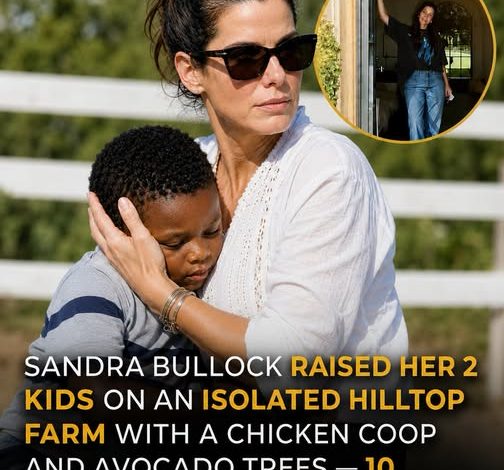
Sandra Bullock has spent decades building a successful career in Hollywood, but acting has never been the only area in which she has shown a strong interest. Over the years, the Academy Award-winning actress has assembled an extensive real estate portfolio that has included properties in California, Texas, New York, Louisiana, Wyoming, and Georgia. Some homes became private retreats, while others were eventually rented or sold. Her property history offers an interesting look at a side of Bullock’s life that exists beyond movie sets and award ceremonies.
It also shows how her priorities have changed through different stages of her personal life and career. In recent years, several of those changes coincided with an especially difficult period for Bullock and her family. One of the most notable properties associated with Bullock was her sprawling farm in Valley Center, California, roughly 40 miles northeast of San Diego. The estate covered approximately 91 acres and combined privacy, agricultural land, landscaped gardens, and multiple residential structures.
Bullock placed the property on the market in September 2022 with an asking price of $6 million. The property attracted attention not simply because a major movie star owned it, but because it was significantly different from the typical luxury homes associated with Hollywood celebrities. Instead of being located in Beverly Hills or overlooking the Sunset Strip, the estate occupied rolling countryside filled with avocado trees and mountain views. The centerpiece was a single-story adobe-style ranch measuring just under 6,000 square feet.
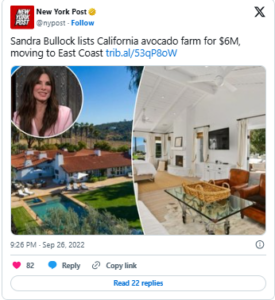
Listing information described four bedroom suites, each with its own private outdoor access, along with six bathrooms. The interior combined rustic architectural elements with comfortable modern features. Wide-plank wood flooring, beamed ceilings, French doors, and expansive views helped create an indoor-outdoor atmosphere suited to the rural setting. The home also contained multiple fireplaces and a Crestron smart-home system. According to the listing agents, Bullock had significantly transformed the property during her ownership rather than simply preserving it exactly as she found it.
The kitchen was another prominent part of the home. Reports described a large eat-in space with a farmhouse-style table and premium appliances. The dining area included large windows overlooking the grounds, while French doors throughout the residence connected interior rooms to verandas, gardens, and courtyards. At the center of the home was a landscaped courtyard with a fountain. Those features gave the estate an atmosphere closer to a countryside retreat than a conventional celebrity mansion. Listing agent Alan Long described the property as a place characterized by calmness, serenity, and dramatic mountain scenery.
Outside the main residence, Bullock’s improvements became even more apparent. The property included a saltwater swimming pool and spa surrounded by extensive landscaping. Ancient olive trees had been brought onto the grounds, while walking paths allowed residents and guests to move through the acreage without leaving the estate. There were also rose gardens, eucalyptus, palm, and citrus trees. The overall design emphasized privacy and nature rather than highly visible luxury. According to Long, Bullock’s goal was not simply to increase the property’s resale value but to create a secluded place where family and friends could gather away from city life.
Agriculture was an important part of the property as well. Listing information identified roughly 1,200 organic avocado trees, along with citrus trees and other plantings. The avocado and citrus groves were already present when Bullock acquired the estate, but reports indicated that she converted them to organic production and expanded the landscaping surrounding them. A walk-in chicken coop added another rural feature that distinguished the estate from a more traditional luxury compound. The land also contained areas that could potentially support additional development, vineyards, greenhouses, or equestrian facilities.
The estate consisted of more than the main residence. Listing information included a separate three-bedroom, two-bathroom manufactured home on the property, as well as additional outbuildings and undeveloped areas. There was also space that could potentially be used for new residences or recreational facilities. Solar equipment, an electric-vehicle charging station, a backup generator, and RV hookups added practical features to the large rural compound. Together, these elements made the property unusually versatile. It could function as a private residence, working agricultural property, family compound, or countryside retreat.
Bullock had owned the Valley Center estate for many years before deciding to sell. Property records cited by Mansion Global show that she bought it in 2007 for approximately $2.725 million through a trust. By the time she placed it on the market in September 2022, the property had been substantially renovated and expanded. The $6 million asking price therefore reflected both the size of the land and years of improvements. The listing went under contract relatively quickly, reportedly within about three weeks.
The final sale closed in early November 2022 for $5.6 million. A deed recorded on November 9 showed that the buyer used a limited liability company to complete the transaction. Although the final price was $400,000 below the original asking price, it remained significantly above what Bullock had paid for the property years earlier. The sale marked another significant change in a real estate portfolio that had already begun shifting during the preceding years.
Bullock’s California holdings were never limited to the farm. She has owned several properties across Southern California, including residences in Beverly Hills, Malibu, Hollywood Hills, and units in the well-known Sierra Towers building near the Sunset Strip. Her homes ranged from large private estates to oceanfront properties and urban condominiums. Reports have described her portfolio as one of the more geographically diverse among major Hollywood actors. Rather than concentrating all of her properties in one neighborhood, she acquired homes in locations that served very different purposes.
Her Sierra Towers transactions attracted particular attention in early 2022. Bullock sold two units in the celebrity-associated high-rise within a short period. One condo sold for $4.4 million after she had purchased it for $3.55 million in 2014. The roughly 1,759-square-foot residence had been remodeled and featured midcentury-inspired interiors, wood finishes, two bedrooms, two-and-a-half bathrooms, and floor-to-ceiling windows overlooking Los Angeles. Another unit in the same building was also sold that year.
Her Malibu holdings demonstrated another part of her real-estate strategy. Bullock was linked to two neighboring properties in a gated oceanfront community. One home included four bedrooms and four bathrooms, private beach access, expansive terraces, and unobstructed views of the Pacific. She later purchased a smaller cottage in the same community. Reports indicated that the smaller property was offered as a rental after she bought it.
The rental price associated with one of Bullock’s Malibu properties also generated headlines. The Los Angeles Times reported in 2022 that she had offered a Malibu beach house for rent at approximately $30,000 per month. That amount reflected the premium attached to private coastal real estate in Malibu, particularly homes with direct views and beach access. It was also another example of Bullock treating some properties as investments rather than using every residence exclusively as a personal home.
Her involvement in real estate stretched well beyond California. Architectural Digest has previously documented homes linked to Bullock in Austin, New York City, New Orleans, Wyoming, and Georgia. Some were long-term residences, while others functioned more as retreats or investments. Bullock has also purchased and sold commercial or investment properties over the years. That variety makes her portfolio difficult to describe simply as a collection of celebrity mansions. It has included city apartments, historic homes, beach properties, ranches, and rural acreage.
Texas played an especially important role earlier in her career. Bullock developed strong ties to Austin and owned multiple properties in the area over the years. She also established business interests there, including an office connected to her production company. One Austin residence was listed for $2.5 million in 2012 and later sold for about $2 million in 2013. The house included more than 5,000 square feet of interior space, a pool, hot tub, wine cellar, and views toward downtown Austin.
Bullock has also had a long connection to New Orleans. Her property holdings there have included a historic Victorian residence dating to the 19th century. The city’s distinctive architecture makes such properties very different from her modern Southern California homes. Her broader portfolio demonstrates an interest in architecture and renovation rather than one particular housing style. Over the decades, she has repeatedly purchased residences with strong individual character instead of simply acquiring newly constructed luxury homes.
Georgia was another important location. In 2001, Bullock purchased a waterfront property on Tybee Island for about $1.5 million. The compound eventually included a main residence and a separate guesthouse on nearly three acres near the ocean. At one point, the property was made available as a vacation rental, allowing guests to stay in a home associated with the actress. The compound was later placed on the market and ultimately sold for $4.175 million.
The Tybee Island property had features designed around coastal living rather than Hollywood-style formality. The main house measured roughly 3,360 square feet, while the guesthouse added another approximately 2,848 square feet. The waterfront location and outdoor areas made the compound particularly suited to family vacations. Before it was sold, the property had also been marketed as a location where visitors could enjoy the natural surroundings and potentially watch dolphins offshore.
Bullock’s Hollywood Hills properties have similarly moved in and out of her portfolio. One home near the Sunset Strip sold in 2018 for approximately $2.925 million after she had owned it for many years. The residence featured vaulted ceilings, an eat-in kitchen, a swimming pool, landscaped grounds, and a primary suite with direct outdoor access. Bullock had previously offered that home for lease, further illustrating how she sometimes used properties as rental investments when she was not occupying them.
One of her most prominent long-term Southern California residences has been a large Tudor-style estate in Beverly Hills. Bullock reportedly purchased that property for about $16.2 million in 2011. The estate sits on several acres and includes a residence measuring more than 8,000 square feet. Previous owners were reported to include notable entertainment and business figures, making the property recognizable even before Bullock acquired it.
Her extensive property history makes the 2022 Valley Center sale especially interesting because it occurred around the same period when Bullock was deliberately reducing her Hollywood workload. In March 2022, while promoting The Lost City, she publicly said she planned to take a break from acting. She explained that she wanted to be at home and spend more time with her children and family. At the time, she did not establish a specific deadline for returning to movies. The announcement sounded like a personal decision to prioritize family after many years of continuous work.
Bullock had reached a position where she could make that choice after decades as one of Hollywood’s best-known leading actors. Her film career included major commercial hits and critically recognized performances in movies such as Speed, Miss Congeniality, The Proposal, Gravity, and The Blind Side. Her performance in The Blind Side earned her the Academy Award for Best Actress. By 2022, however, she made clear that career momentum was no longer the only factor determining how she spent her time.
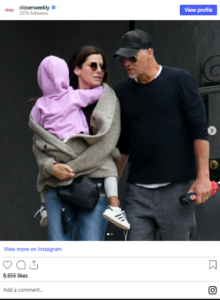
When Bullock described wanting to be with her children “24/7,” the public did not yet know everything happening privately in her household. Her longtime partner, photographer Bryan Randall, had been diagnosed with amyotrophic lateral sclerosis, or ALS. Randall had chosen to keep his condition confidential. As a result, Bullock’s decision to step back from Hollywood occurred while she was helping care for a seriously ill partner without publicly explaining those circumstances.
Randall died in August 2023 at the age of 57. His family revealed after his death that he had lived with ALS privately for three years. They explained that he had chosen early in his illness not to make his diagnosis public and that those closest to him had worked to respect that decision. The announcement gave the public important context that had been missing when Bullock originally discussed stepping away from acting.
Bullock’s sister, Gesine Bullock-Prado, later acknowledged the extraordinary caregiving effort surrounding Randall. In a tribute following his death, she credited her sister and the nursing team that had helped care for him. She also encouraged people who wished to honor Randall to consider supporting the ALS Association and Massachusetts General Hospital. Her words offered one of the first public glimpses into what Bullock had been managing privately.
For several more years, Bullock herself said relatively little about the experience. That changed in August 2026 when she appeared on the SmartLess podcast with Jason Bateman, Will Arnett, and Sean Hayes. During the conversation, she discussed Randall’s ALS diagnosis and the emotional impact of keeping it confidential. She explained that Randall had specifically requested privacy and that honoring that wish meant she could not freely discuss the situation with many people around her.
Bullock said the secrecy became deeply isolating. Randall’s illness unfolded during the COVID-19 pandemic, when many families were already dealing with social restrictions and uncertainty. At the same time, Bullock was raising two children and coordinating care for her partner. She described a period involving nurses, medical decisions, and the emotional strain of watching someone she loved experience a progressive neurological disease.
Her sister was one of the few people who initially knew what was happening. Bullock told the podcast hosts that there were people close to her whom she was not initially able to tell because Randall had asked her not to share his diagnosis. That request significantly limited her support system during a demanding period. Bullock nevertheless said she understood why Randall wanted privacy and continued honoring that choice.
She also spoke about the emotional experience of grieving someone before their death. Bullock said she felt she began grieving Randall approximately four years before he died because illness had changed their lives so profoundly. That statement should not be interpreted as meaning Randall had a confirmed ALS diagnosis for four years. His family publicly described his ALS battle as lasting three years. Bullock was describing her personal emotional experience rather than providing a different medical timeline.
The impact extended to her children as well. Bullock explained that her son Louis and daughter Laila understood that something serious was happening. She said Laila regarded Randall as a father figure, which made his decline especially difficult for the family. Bullock also tried to prevent Louis from feeling that he needed to take on an adult role within the household while he was still young. Her responsibility therefore included caregiving for Randall while also helping two children process circumstances that were painful and difficult to understand.
Seen with that context, Bullock’s decision to withdraw temporarily from filmmaking becomes easier to understand. She was not simply taking an extended vacation after a successful movie. She was prioritizing family during a period involving serious illness, caregiving, parenting, and eventually bereavement. Because Randall wanted his diagnosis kept private, Bullock could not publicly explain the full reason for many of her choices at the time.
This does not mean every real-estate decision Bullock made during that period should automatically be attributed to Randall’s illness. Real-estate transactions often involve financial, family, logistical, and personal factors, and Bullock has not publicly connected every sale to one specific reason. The accurate conclusion is simply that several major changes occurred during overlapping years. Her Valley Center farm was sold in 2022, she stepped away from acting that same year, and she was privately caring for Randall during his ALS illness.
Reports surrounding the Valley Center listing did indicate that Bullock was interested in finding a farm closer to family on the East Coast. That provided a personal explanation for why she might have been willing to leave a property she had spent years transforming. It also fit a broader pattern in Bullock’s life: properties were valuable to her not only as financial assets but as places where family and friends could gather. The California farm had been designed around exactly that idea.
Bullock’s relationship with her sister has remained visible over the years. Gesine Bullock-Prado is an author, pastry chef, television personality, and baking expert based in Vermont. In March 2023, she celebrated the success of her cookbook My Vermont Table, which reached The New York Times bestseller list. Bullock appeared with her sister during the celebration, offering a rare informal glimpse of her family life outside Hollywood.
Family has continued to shape Bullock’s professional choices as she returns more visibly to acting. By 2026, she was working again and preparing for another major film project, Practical Magic 2. Bullock has emphasized that returning to work does not mean abandoning the priorities that led her to step away. Recent reporting indicates that she has continued arranging work around her children’s schedules when possible.
Her return therefore appears more gradual than dramatic. Bullock has not described her previous break as a permanent retirement. Instead, it was a period in which family required more of her attention than acting. The circumstances surrounding Randall’s illness later revealed how significant those responsibilities actually were. By the time she began speaking more openly in 2026, nearly three years had passed since his death.
Bullock also began sharing slightly more of her life publicly. In August 2026, she posted a summer photo collection on Instagram with the caption “Friends, family, fun, fishies, furries, aaaand work.” The images offered followers an uncommon glimpse at her life with family and friends while still protecting significant aspects of her children’s privacy. Reporting on the post noted appearances by Louis and Laila in photographs taken during outdoor activities.
The post also reflected where Bullock appears to be in her life now. Work has returned, but it exists alongside family rather than replacing it. Outdoor activities, time with her children, friendships, and professional projects all appeared together rather than being separated into competing parts of her life. After several years marked by caregiving and grief, that balance represents a significant change from the circumstances surrounding her 2022 break.
Her property history can be understood in much the same way. The homes Bullock acquired were never simply a list of expensive purchases. Some became investments. Others became private retreats. Several were renovated extensively, while others were eventually offered for rent or sold. Her real estate decisions evolved as her personal and professional needs changed.
The Valley Center farm remains perhaps the clearest example. Bullock took a large rural property containing existing avocado and citrus groves and transformed it into a carefully landscaped retreat. She added or upgraded amenities that emphasized outdoor living, privacy, family gatherings, and the natural landscape. When she eventually decided to sell, the property represented approximately fifteen years of ownership and substantial personal investment.
Its $5.6 million sale also demonstrates why Bullock’s real estate activity frequently attracts attention in property publications. She bought the estate for approximately $2.725 million and sold it for more than twice that amount, although purchase and sale prices alone do not account for renovation costs, taxes, maintenance, transaction expenses, or other ownership costs. It would therefore be misleading to describe the difference simply as pure profit. What can accurately be said is that the property’s recorded sale price was substantially higher than its recorded purchase price.
The same caution applies when discussing Bullock’s broader portfolio. Public property records and reputable real-estate reporting reveal many transactions, but celebrities often purchase homes through trusts or limited liability companies. That can make it difficult to determine precisely which properties remain in a person’s portfolio at any particular moment. Reports describing Bullock’s holdings therefore usually refer to properties publicly linked to her over time rather than claiming a definitive current inventory.
What is well documented is the range of those properties. Bullock has owned homes associated with beaches, mountains, historic neighborhoods, major cities, and rural landscapes. She has maintained connections to Los Angeles while also establishing homes far from Hollywood. The diversity of those choices suggests that real estate has played both a practical and personal role throughout her adult life.
Her investments also show that privacy has consistently mattered. The Valley Center farm sat behind a long gated driveway. The Tybee Island compound offered an oceanfront escape. Her Beverly Hills estate occupied several private acres. These properties provided something that can be particularly valuable for a globally recognized actress: places where family life could exist at a distance from constant public attention.
That need for privacy became even more significant during Randall’s illness. His request to keep ALS out of the public eye required an unusually high level of discretion, especially given Bullock’s celebrity. She respected that request for years. The public learned about the diagnosis only after his death, when his family decided to disclose it.
Bullock’s comments in 2026 make clear that maintaining that privacy was emotionally costly. She could not openly explain what she was experiencing, even to some people she normally trusted. She was simultaneously managing medical realities, raising children, and continuing to protect Randall’s wishes. The fact that she had considerable resources did not remove the emotional difficulty of watching someone she loved become seriously ill.
Her experience also illustrates why assumptions about celebrity career breaks can be misleading. When a famous actor disappears from public view, audiences may interpret it as retirement, professional dissatisfaction, or a strategic career choice. In Bullock’s case, there were deeply personal circumstances the public simply did not know. She had good reason not to explain them at the time because doing so would have violated Randall’s clearly expressed wishes.
Three years after his death, Bullock has been able to discuss those years with more distance. Her SmartLess interview did not erase the privacy Randall requested while alive. Instead, it allowed Bullock to talk about her own experience after the diagnosis was already publicly known. Her reflections focused heavily on caregiving, isolation, parenthood, and grief rather than turning Randall’s illness into entertainment.
That distinction is important when considering both her personal story and her public image. Bullock has spent decades being photographed, interviewed, and discussed because of her career. Yet some of the most consequential events in her life occurred almost entirely outside public view. Her real-estate holdings helped provide the private environments where much of that family life unfolded.
Today, the actress is gradually reappearing professionally while continuing to emphasize motherhood. Her children are older, her career is entering another chapter, and projects such as Practical Magic 2 have brought her back into the entertainment conversation. Recent photographs and interviews suggest a person reconnecting with work without abandoning the family-centered priorities she articulated years earlier.
Sandra Bullock’s real estate story is therefore about more than multimillion-dollar homes. It spans decades of changing priorities, investments, renovations, geographic moves, and family decisions. The 91-acre avocado farm, Malibu beach homes, Sierra Towers condos, Austin residences, Tybee Island retreat, and other properties each represent different periods of her life. Some were sold, some were rented, and others have remained associated with her private world.
The Valley Center sale stands out because of its scale and timing. A property Bullock had owned since 2007 was sold in 2022 during the same period when she publicly stepped back from acting and privately devoted herself to family. The estate had been built into an unusually secluded retreat, but eventually her needs changed. That evolution is common in real estate, even when the owner happens to be an Academy Award winner.
What followed was a far more difficult chapter than property headlines initially revealed. Bullock was helping care for Bryan Randall as ALS progressively changed his health. His death in 2023 brought enormous personal loss and finally revealed the medical circumstances the family had kept private for years. By Bullock’s own account, grieving had begun long before the day he died.
Her eventual return to public life has been measured rather than immediate. She spent time with her children, remained close to family, and gradually resumed professional commitments. Her 2026 podcast appearance and social-media update gave audiences a clearer view of what had happened while also showing that she was beginning another stage of her life.
For someone whose career has unfolded under intense public attention, Bullock’s story is a reminder that property sales and professional breaks can have personal contexts that outsiders do not fully understand. Public records can tell us when a house was purchased or sold. Interviews can explain certain decisions after the fact. But responsible reporting requires separating what has actually been confirmed from assumptions about why someone acted.
In Bullock’s case, the confirmed picture is already substantial. She built an unusually diverse real-estate portfolio, transformed a 91-acre California farm, sold it for $5.6 million in 2022, and stepped away from acting during a period when family increasingly required her attention. She later lost her longtime partner after his private battle with ALS and spent years processing that experience before speaking about it publicly. Now, as she returns to work, her family remains central to how she chooses projects and structures her life.
That combination of success, privacy, caregiving, loss, and gradual return makes this period of Bullock’s life far more significant than any single property transaction. Her houses may attract attention because of their size and value, but the larger story is about the way a person’s priorities can change. For Bullock, some of those changes happened quietly, years before the public understood why.