I Stepped Outside Early One Morning and Found Something I Couldn’t Explain at First
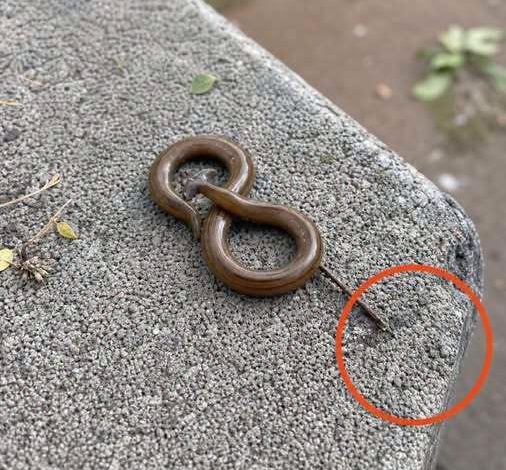
I saw it before I saw the danger.
At first, I thought it was just another worm crossing the wet ground after the rain. But then I looked closer.
It was long.
Dark.
Strangely smooth.
And it moved with a deliberate, almost effortless glide.
Something about it felt wrong.
Most worms twist and wriggle as they move, but this creature seemed to slide across the surface as if the ground belonged to it. Then I noticed its head.
Flat.
Wide.
Shovel-shaped.
It almost looked as though it were watching me.
I stopped walking.
For several seconds, I simply stood there, caught between curiosity and a feeling I couldn’t explain. The creature continued moving slowly across the damp earth, its body stretching forward with an unsettling purpose.
It didn’t look like something that was trying to escape.
It looked like something searching.
I had never seen anything like it.
My first instinct was to get closer, but another part of me quietly warned against it. There was something about the way it moved that made me hesitate.
So I watched.
Eventually, I learned what I had encountered.
It was a hammerhead worm, a terrestrial flatworm with an appearance unlike the ordinary earthworms most people recognize. Instead of wriggling through soil, these creatures glide across surfaces, using their unusual bodies and distinctive flattened heads to move through their environment.
And they are predators.
That discovery completely changed the way I remembered the encounter.
What I had initially dismissed as an unusual worm was actually a hunter.
Earthworms spend their lives performing an important role in ecosystems, helping break down organic matter and improving soil structure. Hammerhead worms, however, can prey on earthworms and other small creatures, making them a very different kind of presence beneath our feet.
The more I learned, the stranger that first encounter seemed.
I remembered the way the animal had moved.
Slowly.
Quietly.
Almost patiently.
There had been no frantic wriggling and no obvious attempt to hide. It simply continued forward as if it knew exactly where it was going.
And perhaps that was what unsettled me most.
Predators don’t always look dangerous.
Sometimes they look strange.
Sometimes they look harmless.
Sometimes they look so unfamiliar that we don’t even know what we’re looking at.
That realization made me think about how quickly humans make assumptions about the natural world.
We see something moving through the grass and immediately give it a category.
A worm.
A bug.
A harmless little creature.
Then we walk away.
But nature does not always fit into the simple categories we create.
There are creatures beneath our feet performing roles we rarely notice. Some build ecosystems. Some destroy. Some hunt. Some decompose. Some quietly compete for survival without ever coming into contact with us.
We pass through these worlds every day without realizing how much is happening around us.
That hammerhead worm reminded me of that.
The strangest part was that nothing dramatic happened.
It didn’t attack me.
It didn’t chase me.
It simply continued across the wet ground while I stood there watching.
Yet the encounter stayed with me.
Maybe because it changed my understanding of what I had seen.
Before I knew what it was, I saw an odd-looking worm.
Afterward, I saw a predator.
The animal itself had not changed.
Only my knowledge had.
And that was the real lesson.
Our understanding of nature is often limited not by what exists, but by what we recognize.
Something can be moving right in front of us while we completely misunderstand it.
That is why curiosity matters.
But so does caution.
The moment I first noticed the creature, I wanted to investigate. I wanted to get closer, perhaps touch it, perhaps figure out what it was.
Instead, I stopped.
I watched.
I learned.
And eventually, I walked away.
There was no need to interfere with something I did not understand.
That choice gave me something better than a closer look.
It gave me perspective.
The natural world is full of creatures that do not need our approval, our fear, or our interference. They simply exist, fulfilling their roles in ecosystems that have been operating long before we noticed them.
The hammerhead worm was not a monster.
It was not waiting for me.
It was simply an animal doing what animals do—surviving, hunting, and moving through its environment.
But seeing it reminded me how little we sometimes know about the world directly beneath our feet.
Now, whenever I see something unfamiliar moving through wet grass or soil, I am less likely to immediately assume I know what it is.
I stop.
I look.
I give it space.
Because sometimes the most valuable thing you can discover in a strange encounter is not what the creature is.
It is how much you still have left to learn.
That dark shape crossing the wet ground looked like nothing more than a worm.
But for a few quiet minutes, it taught me one of nature’s oldest lessons:
Look closer—but know when to leave the wild alone.