Dolly Parton’s final health statement just days before her death aged 80
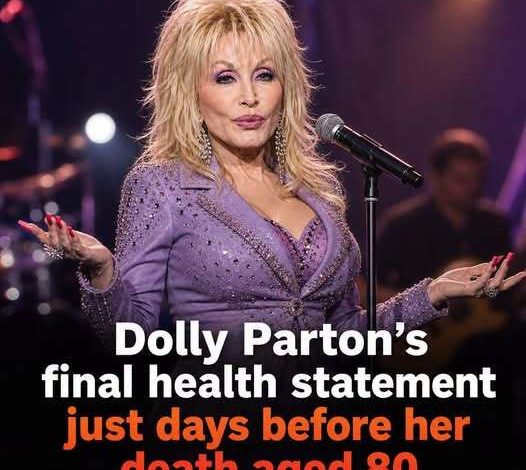
Dolly Parton was breaking inside while the world continued to see only rhinestones, towering heels, bright smiles, and an almost indestructible woman who seemed incapable of slowing down.
For decades, she had mastered the art of making pain look beautiful. She could turn heartbreak into a song, hardship into humor, and exhaustion into another performance. But behind the glittering costumes and infectious laughter, the final chapter of her life was becoming something far more intimate and heartbreaking.
In the end, Dolly Parton’s last great love story was not a song. It was a sacrifice.
Carl Dean, the private man she had loved for decades, was slipping deeper into Alzheimer’s, and Dolly remained fiercely protective of the life they had built away from the cameras. While the world knew her as one of the most recognizable women on Earth, Carl had always been the person who belonged to the private part of her life—the part she rarely allowed the public to see.
As his condition worsened, Dolly devoted herself to caring for him. She kept much of the struggle private, choosing quiet moments at home over public explanations. And as so often happened throughout her life, she placed someone else’s needs ahead of her own.
But her own body was beginning to send warnings she could no longer ignore.
The exhaustion became harder to hide. Health concerns began interfering with the schedule that had once seemed almost impossible to stop. Appearances disappeared from the calendar. Plans changed. Rumors began circulating as fans noticed that something was different.
For someone who had spent a lifetime telling people to keep moving forward, admitting that she herself needed to slow down was almost unimaginable.
Dolly had always been known for pushing through.
She had performed through heartbreak, exhaustion, grief, and pressure. She had built an empire while maintaining an image of warmth and optimism. Even when circumstances were painful, she usually found a joke, a song, or a smile with which to soften the moment.
So when she finally allowed the public to see a glimpse of what she was going through, she did it in the most Dolly way possible.
Rather than appearing broken, she appeared almost magical.
Dressed in fairy wings and surrounded by pink rhinestones, she spoke from Nashville rather than from the familiar world of Dollywood. She joked about having her “wings clipped,” using humor to make something frightening feel less frightening.
She spoke about dehydration and other health problems, attempting to reassure the people who had spent decades worrying about her. The message was essentially the same one she had given throughout her career: don’t panic, I’m going to be okay.
But between the jokes, something else could be heard.
Strain.
The woman who had made an entire career out of projecting boundless energy was suddenly talking about healing. The woman who had encouraged millions of people to keep dreaming was admitting, however gently, that her own body needed time.
Still, Dolly refused to surrender to fear.
She emphasized that her condition was treatable and continued speaking about the work she wanted to do. She talked about projects, music, and the future because that was who she had always been. Even when circumstances became difficult, she looked for the next thing to build.
That determination was part of what made her story so heartbreaking.
She had spent so much of her life caring for other people that caring for herself seemed almost unnatural.
For years, fans had admired her ability to give endlessly—to her family, her employees, charitable causes, children who needed books, communities affected by disasters, and countless people who never met her personally. But the most private sacrifice was happening at home.
Carl’s illness changed the rhythm of their lives.
The woman who had spent decades entertaining millions became a caregiver behind closed doors. Her world narrowed from massive stages and international attention to the quiet responsibilities of protecting the person she loved.
And because Dolly valued privacy so deeply, the public saw only fragments.
A canceled appearance here.
A postponed event there.
A reassuring statement.
Another smile.
Another joke.
Another promise that everything would be all right.
The result was an unusual kind of mystery. The world could see that something had changed, but Dolly did not want her private pain turned into entertainment.
She had spent her entire career sharing pieces of herself through music while keeping certain parts of her life firmly behind the curtain.
Carl was one of those parts.
Their relationship had lasted through decades of fame, cultural changes, enormous success, and the relentless attention that comes with being married to one of the world’s most recognizable performers. He never appeared to want the spotlight, and Dolly respected that.
When illness eventually entered their lives, she protected that privacy even more fiercely.
She could have explained everything.
She could have allowed the cameras into the difficult moments.
Instead, she chose silence.
And perhaps that silence explains why her final public appearances felt so different. Beneath the costumes and humor was a woman carrying an enormous emotional weight while trying to reassure everyone around her that she was still standing.
Even when her own health began demanding attention, she continued thinking about the people who were counting on her.
She kept working.
She kept creating.
She kept promising that she would come back.
That was Dolly’s instinct: give people hope before admitting how much hope she might need herself.
Her story therefore became more than a story about illness. It became a story about devotion, responsibility, and the complicated ways love can make someone extraordinarily strong while simultaneously asking too much of them.
She had spent a lifetime turning pain into something beautiful.
Her final chapter showed just how much pain she had been willing to carry quietly.
The world saw the rhinestones.
Her family saw the woman behind them.
Fans saw the smile.
Those closest to her saw the exhaustion.
And somewhere between those two versions of Dolly was the truth: she was human.
She could be frightened. She could become tired. She could become sick. She could struggle beneath the same burdens that affect everyone else.
But even then, she wanted people to remember hope.
She wanted them to believe that difficult moments could be survived, that healing was possible, and that tomorrow could still contain something worth waking up for.
That may be the most fitting legacy of all.
Because Dolly Parton spent her entire life singing for people who needed someone to tell them that their circumstances did not define them.
In her final years, she needed that message too.
And perhaps that is why her story feels so deeply personal to the people who loved her. Behind the legendary voice, the larger-than-life costumes, and the woman who seemed capable of turning every hardship into a punchline was someone who simply loved deeply—and who kept giving long after the giving had begun to cost her.
The spotlight may have followed her everywhere.
But her greatest act of love happened far away from it.