Dolly Parton’s Final Appearance Looked Serene—Only Days Later, Fans Realized How Ill She Had Become
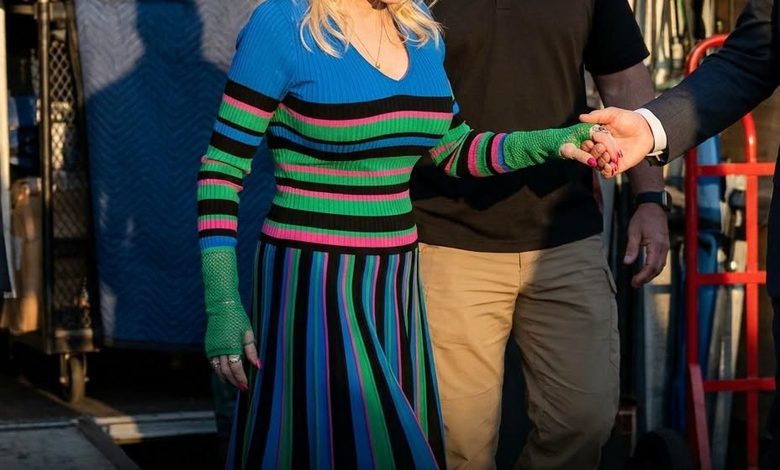
Dolly Parton sat before the camera dressed entirely in white, her familiar blond hair perfectly styled and her voice steady as she thanked the Academy of Country Music for honoring her with its Poet’s Award. She spoke warmly about songwriting as therapy, joy and a gift from God, never hinting that the video would become her final public appearance. Fans later returned to the August 19 recording and described her as looking “like an angel,” struck by how composed she seemed only six days before her death at 80. Yet another image from just weeks earlier told a more complicated story. At a June ribbon-cutting in Cornersville, Tennessee, Parton appeared in person but seemed to need help walking and standing, with two men close beside her as she held oversized ceremonial scissors. At the time, many viewers simply admired that she had shown up. After her death, those same moments were replayed as possible signs that something far more serious had been unfolding behind the rhinestones and smile.
By then, Parton had already been reducing her public schedule. Her husband of nearly sixty years, Carl Dean, had died in March 2025, and she later acknowledged that while caring for him she had neglected some of her own health problems. She postponed and then canceled a Las Vegas residency, missed major appearances and increasingly joined events through prerecorded video. Publicly, she discussed dizziness, dehydration, kidney stones and digestive and immune-system problems, telling fans she was responding to treatment even if recovery was slower than she wanted. She kept joking about it in unmistakably Dolly fashion, explaining that medication sometimes left her “swimmy headed” and that dizziness was hardly compatible with banjos, rhinestones and five-inch heels. Even when doctors prevented her from traveling to Dollywood, she appeared virtually beside oversized butterfly wings and joked that her physician had “clipped” them. To most people watching, the message was reassuring: she was dealing with setbacks, but she still expected to return.
After her death, however, accounts from people described as close to the family suggested that the public had seen only part of the picture. According to those reports, Parton had been seriously ill for months and had intentionally kept the severity of her condition within a small circle, allowing fans to believe that her absences were temporary rather than part of a much more difficult decline. Sources claimed her condition deteriorated substantially behind closed doors and that tremendous effort went into maintaining the polished image audiences associated with her whenever she appeared on camera. The timing made her final interview especially haunting: only four days before she died, Parton acknowledged ongoing health problems while still insisting that she was working and planning ahead. She was admitted to the hospital that same day. The woman who had spent decades transforming hardship into humor had apparently done the same thing with her final illness—revealing just enough truth to explain her absence, while withholding the part she believed would burden the people who loved her.
Even during that retreat, Parton reportedly remained involved in projects intended to outlive the limitations of her health. She continued working on a Nashville museum and hotel and remained invested in the autobiographical Broadway production Dolly: A True Original Musical, which was expected to open on what would have been her 81st birthday. Her enormous estate, estimated in reports at hundreds of millions of dollars, reflected decades of songwriting royalties, film and television work and her stake in the Dollywood enterprise, while her philanthropic legacy continued through the Dollywood Foundation and Imagination Library. Those facts make her final weeks feel less like a conventional retirement from public life than a forced transition from appearing personally to leaving systems behind that could continue without her. By the time she was reportedly confined largely to bed, family—including her sister Stella—remained nearby, while those around her continued respecting the privacy she had apparently insisted upon. Even as her physical world narrowed, the projects carrying her name were still moving outward.
What fans are left with now are two final versions of Dolly Parton that were actually part of the same woman. There is the fragile figure at a Tennessee ribbon-cutting, supported closely as she stood before a cheering crowd, and there is the luminous woman in white speaking calmly about the songs that had carried every dream of her life. Neither image was false. One showed the toll her body was taking; the other showed the spirit she still wanted the world to see. She had spent a lifetime turning poverty, heartbreak, criticism and personal loss into music people could carry with them, and according to those closest to her, she approached her final illness with the same instinct—to protect others from the heaviest part of it. That is why the last video feels so different now. Fans thought they were watching Dolly accept another award. In retrospect, they were watching someone who knew how fragile time had become and still chose, one last time, to talk about gratitude, songs and dreams rather than fear.