Donald Trump signs executive order to rename Lake Ontario as Lake America
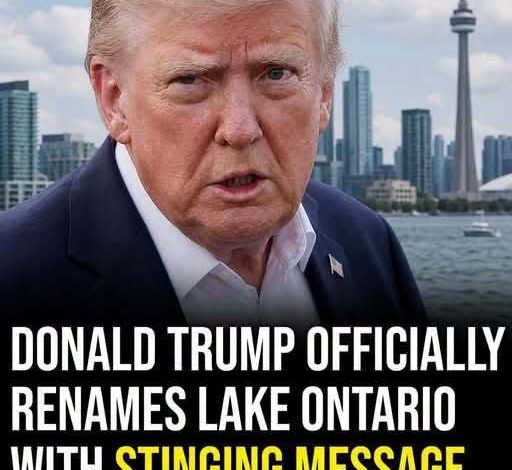
The shock was instant.
One of North America’s Great Lakes had suddenly been stripped of its familiar name with what appeared to be the stroke of a pen.
Trump stood at the podium, surrounded by political allies and supporters, declaring that Lake Ontario would be known as “Lake America” — effective immediately.
For millions of people, the announcement sounded almost surreal.
A lake.
A name.
A presidential order.
And suddenly, an enormous body of water shared by two countries had become the center of a political confrontation.
Canada erupted.
Indigenous leaders spoke out.
Political figures condemned the gesture.
Tariffs loomed over the broader relationship.
Allies watched nervously.
And a lake became a battlefield.
Not a battlefield of soldiers and weapons, but one of language, identity, sovereignty, history, and political power.
What began as a symbolic gesture quickly exposed much deeper fractures between Washington and Ottawa.
For Trump, renaming Lake Ontario could be understood as another performance of political power — a highly visible gesture designed to send a message to Canada, punish Ottawa rhetorically over trade disputes, energize his political base, and place the word “America” onto a landscape shared with a neighboring country.
The practical consequences were limited.
The symbolism was not.
A presidential administration can instruct its own agencies to use a particular name in official documents and communications. But changing the terminology used by one government does not automatically force another sovereign country to adopt it.
And Canada made that distinction clear.
For Canadians, the idea of replacing “Lake Ontario” with “Lake America” felt like something much more significant than a bureaucratic terminology change.
It felt like an attempted erasure.
Not only of a familiar name, but of history.
Of geography.
Of identity.
And of Indigenous language that existed long before either the United States or modern Canada took its present form.
That history matters.
The word “Ontario” is not simply a modern political label invented by a government office.
It has roots reaching back centuries.
The name is connected to Indigenous languages and traditions that predate the borders now separating the United States and Canada.
That is why the dispute immediately became about more than Donald Trump.
It became about who has the authority to rename places that existed long before today’s political institutions.
And who gets to decide which histories are remembered.
For Ottawa, the answer was straightforward.
Canada would continue calling the lake Lake Ontario.
There was no reason to accept Washington’s terminology.
No Canadian map needed to change.
No Canadian government needed to rewrite its records.
No Canadian citizen was required to adopt the new name.
The lake remained what it had always been.
Lake Ontario.
But the political atmosphere around it had changed dramatically.
The broader dispute with the United States had already become increasingly tense over trade.
Tariffs were hanging over businesses and governments.
Negotiations were becoming more difficult.
Politicians were trading increasingly aggressive statements.
And the relationship between two countries that had spent generations deeply intertwined was becoming a stage for political confrontation.
Against that background, renaming the lake looked less like an isolated administrative decision and more like another message in an ongoing argument.
The message was simple:
America would not be pushed around.
At least, that was how supporters could interpret it.
For Trump’s base, symbolic acts of national assertion can carry enormous emotional power. They communicate strength without requiring a military action or a major legislative battle.
A name can become a slogan.
A slogan can become a rallying cry.
And a rallying cry can reinforce the idea that the country is reclaiming control over its own identity.
But the same gesture can look completely different from across the border.
For Canadians, it could appear arrogant, dismissive, and intentionally provocative.
The lake is not exclusively American.
It is part of a shared geographic system connecting two countries.
Its history is older than the political disagreement surrounding it.
Its shoreline has been home to Indigenous peoples for centuries.
Its waters have supported communities, transportation, fishing, recreation, and economic activity across generations.
Trying to turn its name into a symbol of one country’s dominance therefore touches a sensitive nerve.
And Indigenous leaders were among those who highlighted that deeper history.
Long before modern borders existed, Indigenous peoples already had names for the lands and waters of the region.
Those names carried meaning.
They reflected relationships with the land.
They were not simply labels placed on maps.
They were part of living histories.
That is why the dispute over “Lake America” inevitably raised a larger question.
If a government can rename a place through executive action, does that mean the older histories attached to it disappear?
Of course not.
A political decree can change terminology in official documents.
It cannot erase centuries of Indigenous history.
It cannot remove the memory embedded in a place.
And it cannot force everyone who shares that landscape to accept the same interpretation.
That became particularly obvious when Canadian leaders responded.
Premier Doug Ford answered with characteristic bluntness, refusing to embrace Washington’s terminology and responding in language that reflected the anger many Canadians were feeling.
Prime Minister Mark Carney chose a different approach.
Rather than matching every insult with another insult, Carney focused on the history of the word itself.
He reminded audiences that “Ontario” comes from the Wendat language and is associated with a beautiful or great lake.
It was a calm response.
But it carried a sharp political message.
The name existed before Donald Trump.
It existed before modern Canadian politics.
It existed before the current trade dispute.
And it certainly did not depend on the approval of the United States government.
That was the point.
Borders can change.
Governments can change.
Presidents can change.
Tariffs can rise and fall.
Political alliances can strengthen or weaken.
But some names are rooted much deeper.
They survive because people use them.
Because communities inherit them.
Because history gives them meaning.
And because language cannot simply be rewritten by executive order.
That is why Canada’s response was so significant.
Ottawa did not need to win a symbolic argument by shouting louder.
It simply had to keep using the name it already had.
Lake Ontario.
The contrast could not have been clearer.
Washington could tell American agencies what to print.
Canada could tell Canadian institutions what to print.
And ordinary people on both sides of the border could continue speaking as they always had.
The result was almost absurd.
One lake.
Two names.
Two political realities.
One side saying “Lake America.”
The other saying “Lake Ontario.”
And the water itself completely indifferent.
The lake does not recognize presidential decrees.
It does not understand tariffs.
It does not respond to campaign slogans.
It does not care which government wins the next election.
It simply remains where it has always been.
That is what makes symbolic political battles so revealing.
They often have very little effect on the physical world.
But they reveal how governments and populations see one another.
The renaming exposed how fragile the relationship had become.
A disagreement that began with trade had expanded into questions of national pride.
Then language.
Then history.
Then sovereignty.
And eventually, geography itself.
That is how political tension spreads.
One issue creates another.
A tariff produces a retaliation.
A retaliation produces another statement.
A statement becomes a headline.
The headline becomes a political weapon.
And suddenly, a shared lake becomes a symbol of everything the two countries disagree about.
Yet beneath the political theater is an important reality.
The United States and Canada remain deeply connected.
Their economies are intertwined.
Their people cross the border every day.
Families live on both sides.
Businesses rely on customers and suppliers across the border.
Communities share infrastructure, culture, and history.
The relationship is far too deep to be reduced to one presidential order.
But deep relationships can still become strained.
Trust can be damaged by repeated confrontations.
Even symbolic insults can accumulate.
And when leaders repeatedly frame one another as adversaries, ordinary disagreements can become harder to resolve.
That is why the lake matters.
Not because its name changes the geography.
It does not.
But because names can communicate intent.
They can communicate respect.
Or disrespect.
Cooperation.
Or confrontation.
Memory.
Or erasure.
When a president attempts to rename a shared landmark, the gesture inevitably raises questions about whose identity is being centered.
For Trump, “Lake America” places American identity at the center.
For Canadians, “Lake Ontario” preserves a name tied to the region’s history and their own national identity.
For Indigenous communities, the discussion can go even deeper, because both modern national names and borders came long after Indigenous peoples had already named and understood these lands and waters.
That is perhaps the greatest irony.
The argument between two modern nation-states is happening over a place whose history predates both political systems.
The lake was here before the United States existed.
It was here before Canada existed in its modern form.
It was here before today’s borders.
It was here before today’s presidents and prime ministers.
And it will almost certainly remain long after all of them are gone.
That makes the attempt to control its name seem both powerful and strangely temporary.
Political leaders can dominate headlines for a day.
They can create viral moments.
They can provoke their opponents.
But history is harder to command.
Language is harder to control.
And communities are not required to forget simply because a government changes a label.
That is why Mark Carney’s message carried such weight.
He did not need to threaten anyone.
He did not need to match the spectacle.
He simply reminded people where the name came from.
Ontario.
A word with roots in Indigenous language.
A word carrying history.
A word that existed long before the current political argument.
And therefore, a word that cannot be casually separated from the people and cultures who gave it meaning.
Canada’s position was ultimately straightforward.
Call it what you want in Washington.
Canadians will call it Lake Ontario.
That quiet refusal may be more powerful than another round of political insults.
Because it demonstrates the limits of executive power.
A president can control the language of his own administration.
He cannot control the language of another country.
He cannot control what people say in their homes.
He cannot control the names inherited through generations.
And he cannot erase the history embedded inside those names.
So the lake remains.
The tariffs may rise.
The rhetoric may intensify.
Politicians may trade accusations.
Supporters may celebrate.
Critics may condemn.
But the water keeps moving.
The seasons continue changing.
Boats continue crossing.
People continue living along its shores.
And the name spoken in Canada remains the same.
Lake Ontario.
Perhaps that is the final lesson hidden inside this strange political confrontation.
A government can rename something on paper.
But paper is not history.
A presidential order can change an official label.
But it cannot rewrite everyone’s memory.
A politician can demand a new name.
But language belongs to the people who use it.
And in Canada, the old name will continue to be spoken.
Not because Ottawa won a shouting match.
Not because Washington apologized.
But because some names are too deeply rooted to disappear simply because a president decided they should.
Lake Ontario was here before the argument.
It will remain after the argument.
And while politicians fight over what to call it, the lake itself will continue silently reminding both countries that history is bigger than any one administration.
On Canadian maps and on Canadian tongues, it remains Lake Ontario.
Then.
Now.
And, if history has anything to say about it, for a very long time to come.