The singer never had kids, and her husband, Carl Dean, passed away before her
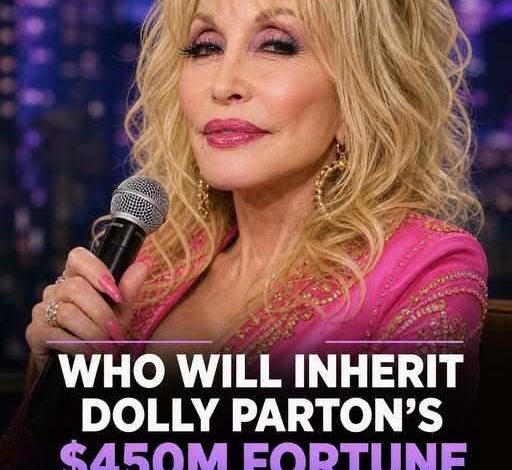
Her death shocked the world.
But the real shock is what she may have left behind.
Not the rhinestones.
Not the wigs.
Not the decades of songs, performances, and unforgettable moments that turned her into a cultural icon.
But a massive fortune—reportedly worth hundreds of millions of dollars—with questions surrounding who will control it, how it will be divided, and what will happen to the empire she spent a lifetime building.
There is no obvious traditional heir waiting in the wings. No living spouse beside her to simply step forward and take control. And beyond the lawyers, business partners, and executives studying documents and agreements, there is an enormous fan base that feels emotionally connected to everything she represented.
Some fans even believe they deserve a piece of the promise she created—a promise built around kindness, opportunity, music, and helping people who might otherwise have been forgotten.
Lawyers whisper.
Partners worry.
And Dollywood itself could become one of the most closely watched pieces of the entire puzzle.
For years, Dolly Parton built something much larger than a music career. She created an entertainment empire, a business legacy, a charitable network, and a public identity so recognizable that her name became almost synonymous with generosity.
So when a person like that dies, the question isn’t simply, “Who gets the money?”
The bigger question is:
What happens to the mission behind it?
In the end, Dolly Parton’s last act may be the most revealing reflection of who she always was. With no children and her beloved Carl gone before her, she reportedly structured her estate to behave less like a traditional dynasty and more like a living instrument of kindness.
Rather than creating a legacy focused entirely on passing wealth from one generation to the next, the plan appears designed around preserving the things she spent decades building.
That distinction matters.
Because Dolly’s greatest legacy was never simply the number attached to her bank accounts.
It was what she did with what she earned.
Insiders have pointed toward trusts and long-term arrangements designed to protect Dollywood’s future, preserve her song catalog, and keep the machinery of her creative and charitable work operating long after her voice fell silent.
The goal, according to those familiar with the broader structure, is not simply to preserve an empire for its own sake.
It is to make sure the empire continues doing what it was created to do.
That could mean protecting Dollywood as a place where families can continue making memories. It could mean ensuring that her music remains available to future generations. And it could mean directing significant resources toward causes that were deeply connected to her identity.
Literacy.
Rural healthcare.
Music education.
Children who need books.
Communities that have historically struggled to access opportunity.
People who may never have met Dolly personally, but whose lives could still be changed by the wealth she accumulated.
That is what makes the question of inheritance so unusual.
What looks like a vacuum of heirs may actually be a deliberate rejection of hoarding.
Dolly had the opportunity to create a traditional dynasty. She could have left enormous wealth to a small circle of relatives and allowed the fortune to remain concentrated within the family.
Instead, the philosophy surrounding her legacy appears to point in another direction.
Use the money.
Keep the mission alive.
Make the resources useful.
That changes the meaning of an estate.
It becomes less about who receives the largest check and more about what continues after the person who created everything is gone.
Of course, estates of this size are rarely simple. Businesses have contracts. Intellectual property has complicated ownership structures. Music catalogs can generate revenue for decades. Attractions require management, employees, investment, and long-term planning. Charitable organizations need their own structures to ensure that donations are handled responsibly.
There are lawyers involved.
There are financial advisers.
There are business partners.
There are people whose entire professional responsibility may now be connected to making sure the machinery Dolly built continues operating exactly as intended.
And that is where the secrecy becomes particularly interesting.
If some of the details remain sealed or private, the public may never know every person who benefits from her estate. They may never see every trust, every agreement, or every decision made behind closed doors.
But perhaps that secrecy is not necessarily a contradiction of Dolly’s public generosity.
It may actually be part of her final boundary.
The private woman behind the public halo has always existed separately from the larger-than-life character the world knows.
Dolly gave the public music.
She gave audiences laughter.
She gave families places to visit and memories to make.
She gave children books.
She supported communities.
But there were still parts of her life that belonged only to her.
Her estate may be the final example of that distinction.
The mystery, then, is not simply whether someone “wins” Dolly’s fortune.
The more meaningful question is how many lives that fortune could quietly change.
How many children could receive books?
How many students could have access to music education?
How many families in rural communities could receive assistance?
How many people could benefit from programs that continue operating because she planned for them to survive her?
Those are numbers that may never appear on a celebrity website.
They may never become viral headlines.
But they could become the most important numbers associated with her name.
Because wealth has a strange way of changing meaning after death.
During someone’s lifetime, a fortune can represent success, security, influence, and freedom.
Afterward, it becomes a question of direction.
Where does it go?
What does it become?
And who does it help?
For Dolly, the answer may ultimately be found not in a single heir but in thousands of people who never knew her personally.
That would be a fitting conclusion for someone whose public image was built around the idea that success means more when it can be shared.
The rhinestones will eventually become memorabilia.
The wigs will become artifacts.
The photographs will become pieces of history.
The songs will continue playing.
Dollywood will continue welcoming families.
And the charitable work may continue reaching people who will never know exactly how much of the help they received began with a woman who grew up dreaming far beyond the circumstances she was born into.
If the details remain sealed, that secrecy may be her final boundary.
Not a refusal to give.
But a refusal to turn generosity into another spectacle.
The private woman behind the public halo, making sure the spotlight lands not on a lucky inheritor, but on the people she never met and helped anyway.
And perhaps that is the most fitting way for Dolly Parton’s fortune to survive.
Not as a monument to how much she accumulated.
But as proof of how much she was willing to give away.