Dolly Parton fans blown away by her real hair after years of seeing her in wigs
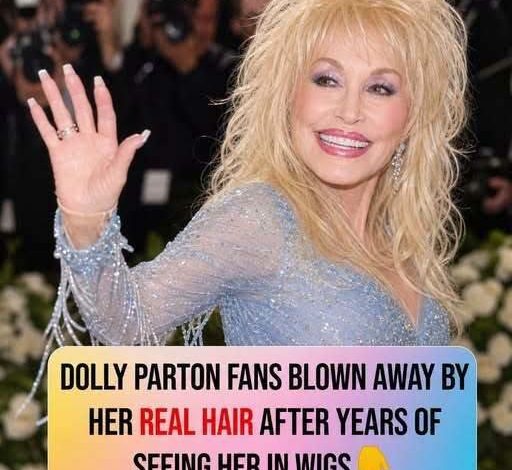
She’s gone, and the armor is finally off.
For decades, Dolly Parton’s towering wigs were more than spectacle. They were part of the image the world knew, but they were also something much more personal—a shield between the woman beneath the spotlight and the millions of people who believed they knew her.
The bigger the hair, the brighter the rhinestones, the more unmistakable the Dolly Parton image became.
But behind that image was another Dolly.
Quieter.
Softer.
More private.
And now, in the quiet after her death at 80, the world is being reminded of the woman she kept mostly for herself. The hair beneath the wigs. The simple moments. The unguarded laughter. The photographs and stories from people who knew her away from the stage.
Soft.
Simple.
Startlingly human.
For fans who spent decades seeing Dolly transformed into an almost larger-than-life character, those glimpses can feel unexpectedly emotional. Because they reveal something the costumes sometimes made easy to forget: beneath the wigs, makeup, sequins, and carefully constructed glamour was an ordinary woman from Tennessee who had simply learned how to carry an extraordinary amount of attention.
The wigs were never merely about vanity.
They were part of the armor.
Dolly once explained that she liked the way wigs allowed her to maintain a consistent appearance and avoid the daily struggle of styling her own hair. But there was something deeper in the ritual too. When she stepped onto a stage, she became the version of Dolly the world expected to see.
When she took the wig off, she could step away from that expectation.
She could simply go home.
Offstage, without the glittering armor, she was smaller somehow, but never diminished.
If anything, she seemed more recognizable as a human being.
Friends have recalled moments when she would remove a wig, shake out her own fine, pale hair, and laugh at how different she looked. Her husband, Carl Dean, famously joked that without the elaborate hairstyle she could resemble a “Q-Tip.”
Those moments weren’t glamorous.
That was exactly why they mattered.
There was no stage lighting.
No audience waiting for a performance.
No photographer asking for the perfect angle.
Just Dolly laughing at herself.
Just a woman who had spent years creating one of the most recognizable images in entertainment and could still find humor in how ordinary she looked underneath it.
In those private moments, she wasn’t the woman people expected her to be.
She wasn’t the country-music legend.
She wasn’t the businesswoman.
She wasn’t the philanthropist.
She wasn’t the woman covered in rhinestones and towering hair.
She was Dolly Rebecca Parton.
A woman from the Smoky Mountains.
A wife.
A friend.
A sister.
A daughter.
Someone who had carried the weight of fame for decades and needed somewhere she could put it down.
That hidden hair became part of a quiet ritual of trust.
It was brushed in kitchens.
Pinned back in hotel rooms.
Adjusted inside tour buses.
Left natural during slow mornings before the world demanded the familiar Dolly again.
Those moments were never meant for millions of eyes.
They belonged to the private version of her life.
And perhaps that is why the image of Dolly without her signature hair feels so powerful.
It represents something the public rarely gets from celebrities: the privilege of seeing them when they aren’t performing.
The world often assumes that famous people are always the person we see on television.
But a public image is still an image.
There is always another person underneath.
Dolly understood that better than most.
She created a character that became inseparable from her identity, but she never allowed that character to consume every part of her.
The wigs were costume.
But they were never a lie.
They were a choice.
A way of controlling how she appeared.
A way of creating consistency.
A way of turning herself into something unmistakable while protecting the parts of herself that didn’t belong to the audience.
That distinction is important.
Dolly gave the public almost everything.
Her voice.
Her songs.
Her humor.
Her stories.
Her childhood memories.
Her generosity.
Her time.
Her image.
But she kept certain things sacred.
Her marriage.
Her private routines.
Her quiet moments.
And, in a strange way, her natural hair.
That tiny piece of privacy represented something much larger.
It was one part of herself that didn’t have to be packaged.
Didn’t have to sparkle.
Didn’t have to entertain.
Didn’t have to be photographed.
It could simply exist.
The public saw the larger-than-life Dolly.
The people closest to her saw the woman who could take off the wig at the end of the day, laugh at herself, and become completely ordinary again.
And perhaps that was the balance that allowed her to survive decades of extraordinary fame.
Because being loved by millions can sound like a dream.
But being watched by millions is something else entirely.
Every outfit is analyzed.
Every photograph is discussed.
Every change in appearance becomes news.
Every mistake can become a headline.
Every private decision can become public property.
Dolly learned how to give people enough to love without giving them everything.
That was a form of self-protection.
And maybe it was one of the reasons she could remain so generous without completely disappearing inside her public persona.
She knew where the boundary was.
The wigs belonged to Dolly Parton the performer.
The natural hair belonged to Dolly the woman.
And when the wig came off, the performance could end.
There is something deeply touching about that idea now.
Because after a lifetime of seeing Dolly surrounded by spectacle, fans are left clinging to the smallest details.
Not necessarily the biggest performances.
Not the most expensive costumes.
Not the brightest stage.
But the quiet Dolly.
The woman sitting at home.
The woman laughing with her husband.
The woman brushing her own hair.
The woman waking up without needing to become anyone else.
Those images carry a different kind of intimacy.
They remind people that behind the legend was someone who needed privacy just like everyone else.
Someone who could be tired.
Someone who could be vulnerable.
Someone who could want a quiet morning without cameras.
And perhaps that is the part of her story people are only beginning to appreciate.
Dolly didn’t protect herself because she was ashamed of who she was.
She protected herself because she understood that not everything beautiful needs to be shared.
Some things become more valuable precisely because they remain private.
Her natural appearance didn’t need an audience.
It didn’t need approval.
It didn’t need to become another part of the Dolly Parton brand.
It was simply hers.
And for a woman who spent so much of her life giving pieces of herself away, having one small part that remained untouched may have been essential.
The world received the rhinestones.
The wigs.
The songs.
The stories.
The laughter.
The generosity.
But somewhere behind closed doors was a woman who could take all of that off.
And breathe.
That may be the real meaning behind the phrase “armor.”
Armor isn’t necessarily something you wear because you are pretending.
Sometimes you wear it because the world is heavy.
Sometimes it helps you face a room full of people.
Sometimes it gives you confidence.
Sometimes it creates distance.
And sometimes, when you finally return home, you take it off.
Dolly’s wigs could be all of those things at once.
They helped create the legend.
They helped maintain her image.
They helped her feel prepared.
But they also gave her the ability to draw a line between the public world and the private one.
The woman underneath wasn’t less beautiful.
She was simply less protected.
And that vulnerability was something she reserved for people she trusted.
Now, as fans mourn, it is that private, unvarnished Dolly they seem to hold onto.
Not because the glamorous version wasn’t real.
It was.
But because the ordinary version reminds them that there was a real human heart underneath everything.
A woman who laughed.
A woman who loved.
A woman who worried.
A woman who worked until she was exhausted.
A woman who understood the value of privacy.
A woman who could step onto a stage looking larger than life and later disappear into a quiet room where nobody expected anything from her.
That contrast may be one of the most beautiful things about her legacy.
She didn’t choose between being extraordinary and being ordinary.
She allowed herself to be both.
Onstage, she could become enormous.
At home, she could become small again.
Neither version canceled the other.
Both were Dolly.
And perhaps that is why the stories about her natural hair feel so emotional.
They aren’t really about hair.
They’re about permission.
Permission to take off the costume.
Permission to stop performing.
Permission to be imperfect.
Permission to be ordinary after spending an entire lifetime being extraordinary.
Dolly gave the world permission to dream loudly.
Maybe she also gave herself permission to live quietly.
That quiet life existed behind the curtain, behind the cameras, behind the wigs and rhinestones.
It was the part of her story that didn’t need to be sold.
Didn’t need to be explained.
Didn’t need to be turned into entertainment.
It simply needed to belong to her.
And now, after a lifetime in which the world claimed so much of her attention, those private details may become some of the most precious pieces of her memory.
The soft hair beneath the towering wig.
The laughter when she saw herself in the mirror.
The casual moments in kitchens and hotel rooms.
The mornings before the lights came on.
The woman who didn’t need to look like Dolly Parton because she already knew who she was.
That may be the image worth remembering.
Not a legend stripped of her glamour.
But a woman who understood that glamour was something she could put on—and take off.
The wigs were never the person.
They were only the frame.
The real Dolly was always underneath.
And perhaps the greatest courage wasn’t wearing the armor in front of millions.
It was knowing when she could finally take it off.
Now that the world can no longer hear her laugh in person or watch her walk onto another stage, fans are holding onto those quieter memories.
They are remembering the woman behind the icon.
The woman who gave so much away while keeping one small corner of herself protected.
And that private softness may be one of the most beautiful things she ever left behind.
Because beneath the legend lived someone wonderfully ordinary.
A woman who loved loudly.
Worked relentlessly.
Gave generously.
Laughed freely.
And protected herself softly.
The world got the rhinestones.
The world got the music.
The world got Dolly.
But somewhere underneath all that glitter was a woman who simply wanted to be herself when the lights went out.
And maybe that was never a secret meant to be solved.
It was a piece of herself she had earned the right to keep.