My 8-Year-Old Son Gave Up His Lunch Money to Buy a Little Girl with Down Syndrome a Red Birthday Dress — The Next Morning, Our Lawn Was Covered in Lunchboxes
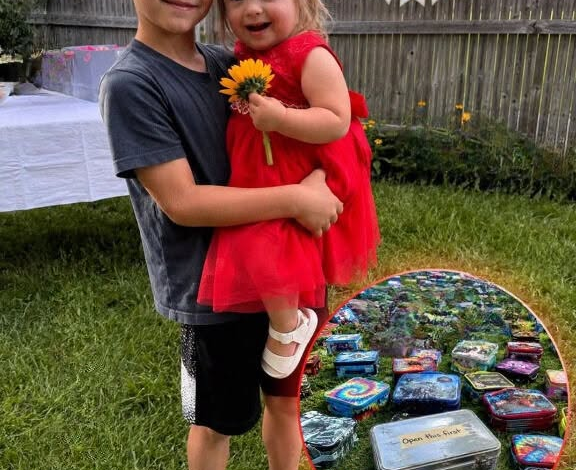
The first time Noah saw the red dress, he stopped in front of the shop window.
“Mom.”
He pointed at the tiny red dress with the full skirt and little bow.
“Lucy needs that.”
I smiled. “Needs it?”
He thought for a second.
“Okay… she wants it.”
Lucy was our neighbor’s nearly two-year-old daughter. She had Down syndrome and adored Noah. He brought her dandelions, drew pictures for her, and made silly noises just to hear her laugh.
Her mother, Hannah, was raising her alone, and money was often tight.
A few weeks before Lucy’s birthday, Hannah told me they weren’t planning much.
“Just cake and a few balloons,” she said. “We’ve had extra appointments lately.”
Noah overheard.
Later, he asked why Lucy wasn’t having a “real birthday.”
I explained that Hannah had other important things to spend money on.
He nodded quietly.
After that, Noah became strangely careful with money.
He started refusing snacks.
He asked his dad if he could earn money by raking leaves.
Then I found several crumpled bills on his dresser.
And one afternoon, I discovered the truth.
Inside his closet was the red dress.
He had bought it himself.
“You skipped lunch to buy this?”
“Not every day.”
I hugged him.
“Buddy, you never skip food to show someone you love them.”
He looked down.
“But Lucy’s birthday is tomorrow.”
That evening, my mother-in-law saw the dress.
When she learned what Noah had done, she shook her head.
“That’s a waste of money. Lucy is only two. She probably doesn’t even understand birthdays.”
Noah looked at her.
“She understands when someone is kind to her, Grandma.”
The room went silent.
The next day, Noah gave Lucy the dress.
When Hannah put it on her, Lucy immediately grabbed the skirt and started spinning.
Noah laughed so hard he had to sit down.
Even my mother-in-law stood quietly by the fence, watching.
That night, I found Noah sleeping peacefully.
I looked at Cyril.
“I’m proud of him.”
“So am I.”
But we both agreed he was never skipping lunch again.
The next morning, Noah came running into our bedroom.
“Mom! Dad! Come outside!”
I followed him onto the porch.
Then I stopped dead.
Our entire lawn was covered in lunchboxes.
There were dozens.
Dinosaur lunchboxes.
Superhero lunchboxes.
Brightly colored bags.
Old metal containers.
Brand-new insulated ones.
They stretched almost all the way to the sidewalk.
Noah stared at them.
“Are these for me?”
“I honestly don’t know.”
Then he noticed the biggest one.
An old metal lunchbox sat in the middle of the lawn.
A card was taped to the top:
OPEN THIS FIRST
Noah opened it.
Then his face went completely pale.
Inside were bundles of cash.
There was also a work badge, a key, and a wedding photograph.
He backed away.
“Mom…”
He swallowed.
“Call the police.”
Before I could move, a woman hurried toward us from the sidewalk.
“Please don’t!”
She was in her thirties and had Down syndrome.
Noah pointed at the lunchbox.
“Why is your money in my yard?”
She stopped.
Then smiled nervously.
“Because apparently I didn’t do a very good job of making this look innocent.”
Her name was Tessa.
Hannah was behind her, along with several other neighbors.
Then Hannah explained everything.
The night before, she had posted a photo of Lucy wearing the red dress.
She told people what Noah had done.
Families from the community center started talking.
And someone had an idea.
“If one little boy could give up something important to make another child happy,” someone said, “maybe we could all give something too.”
The lunchboxes weren’t filled with random gifts.
They represented contributions from families trying to help fund a new community program for children with Down syndrome, their siblings, and their friends.
Art.
Music.
Games.
Gardening.
Activities where children could simply have fun.
Tessa opened the big lunchbox again.
She pointed to the work badge.
“I’ve worked at the same bakery for seven years.”
Then the key.
“My own apartment.”
Then the wedding photograph.
“And that’s my husband.”
Noah looked at her.
“You’re married?”
“Yep.”
“Does he snore?”
Tessa laughed.
“Terribly.”
Noah nodded.
“So does Dad.”
Cyril looked offended.
“Excuse me?”
Everyone laughed.
Then Tessa became serious.
“When I was little, people told my parents there were many things I might never do.”
She smiled.
“They were wrong.”
She looked at Noah.
“People don’t always know what someone else’s future will look like.”
Across the room, Lucy started spinning in her red dress again.
My mother-in-law watched her.
Noah looked at her.
“See?”
She frowned.
“See what?”
“She understood, Grandma.”
And suddenly I knew exactly what he meant.
He wasn’t saying Lucy understood birthdays the way adults do.
He meant she understood happiness.
Hannah stood beside me, holding back tears.
“I spend so much time thinking about what might help Lucy in the future,” she whispered.
“Appointments. Therapy. What she should learn next.”
She looked at her daughter.
“I forgot to ask what she might simply enjoy.”
Later, Noah opened one of the new lunchboxes.
Inside was a sandwich, fruit, juice, and a cookie.
He looked at it.
“It’s just lunch.”
Tessa smiled.
“Exactly.”
Cyril crouched beside him.
“Next time you decide to save the world, let us know before you stop eating.”
Noah shook his head.
“I wasn’t saving the world, Dad.”
Cyril looked around the room.
“Apparently nobody told them.”
That evening, the lawn was empty again.
The lunchboxes had gone home.
No cameras.
No speeches.
Just our porch, a warm breeze, and Noah eating his sandwich from his new lunchbox.
Lucy sat beside him in the red dress.
She reached for his food.
Noah pulled it away.
“Lucy. Mine.”
She reached again.
He sighed.
Then he tore off a small piece and gave it to her.
I instinctively reached toward the red dress when I saw jelly smeared across it.
Then I stopped.
Lucy was laughing.
Noah was laughing.
And suddenly I realized something.
The dress wasn’t supposed to stay perfect.
It was supposed to make a little girl feel like a princess.
And that day, it did.
So I left the stain alone.