Woman pours water over neighbor’s son after he did the same to her cat
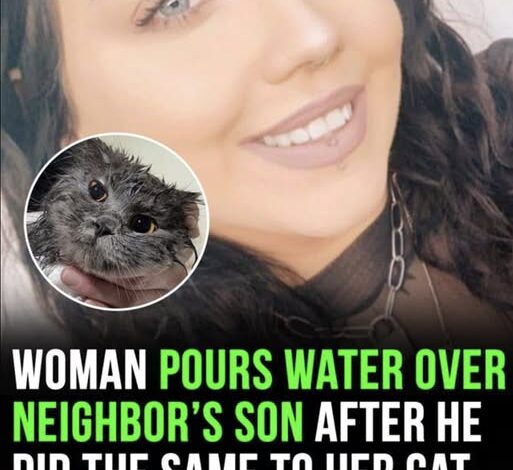
Cruelty towards animals is something the vast majority of us take very seriously, and rightly so. The idea of deliberately causing pain, fear, or distress to a defenseless creature is deeply disturbing to most people. Animals depend on humans for care and protection, especially pets that live in our homes and trust us completely. Inflicting misery on them simply because one can is often seen as a sign of troubling character traits, a lack of empathy, or a failure to understand responsibility. Thankfully, society has evolved in many ways, and the days when people could openly mistreat their pets or other animals without consequences are largely behind us.
That said, isolated incidents still occur, and they serve as reminders that vigilance and accountability remain necessary. Even if severe abuse is less tolerated than in the past, smaller acts of unkindness or thoughtless behavior toward animals still happen. For many of us, the thought of intentionally scaring or harming a defenseless animal is upsetting enough. Unfortunately, not everyone shares that same sensitivity or awareness.
This is likely one reason why the internet often rallies behind people who step in to defend animals when they are vulnerable. Stories of individuals protecting pets or standing up against mistreatment tend to spread quickly online, sparking passionate reactions. A few years ago, one such story went viral after a woman shared the unusual way she responded to her neighbor’s son when he poured water on her cat.
The woman, Shannon Cooper, ignited a heated debate on social media when she revealed that after the neighbor’s child threw a cup of water over her cat while it was peacefully sitting on a fence, she retaliated by pouring a basin of water over him from her window. According to Shannon, the cat had simply been minding its own business when the child deliberately soaked it and laughed. Feeling protective and angry, she decided to respond immediately and in kind.
Now, pouring water on a cat is obviously not comparable to the more severe and malicious forms of animal cruelty that truly endanger lives. However, Shannon felt strongly that her pet had been disrespected and unnecessarily distressed. From her perspective, it wasn’t just about the water itself — it was about the principle of not mistreating an animal for amusement.
After she shared the story on X, her post quickly gained traction. It read:
“My 10-year-old neighbour just threw a cup of water over my cat who was sitting on the fence minding his own business and laughed so I threw a basin of water over him from the window and now his dad is at my door going mental but I don’t see the problem, don’t touch my cat.”
The internet was immediately divided. Many people sided with Shannon, arguing that her reaction was a harmless but effective way to teach the child a lesson. One supporter wrote, “Someone messes with my cat, they will be dealing with me.” Another commenter added, “Just goes to show you that if you don’t teach your kids respect, somebody else will!”
Some parents even expressed approval. One mother commented that if her own 11-year-old twins had done something similar and received the same response, she would have accepted it. “It’s water, they will survive. A 10 yr old knows better!” she wrote, suggesting that children of that age are capable of understanding basic respect for animals.
Another commenter reflected on their own childhood experiences, saying they had faced much harsher consequences growing up. Compared to that, they felt a splash of water was minor and even educational. In their view, the situation illustrated a simple but important lesson: actions have consequences, and sometimes those consequences are immediate.
However, not everyone agreed with Shannon’s approach. Critics argued that while the child’s behavior was wrong, it should have been addressed by speaking to the parents rather than responding in kind. One person described her reaction as childish, insisting that discipline is ultimately the responsibility of a child’s guardians. Another parent wrote that although the child shouldn’t have poured water on the cat, it wasn’t Shannon’s place to punish him.
Some commenters focused on child development, pointing out that children are still learning boundaries, empathy, and consequences. One argued that adults, being fully developed, should model mature behavior rather than mirror the actions of a child. From this perspective, Shannon’s retaliation blurred the line between setting a boundary and stooping to the same level.
As the online debate intensified, Shannon later clarified that the situation had not caused lasting tension between her and her neighbors. In a follow-up, she explained that both the child and his father were laughing about the incident afterward. She also noted that the father had initially been upset because he didn’t know what his son had done before confronting her. Once the full story came out, the situation reportedly cooled down. Shannon even mentioned that the boy was actually 13, though he looked younger.
In the end, the incident became less about the water itself and more about larger questions: How should adults respond when children mistreat animals? Where is the line between teaching a lesson and overreacting? And who holds responsibility for instilling respect in young people? While opinions remain divided, the story clearly resonated with many because it touched on two deeply felt values — protecting animals and guiding children toward empathy and accountability.