My Son Mocked Our Waiter With Down Syndrome — Then an Old Box Changed Everything
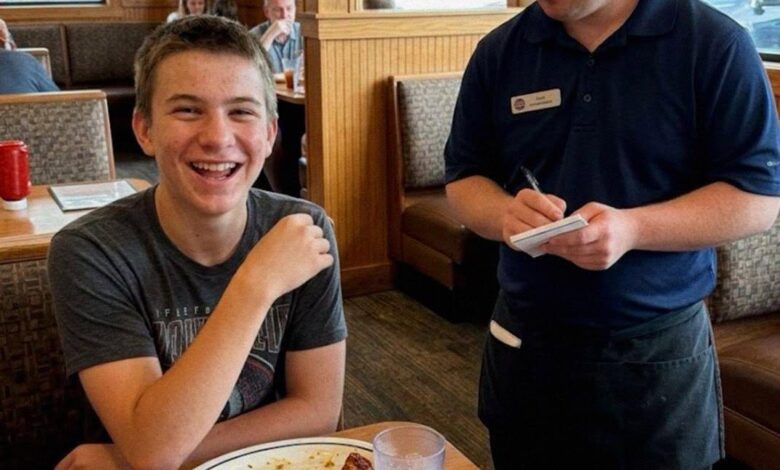
My son Leo was fourteen when he made a mistake I knew he would remember for the rest of his life.
We were at a restaurant when our waiter, Sam, struggled to get a few words out.
Leo laughed.
Then he copied the way Sam spoke and moved.
I was shocked.
On the way home, I said almost nothing.
Instead, I went to my closet and pulled out an old wooden box I hadn’t opened in years.
Inside was a faded photograph of a young boy sitting in a wheelchair, wearing a paper crown and smiling at the camera.
Leo picked it up.
“Who is he?”
“My brother.”
He looked at me, surprised.
“You had a brother?”
“Yes. His name was Michael. He had Down syndrome.”
Michael died when he was nineteen.
I told Leo how much he loved music, how he hated thunder, and how he always noticed when someone was lonely.
Then I showed him photographs and an old newspaper clipping about Michael volunteering at a community center.
“He didn’t care about being important,” I told Leo. “He cared about making people feel welcome.”
Leo stared at the pictures.
Then he quietly asked, “Did people make fun of him?”
“Sometimes.”
“Did you?”
“No. But I didn’t always know how to defend him.”
Leo looked down.
I told him something Michael’s friend Daniel had once said:
“Being different isn’t the same as being less.”
Leo’s eyes filled with tears.
“I messed up.”
“Yes.”
“Badly.”
“Yes.”
I could have taken his phone away and grounded him for a month.
But I knew that might only teach him how to avoid getting caught.
“I want you to learn something else,” I said. “How to notice another person’s dignity before you decide whether something is funny.”
The next day, Leo returned to the restaurant.
Sam was there.
Leo stood in front of him, nervous.
“I owe you an apology,” he said. “I made fun of the way you talked and moved. It was disrespectful, and I knew it while I was doing it.”
Sam listened.
Then he simply said, “Thank you for saying that.”
It wasn’t a dramatic moment.
There was no instant friendship.
Just an apology—and acceptance.
On the way home, Leo looked out the window.
“Mom?”
“Yeah?”
“Do you think Uncle Michael would have liked me?”
I smiled.
“He probably would have.”
“Even after what I did?”
“Yes.”
“Why?”
“Because Michael was very good at giving people another chance.”
Months later, Leo asked to see the photographs again.
He wanted to know everything about Michael—his favorite music, the things he hated, what made him laugh, and whether he knew how much people loved him.
Then one evening, he looked at Michael’s photograph and said something I’ll never forget:
“I think I was so busy trying to be cool that I forgot everyone is somebody.”
That was the moment I knew something had changed.
The wooden box had held my brother’s memories for years.
But I finally realized it wasn’t just holding the past.
It was carrying a lesson into the future.