What was this strange wooden tool really used for?
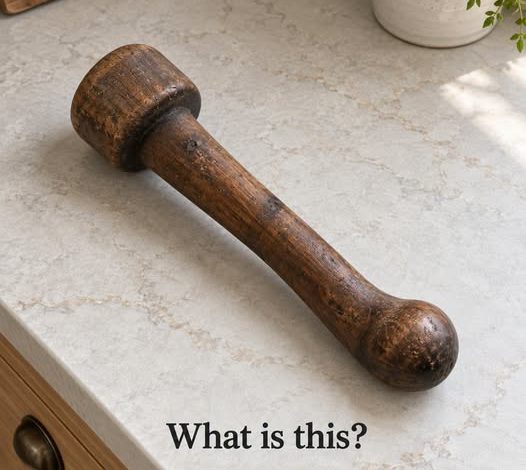
Found a Strange Wooden Tool in an Old Dresser? Its Simple Purpose Once Mattered in Everyday Life
Finding an unfamiliar object in an old dresser can turn an ordinary afternoon of sorting into a small mystery.
It may be tucked beside buttons, loose thread, old photographs, folded handkerchiefs or other belongings that have not been touched in years.
At first, the object itself may not offer many clues.
It is made of wood.
It has a rounded end.
Some versions have a long handle.
Others are shaped more like an egg or a mushroom.
There are no gears, blades, switches or obvious moving parts.
And that simplicity is exactly why so many people today struggle to identify it.
The answer is not exotic.
It is far more ordinary — and perhaps more interesting because of that.
The object was designed to help repair clothing.
More specifically, it was commonly used for darning socks, stockings and other knitted garments.
It is usually known as a darning mushroom, darning egg or sock darner, depending on its particular shape.
For generations, tools like this helped families keep worn clothing in use instead of replacing it immediately.
But the way they worked reveals why such a simple piece of wood could be so useful.
The Rounded Surface Was the Key
A hole in a sock can be surprisingly awkward to repair.
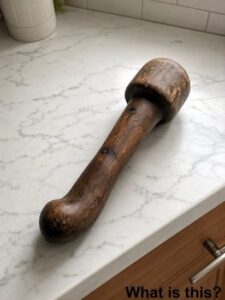
Socks are soft, flexible and curved.
If the damaged fabric is placed flat on a table, the material can collapse, bunch up or lose its natural shape while someone is trying to sew it.
The solution was simple.
A smooth rounded object was placed inside the sock.
The worn section was positioned over the curved surface.
The fabric could then be held with gentle tension while the repair was made.
That is the basic purpose of a traditional darning egg or mushroom.
The Victoria and Albert Museum describes the darning egg as a tool that maintains the tension of a garment, making holes in socks or jumpers easier to repair.
The shape was not decorative.
It solved a practical problem.
And that problem appeared often.
Socks Were Especially Vulnerable to Wear
The heel and toe of a sock experience repeated friction.
Every step places pressure on the fibers.
Over time, the material can become thinner.
Eventually, a weak area may turn into a hole.
Today, inexpensive socks are widely available, and many people simply replace a damaged pair.
Historically, replacement was not always the first response.
Textiles could represent significant household value, and repairing worn items was a normal way to extend their usefulness.
The Metropolitan Museum of Art notes that darning was historically used to repair textiles and prolong their useful life, particularly in periods when textiles were valuable household possessions.
That makes the small wooden tool easier to understand.
It was not created for an unusual craft.
It helped with a very ordinary household problem.
Darning Was Different From Simply Sewing a Hole Shut
When people first hear that the object was used to repair socks, they may imagine that the torn edges were simply pulled together and stitched.
Darning is more structured than that.
The technique can rebuild a missing or worn section of fabric with thread.
A series of stitches is worked across the damaged area in one direction.
Additional thread can then be passed across those stitches in the opposite direction.
The result creates a small woven structure over the weak or missing area.
Instead of merely closing the edges, the repair can replace some of the fabric that has been lost.
That is why the curved support underneath the garment was so helpful.
It provided a stable surface while this tiny woven patch was being created.
The Tool Helped Preserve the Garment’s Shape
Stretching a hole too tightly during repair can distort a sock.
Leaving it too loose can create bunching.
The smooth rounded surface gave the person sewing a form to work against.
A heel could sit naturally over the curve.
A toe could be positioned in a similar way.
The fabric remained supported without having to be pulled flat.
Once the darning was finished and the tool removed, the garment could retain a more natural shape.
It was a small design advantage.
But for repetitive household repairs, small advantages mattered.
Why So Many Were Made From Wood
Wood was well suited to this purpose.
It could be shaped into a smooth curve.
It was relatively light.
It could be held comfortably.
And once properly finished, it provided a firm surface without sharp edges that might catch on yarn.
Some wooden darners were plain and strictly functional.
Others were turned more carefully and given decorative handles.
Different makers produced slightly different shapes.
The basic principle, however, remained remarkably consistent.
A smooth curved form went underneath the damaged textile.
The needle and thread did the rest.
Not Every Darner Looked Like a Mushroom
The names can sometimes create confusion.
A darning mushroom usually has a broad rounded head and a narrower stem or handle.
A darning egg may be a solid oval object without a long handle.
Other examples fall somewhere between the two.
Some were elongated.
Some were almost spherical.
Some incorporated handles designed to make the object easier to hold while sewing.
Materials varied as well.
Wood was common, but surviving darning tools have also been made from other materials.
The appearance changed.
The purpose did not.
This Was Part of a Much Larger Culture of Mending
Darning was not an isolated household activity.
Repairing textiles was historically an important practical skill.
Evidence survives in museum collections.
For example, the Metropolitan Museum of Art holds an American darning sampler made in 1814 by Esther Smith while she attended the Wilmington Boarding School.
The sampler demonstrates different woven repair patterns.
It also illustrates something important about daily life at the time.
Darning could be taught as a practical skill.
It was not merely an improvised technique used occasionally.
People learned how to do it properly.
The V&A also documents historic needlework samplers demonstrating darning skills, including examples associated with the practical ability to mend family clothing.
So the mysterious wooden object belongs to a much broader history of textile maintenance.
Sewing Skills Were Often Learned Early
For much of history, practical textile skills were passed from one person to another.
Someone might learn by watching a parent, relative, teacher or experienced needleworker.
Modern written patterns and online tutorials were not always necessary.
The V&A notes that many traditional knitting skills were historically learned through observation and practice rather than written instructions.
The same culture of practical knowledge helped sustain repair skills.
A person who knew how to sew could fix a loose seam.
Replace a button.
Patch damaged cloth.
Or darn a worn sock.
The tools for those jobs remained close at hand.
That is one reason darning tools are often discovered among old sewing supplies.
The Dresser Drawer Was a Logical Place for It
An old darner found beside needles, thread or clothing is not out of place.
It would have been stored where it was easy to reach when repairs were needed.
A sewing basket was another natural location.
So was a cabinet or drawer used for household textile supplies.
The object did not require special maintenance or complicated storage.
It could simply remain there until needed again.
That may help explain why so many survive.
A wooden tool can sit quietly in a drawer for decades.
Long after its owner stops using it, the object remains.
The knowledge of what it was for may disappear first.
And that is how an ordinary household implement becomes a puzzle.
It Could Be Used for More Than Socks
Socks were a common use, but the basic idea was broader.
The V&A’s modern description of a traditional darning egg specifically mentions holes in both socks and jumpers.
Any knitted fabric that benefited from support could potentially be easier to mend over a suitable curved form.
Stockings are another obvious example.
The tool’s usefulness came from its shape rather than from being restricted to one particular garment.
Still, socks remain strongly associated with it.
There is a reason for that.
They combine frequent wear, curved construction and relatively small repair areas — exactly the type of problem the tool handles well.
A Tiny Object Could Save a Useful Garment
The value of repair becomes clearer when viewed historically.
Textiles were not always as disposable as many mass-produced garments can seem today.
Repairing a worn item could extend the time before replacement became necessary.
The Metropolitan Museum’s description of historical darning emphasizes precisely this purpose: prolonging the usefulness of textiles.
A damaged sock might still contain plenty of good material.
Only one small section could be worn through.
Discarding the entire item would waste everything that remained intact.
Darning addressed the damaged portion.
The wooden support simply made the job more manageable.
Why the Technique Became Less Familiar
Daily life changed.
Industrialized textile production expanded.
Machine-made clothing became increasingly accessible.
Modern fibers and manufacturing methods also changed the kinds of garments people bought and how often they replaced them.
Over time, hand mending stopped being as central to everyday household routines for many people.
When a task becomes less common, its specialized tools become less recognizable.
That is exactly what happened to many darning eggs and mushrooms.
The object did not become difficult to understand because its design was complicated.
The surrounding habit disappeared.
Without the habit, the shape lost its obvious meaning.
That Is Why People Guess So Many Different Uses
Without textile context, a darning mushroom can resemble several unrelated objects.
Its shape may remind someone of a kitchen pestle.
Another person may think it belongs to woodworking.
Others may imagine that it was some kind of massage tool.
Those guesses are understandable.
The object usually carries no instructions.
There may be no manufacturer’s label.
And a smooth rounded piece of wood does not immediately announce its function.
Place a sock over it, however, and the mystery starts to disappear.
The dimensions suddenly make sense.
The curve has a reason.
The handle has a reason.
Even the smoothness of the wood has a reason.
The Best Household Tools Often Look Simple
The darner is a good example of a design that does not need complexity.
No mechanism is required.
No electricity is involved.
There is nothing to adjust.
The tool performs one physical job extremely well.
It supports fabric.
That simplicity helped it remain useful across generations.
A wooden darning egg made many decades ago can still perform the same basic function today.
Its effectiveness does not depend on technology.
It depends on geometry.
Some Old Examples Show Years of Use
An antique wooden darner may have darkened areas, small surface marks or a polished appearance.
However, those characteristics should not automatically be assigned one particular cause without examining the object itself.
Age, handling, finishing materials and storage conditions can all affect old wood differently.
What can be said safely is that many surviving household objects show signs of long use.
A heavily used darner may have been part of countless small repairs.
There is no way to know the exact garments without a documented family history.
But the tool’s intended function is clear.
And sometimes that is enough to make the object interesting.
Darning Has Not Completely Disappeared
The skill is still practiced today.
In fact, museums and craft organizations continue to teach it.
V&A Dundee has promoted care, repair and customization of clothing, including darning socks, as part of efforts to encourage people to extend the life of garments.
Young V&A has also hosted visible-mending activities that teach darning.
That does not mean society has returned to the household habits of previous centuries.
But it shows that the technique still has practical relevance.
People may approach it for different reasons now.
Some want to keep a favorite garment.
Some enjoy textile crafts.
Others are interested in reducing unnecessary clothing waste.
The old method still works.
Modern Mending Can Even Be Intentionally Visible
Traditional darning often aimed to make a repair neat and unobtrusive.
A skilled repair could imitate the surrounding weave.
Historical darning samplers show how sophisticated the technique could become.
Modern mending does not always try to hide the repair.
Some contemporary approaches use contrasting thread and deliberately visible patterns.
The repaired area becomes part of the garment’s design.
The philosophy may be different.
The fundamental idea remains familiar.
Damaged fabric does not always need to be discarded.
Sometimes it can be rebuilt.
An Old Darner Can Still Do Its Original Job
If a surviving wooden tool is smooth, clean and structurally sound, the design itself has not become obsolete.
The basic method remains straightforward.
The garment is positioned over the rounded section.
The damaged area is centered where it can be reached comfortably.
Then a darning repair is worked across the weak section.
A modern tool may look newer.
Its underlying function is essentially the same.
That is one of the more remarkable things about these objects.
Their usefulness survives because the physical problem has not changed.
A hole in knitted fabric is still a hole in knitted fabric.
But Not Every Wooden Object Is Automatically a Darner
Identification should still be done carefully.
Many antique household tools have rounded wooden ends.
A photograph, dimensions, context and construction details can all help distinguish one object from another.
A mushroom-shaped or egg-shaped implement found among sewing materials is strongly consistent with a darning tool.
But an article should not identify every vaguely similar antique object with certainty without seeing it.
That distinction matters.
Historical identification is strongest when the object’s shape and context match documented examples.
The darning eggs sold and preserved by textile institutions provide that comparison.
The Object Tells a Broader Story About Clothing
A darner is not important because it was technologically advanced.
Its significance lies in the behavior around it.
It represents a time when maintaining garments was a routine part of household work.
A hole could trigger a repair rather than immediate disposal.
Knowledge of fabric mattered.
Needlework had practical economic value.
A simple tool helped make that work easier.
Those ideas are visible in a single piece of shaped wood.
That is why such objects can be surprisingly revealing.
It Also Explains Why Darning Was Taught
Historical darning samplers are especially useful evidence.
They show that people were not merely learning decorative embroidery.
They were practicing ways to restore different fabric structures.
The 1814 sampler held by the Metropolitan Museum includes multiple mending patterns intended to replicate woven textiles.
That requires planning and precision.
A well-done darn was not simply a collection of random stitches.
It reconstructed a fabric structure.
The modest wooden darner supported the same basic goal at home.
What Looks Like a Forgotten Gadget Was Really a Practical Aid
There is a tendency to imagine that unusual antique objects must have had equally unusual purposes.
Often, the opposite is true.
Many mysterious tools belonged to repetitive domestic tasks that have faded from everyday experience.
Laundry equipment.
Food-preparation implements.
Sewing accessories.
Garment-care tools.
Once the task disappears, the object becomes unfamiliar.
The darning mushroom fits that pattern perfectly.
Its mystery is created by cultural change, not by complicated design.
A Century Can Make an Ordinary Object Look Strange
Imagine someone unfamiliar with modern life discovering a small USB adapter a century from now.
Without the surrounding technology, its purpose might be impossible to infer.
The same thing happens in reverse with household antiques.
People once understood darning tools because they understood darning.
Remove that shared knowledge, and the tool becomes ambiguous.
That gap between generations can turn a simple dresser drawer into a small history lesson.
And the final answer is often more satisfying than the guesses.
It Was Made to Keep Things Going
The wooden object was designed around a practical idea.
Use what is still useful.
Repair what can reasonably be repaired.
Support the fabric properly.
Rebuild the damaged area.
Then return the garment to use.
There is no dramatic mechanism hidden inside it.
No secret compartment is required for the basic function.
No unusual ritual explains its shape.
It is a sewing aid.
And its design makes perfect sense once the missing sock is added to the picture.
The Real Surprise Is Not What the Tool Did
The most interesting part may be how unfamiliar that purpose has become.
Darning once had enough importance to appear in formal needlework education.
Museum collections preserve samplers demonstrating the skill.
Traditional darning eggs remain recognizable tools within textile history.
And modern institutions are still teaching versions of the technique today.
Yet place one of these objects in front of someone who has never repaired a sock, and it can look completely mysterious.
That contrast reveals how quickly everyday knowledge can disappear.
So What Was the Strange Wooden Tool?
If the object has the characteristic smooth rounded sewing surface and matches documented darning forms, the answer is wonderfully simple.
It is a darning tool — commonly called a darning mushroom, darning egg or sock darner.
It was placed beneath worn fabric to keep it supported and under suitable tension while new thread was worked across the damaged area.
Its purpose was not to decorate the home.
It was not designed as an electronic device, medical instrument or complicated workshop mechanism.
It helped repair clothing.
And for the households that depended on it, that simple purpose was more than enough.
A Small Object With a Long Memory
An old darner may outlive the garments it once helped repair.
It may outlive the sewing basket it originally belonged to.
It may even remain after nobody in the family remembers its name.
But the design still preserves its original logic.
The smooth curve supported fabric.
The hand held the tool steady.
The needle rebuilt the worn section.
Then the garment went back into use.
That is the story contained in this strange little wooden object.
Not a dramatic invention.
Not a forgotten machine.
Just a carefully shaped household tool from a culture in which repairing something useful was often the natural thing to do.
And after decades in a drawer, it can still teach that lesson.