The ultimate visual brain-scan test: left-brained, right-brained ?
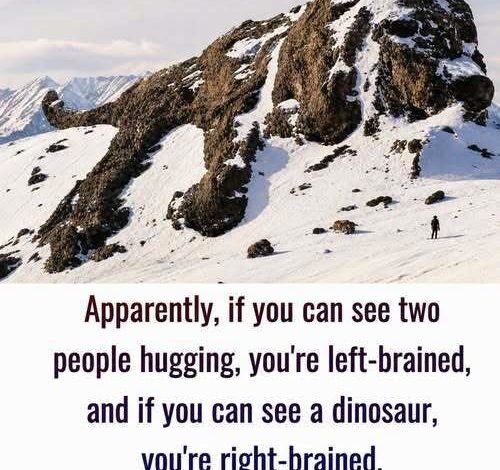
The first thing you see is wrong.
Your brain rushes to label the scene.
Two lovers locked in a snowy embrace.
Or perhaps the shadow of some enormous dinosaur buried beneath the landscape.
For a moment, either explanation feels completely convincing.
That certainty is exactly what makes the image so difficult to solve.
You stare.
You zoom in.
You follow the outlines.
And slowly, the picture begins to betray the story your brain created.
Edges shift.
Shadows rearrange themselves.
Shapes that seemed obvious suddenly become something else entirely.
At first glance, the image feels like a trick question with only two possible answers: tender human drama or an ancient beast emerging from the snow.
But that forced choice is the trap.
Because the scene isn’t really about either one.
The snow-covered “mountain” is actually fur.
The apparent ridge is a curved back.
And the dark shape on the left isn’t some mysterious creature hiding beneath the snow.
It’s a buried snout.
Look closely enough and a quiet eye appears.
Then floppy ears dusted with white begin to emerge from the confusion.
Once you notice the front paws draped over the ridge, the entire composition starts falling into place.
Follow the long body stretching toward the right.
Notice the enormous back.
Trace the shape of the head.
Suddenly, the mystery disappears.
The dinosaur vanishes.
The embracing figures dissolve.
And what seemed like an impossible snowy landscape becomes something wonderfully ordinary:
A gigantic dog sleeping peacefully in the snow.
The transformation can happen almost instantly.
One second, you’re searching for a hidden monster.
The next, you’re wondering how you ever failed to see the animal.
That’s what makes visual illusions so fascinating.
They aren’t necessarily fooling our eyes.
They’re fooling our interpretation.
Our brains are constantly trying to make sense of incomplete information. We don’t simply look at shapes and colors—we immediately construct a story around them.
If the first interpretation seems plausible, the brain becomes reluctant to abandon it.
That’s why the image can feel almost frustrating.
You’re not missing the object.
You’re looking directly at it.
You’re simply assigning the wrong meaning to what you’re seeing.
And once someone gives you the correct interpretation, there’s almost no going back.
The dog’s face becomes obvious.
The paws are unmistakable.
The enormous body can no longer be confused with a mountain.
The illusion collapses.
But the deeper lesson remains.
We do something similar far beyond photographs.
We form first impressions of people.
We make assumptions about situations.
We decide what a headline means before reading the article.
We hear one explanation and unconsciously begin interpreting every new detail through it.
The first story becomes the frame.
And once that frame is established, evidence that contradicts it can become surprisingly difficult to recognize.
This strange image demonstrates that process in the safest possible way.
There are no consequences.
Nothing important depends on whether you see a dinosaur or a dog.
But the mechanism is real.
Our minds love certainty.
They love patterns.
They love stories that make confusing information feel simple.
Sometimes, though, the truth is hiding inside the very thing we’re looking at.
All it takes is slowing down.
Looking again.
And being willing to admit that the first thing we saw wasn’t necessarily the thing that was there.
Because beneath the “mountain,” beneath the dinosaur, beneath the entire illusion, there was never anything frightening at all.
Just a gigantic dog.
Fast asleep.
Completely unaware that thousands of people were staring at its snowy nap and trying desperately to figure out what they were seeing.