My Brother Took This Photo Only 21 km from Our House Do You Have Any Idea What It Is?
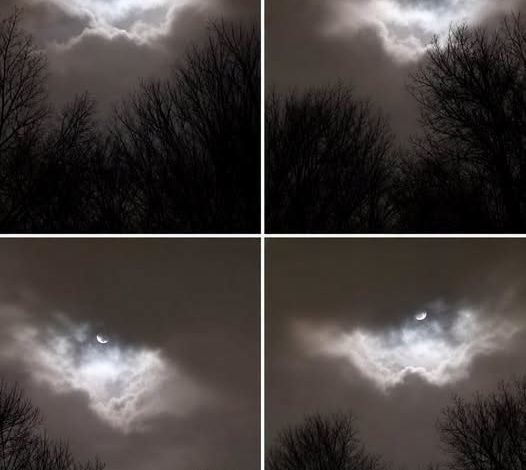
A ghostly figure appears in the clouds.
For a few fleeting seconds, the sky seems to form something almost impossible to ignore. A statue. An angel. A human figure standing silently above the horizon. People stare at the photograph and swear they can see a message hidden in the clouds.
Some call it a miracle.
Others immediately whisper hoax.
But the real story is stranger—and far more human.
Because this isn’t simply about an unusual weather formation. It’s about the brain, belief, memory, and the remarkable way humans can transform random shapes into something deeply familiar. It’s about that split second when the sky seems to look back at us, and suddenly an ordinary cloud feels like something more.
The photograph, captured near the Tyrrhenian Sea, froze one of those rare moments when everything happened to align perfectly. Clouds gathered in just the right formation. Sunlight struck them from a particular angle. Distance softened the edges, while the surrounding landscape gave the shape a sense of scale.
And then the human eye did what it has been doing for thousands of years.
It searched for meaning.
At first glance, the formation can look like a towering figure suspended above the landscape. Depending on where your eyes settle, it may resemble a statue, an angel, a person praying, or even some kind of mysterious sign.
That is what makes images like this so compelling.
There is no need for digital manipulation to make the scene feel supernatural. Nature itself can create combinations of light, shadow, vapor, and perspective that briefly resemble objects we recognize. The shape may exist for only moments before the wind stretches it apart and the familiar outline disappears.
Yet once someone points it out, it becomes almost impossible not to see.
That phenomenon has a name: **pareidolia**.
Our brains are constantly looking for recognizable patterns in an environment filled with incomplete information. We see faces in clouds, animals in rock formations, figures in shadows, and familiar objects in stains or reflections.
It isn’t a glitch.
In many ways, it’s an ancient survival feature.
For early humans, noticing a possible face or figure hidden in the landscape could have been useful. A vague shape behind the trees might have been nothing—but it might also have been a predator, another person, or a potential threat. The brain evolved to make quick guesses, sometimes preferring a false alarm over missing something dangerous.
Thousands of years later, that same instinct can turn a passing cloud into an angel.
And that’s where belief enters the picture.
One person sees a sacred figure and feels comfort. Another sees an eerie silhouette and feels uneasy. Someone else sees nothing more than sunlight passing through moisture in the atmosphere.
All three people can be looking at exactly the same photograph.
That doesn’t necessarily mean one of them is lying.
It means perception is personal.
Our experiences, expectations, memories, and beliefs influence what our brains notice first. When someone tells us, “Look at the angel,” our attention begins searching for the features that make an angel possible. Another person might be told, “Look at the statue,” and suddenly the same cloud appears rigid and humanlike.
The image becomes a kind of psychological Rorschach test written across the sky.
And perhaps that’s what makes the photograph near the Tyrrhenian Sea so fascinating.
It doesn’t need to prove anything supernatural to be remarkable.
The cloud was real.
The photograph was real.
The moment was real.
What remains uncertain is the meaning we attach to it.
That distinction matters because humans have always looked upward for answers. Long before weather forecasts and satellites, people studied the sky for omens, warnings, signs, and messages. Unusual clouds could become stories. Strange lights could become legends. A rare alignment of nature could be remembered for generations.
Even today, surrounded by technology and scientific explanations, that instinct hasn’t disappeared.
We still stop when the sky does something unexpected.
We still take photographs.
We still send them to friends.
And within minutes, someone asks the same ancient question:
**“What do you think that is?”**
Maybe it’s an angel.
Maybe it’s a statue.
Maybe it’s simply water vapor, sunlight, and coincidence.
But there is something strangely beautiful about the fact that a passing cloud can make thousands of people pause long enough to wonder.
The formation will eventually disappear. The wind will reshape it. The light will change. The sky will return to looking ordinary.
But for a brief moment, it offered something humans have always been drawn toward: mystery.
And perhaps that’s the real lesson hidden inside the photograph.
The strange figure isn’t necessarily evidence that the supernatural entered our world.
It may be evidence of something equally powerful—the extraordinary human need to find patterns, meaning, comfort, and stories in an otherwise chaotic universe.
Two people can stare at the same cloud and see completely different things.
One sees a saint.
Another sees a storm.
Another sees nothing at all.
And somehow, all of those reactions are part of the story.
Because sometimes the most fascinating thing in the sky isn’t what the cloud resembles.
It’s what the cloud reveals about the people looking at it.