Letter from 9/11 Flight Attendant Reaches Her Son 24 Years Later
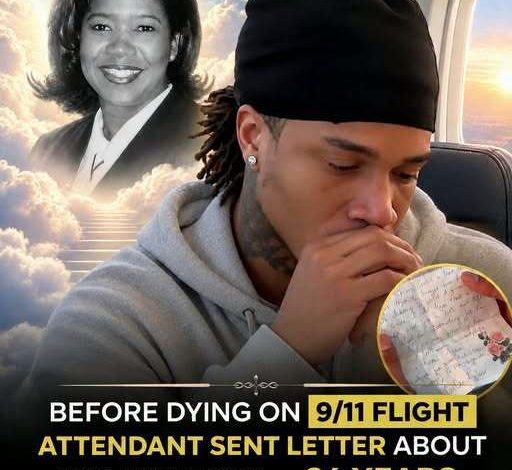
A letter no one expected to see again suddenly reappears. A mother’s voice, silenced on 9/11, breaks through more than two decades of silence to reach the son she left behind. The paper is old, the ink has survived the years, and the handwriting carries something no photograph ever could: her voice. A teacher kept a quiet promise, a reporter followed a hunch, and a grown man met his mother again on a flickering screen, as her handwriting traveled across 24 years to find him.
For most of his life, Jevon Castrillo knew his mother through memories.
He remembered her smile.
He remembered the way she spoke to him.
He remembered the feeling of being loved by her.
But memories can become fragile things. They change as childhood gives way to adulthood. Details blur. Voices become harder to hear in your mind. Photographs preserve faces, but they cannot preserve the ordinary words a parent says to a child.
Then, unexpectedly, a piece of that ordinary life returned.
It arrived in the form of a worn letter.
When Jevon Castrillo finally held the piece of paper, time seemed to fold in on itself. For a moment, the years between childhood and adulthood disappeared. The note wasn’t about terror, planes, politics, or history. It wasn’t a document written for the public. It was something much smaller and far more personal.
It was about a little boy.
A little boy who had read a library book from cover to cover.
A mother who was so proud that she wanted someone else to know.
And a teacher who understood that the words on that page mattered.
Months before Flight 93 became part of one of the darkest chapters in American history, Cee Cee Ross Lyles had written the note to her son’s kindergarten teacher. She wasn’t trying to create a historical record. She wasn’t thinking about the future.
She was simply being a mother.
She wanted the teacher to know that Jevon had read the entire book.
She wanted someone to recognize his accomplishment.
She wanted to celebrate him.
Those small details are what make the letter so powerful.
In the years after September 11, Cee Cee Ross Lyles became remembered by the world as one of the people aboard United Airlines Flight 93. Her name became part of a story of courage and sacrifice that millions of people learned about. She became a hero in the national memory.
But to Jevon, she was something before she was a hero.
She was Mom.
She was the person who noticed when he was proud of something.
She was the person who wanted his teacher to know.
She was the person who believed a child’s accomplishment was worth putting into words.
And those words survived.
Across 24 years, a kindergarten teacher guarded the letter through four different moves, refusing to let it disappear. She could have lost it. It could have been thrown away during a move. It could have been damaged by time, misplaced in a box, or forgotten in a drawer.
But somehow, she kept it.
Perhaps she understood that she wasn’t simply preserving a piece of paper.
She was preserving a small piece of a family.
The letter had survived while so many other things from that period of Jevon’s childhood were gone. The world had changed. People had grown older. Children had become adults. The little boy whose reading achievement had inspired his mother to write the note was now a grown man with a life of his own.
But his mother’s handwriting remained.
Eventually, a journalist became involved.
A hunch led the reporter toward the old story and the forgotten letter. What might have remained hidden in a box for another decade was suddenly being brought back into the light.
The letter began moving toward the person who had always been its intended recipient.
Jevon.
The journey was more than physical.
It was a journey through memory.
Through childhood.
Through grief.
Through the strange passage of time.
When the moment finally came for Jevon to see the letter, it wasn’t simply an old document being handed to him.
It was his mother speaking again.
Not through a speech.
Not through a television interview.
Not through a history book.
Through her own handwriting.
The words were intimate because they had never been written for millions of people to read. They were written for a teacher. They were written about her son. They came from a completely ordinary moment in a life that would soon be taken away.
That ordinary quality made them extraordinary.
On a video call, memories, photographs, and trembling words began stitching together a bridge between past and present. The people connected through the letter could see what the passage of time had done, but they could also see what it had failed to erase.
Love remained.
Jevon, now a father himself, read his mother’s praise through tears.
There is something uniquely painful about discovering a parent’s words decades after they were written. The words were created for a child who no longer exists in quite the same way. The little boy who received his mother’s pride grew up, became an adult, and eventually became a father himself.
Yet the letter spoke to that little boy as though no time had passed.
She didn’t know what the future would bring.
She didn’t know how the world would remember her.
She didn’t know that her name would one day appear in documentaries, memorials, books, and stories about September 11.
She knew only that her son had read a book.
And she was proud.
That may be the most moving part of the entire story.
History tends to remember people through their final moments.
Cee Cee Ross Lyles is remembered as a passenger aboard Flight 93, a woman whose life became part of an extraordinary story of courage on September 11.
But the letter offers something history often cannot.
It gives her back her ordinary humanity.
It reminds us that before she became a name associated with tragedy, she was a mother who worried about her children, celebrated their achievements, and took the time to tell a teacher how proud she was.
She was not thinking about becoming a symbol.
She was simply loving her son.
And somehow, that love crossed decades.
The teacher’s decision to keep the letter mattered because she understood that the future could never know exactly what the past would mean. At the time, it was only a note from a proud mother. Years later, it became a precious connection between a son and a parent he lost far too soon.
Four moves could not erase it.
Twenty-four years could not erase it.
Distance could not erase it.
Even death could not erase the voice contained in those lines.
When Jevon looked at his mother’s handwriting, he wasn’t simply looking backward.
He was receiving something new.
A message that had been waiting for him.
A reminder that she had seen him.
That she had noticed him.
That she had been proud of him.
And perhaps that is why the moment carried such emotional weight. The world had spent years telling Jevon who his mother was to history.
The letter told him who she was to him.
A mother.
A woman who found joy in something as simple as her child finishing a library book.
A parent who wanted to make sure someone else recognized her son’s accomplishment.
A voice that had been silent for more than two decades, suddenly speaking again.
For Jevon, now a father himself, the discovery carried another layer of meaning. He could understand the letter not only as the son who received his mother’s love, but as a parent who now knew what it meant to feel that fierce, almost instinctive pride in a child.
He could see the mother behind the handwriting in a way he perhaps couldn’t have when he was young.
And that made the letter feel alive.
The world remembers September 11 through enormous images: burning buildings, collapsing towers, airplanes, smoke, memorials, names engraved in stone, and stories of extraordinary courage.
But sometimes history survives in something much smaller.
A single page.
A few lines of handwriting.
A teacher’s careful decision not to throw something away.
A mother’s pride.
A son’s tears.
And a message that somehow waited 24 years to arrive.
In a world that remembers Cee Cee Ross Lyles as a hero, Jevon finally got to remember her as something even more intimate.
His mom.
The woman who wrote about a little boy she loved.
The woman who believed his achievement was worth celebrating.
The woman whose handwriting survived long enough to tell him, once again, what she had wanted him to know all along:
She was proud of her son.
And after all those years, he finally had her words in his hands.