The World Has Lost A True Hollywood Icon… See more
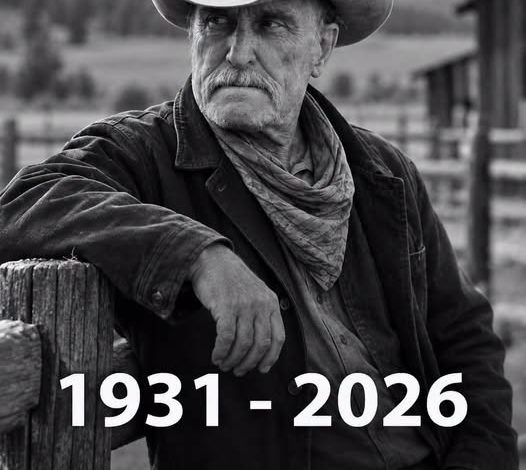
His final scene has faded to black.
Hollywood is holding its breath. Fans are left with a silence that feels almost unbearable. Robert Duvall, the man who slipped into roles so completely that audiences often forgot where the actor ended and the character began, is gone at 95.
And with him, it feels as though a particular kind of American acting has disappeared.
There was never much distance between Duvall and the men he portrayed. He did not need grand speeches, exaggerated gestures, or the kind of theatrical performance that demanded attention. He could sit quietly in a room, glance across a table, lower his voice, and somehow make the entire scene feel heavier. His greatest gift was not simply memorizing lines or becoming physically recognizable as someone else. It was the ability to make fictional people feel as though they had existed long before the camera arrived—and would continue existing after it left.
That was the secret behind performances as different as Tom Hagen, Lieutenant Kilgore, and Mac Sledge.
As Tom Hagen in *The Godfather*, he brought restraint and intelligence to a man surrounded by violence and power. He never needed to announce what Hagen was thinking. A look could do it. A pause could do it. The quiet certainty in his voice could reveal an entire calculation happening beneath the surface.
Then came Lieutenant Colonel Bill Kilgore in *Apocalypse Now*, a character almost impossible to forget. Duvall transformed military madness into something strangely charismatic and unsettling, creating a performance that could be funny, frightening, absurd, and unforgettable within the same breath. His famous presence in those scenes became larger than the dialogue itself.
And as Mac Sledge in *Tender Mercies*, he showed another side entirely.
There was no armor left.
Sledge was wounded, tired, proud, and searching for a reason to keep going. Duvall played him without sentimentality, allowing the character’s pain to exist in the silences between words. It was the kind of performance that did not tell the audience how to feel. It simply placed a broken man in front of them and trusted them to understand.
That trust defined Duvall’s career.
He made audiences lean forward because they believed him.
Directors trusted him because he understood that acting was not about showing the audience how talented you were. It was about making them forget they were watching an actor at all. Fellow performers studied the discipline behind his work. He could disappear into a character without making the transformation feel artificial.
For decades, he carried that philosophy with him.
He was never especially interested in turning himself into a celebrity spectacle. Away from the camera, Duvall guarded his private life and allowed the work to speak louder than the headlines. He did not need to constantly reinvent his public image. He did not need to chase attention simply to remain relevant.
He worked.
Again and again, he showed up.
He learned the lines. He understood the character. He listened. He waited. And when the camera began rolling, he told the truth.
Perhaps that is why watching him age on screen felt so different from watching most actors grow older.
Duvall never seemed desperate to hide time.
The lines on his face became part of the performances. The slower movements, the pauses, the weathered voice, the hesitation before a sentence—all of it became another instrument. He allowed experience to remain visible. Instead of fighting every sign of age, he used it to add history to the people he played.
In an industry constantly searching for the next version of itself, Duvall remained remarkably consistent.
He chose craft over spectacle.
Character over image.
Truth over vanity.
And that consistency became its own kind of rebellion.
Behind the quiet eyes were decades of sacrifice, long days on sets, difficult choices, opportunities accepted and others left behind, and the complicated personal battles that accompany a life devoted so completely to an unforgiving profession. There were roles he did not take, moments when Hollywood may not have known what to do with him, and periods when the next great opportunity was never guaranteed.
But he kept going.
He understood something that is increasingly difficult to remember: an actor does not have to dominate a scene to own it.
Sometimes the most powerful moment is the smallest one.
A man sitting alone.
A sentence spoken almost under his breath.
A glance toward someone he loves.
A pause before admitting something painful.
Duvall knew how to live inside those moments.
That is why his death feels larger than the loss of another celebrated performer. It closes a chapter in American cinema that cannot simply be reopened with another name. There will be other gifted actors. There will be other awards, other performances, other unforgettable characters.
But there was only one Robert Duvall.
For generations of viewers, his face became part of the emotional landscape of American film. His characters could be frightening or tender, arrogant or broken, powerful or powerless. Sometimes they were all of those things at once.
And somehow, no matter how different the roles were, he made each one feel human.
That may ultimately be his greatest legacy.
Not the awards.
Not the famous lines.
Not even the iconic characters themselves.
It is the feeling that, for a few minutes, we were not watching Robert Duvall perform.
We were watching a real man live through something.
Now the screen has gone dark.
The final scene has faded.
But the work remains behind—the voices, the faces, the silences, the tiny gestures that carried more meaning than pages of dialogue. They remain for anyone willing to watch closely.
Quiet.
Stubborn.
Honest.
And powerful enough to outlive the man who created them.
Robert Duvall is gone at 95, but the characters he left behind are still speaking.
And cinema is quieter without him.