MARINE VETERAN DIES SUDDENLY AT 28 — LEAVING HIS 2-YEAR-OLD SON TO GROW UP WITH STORIES OF HIS DAD
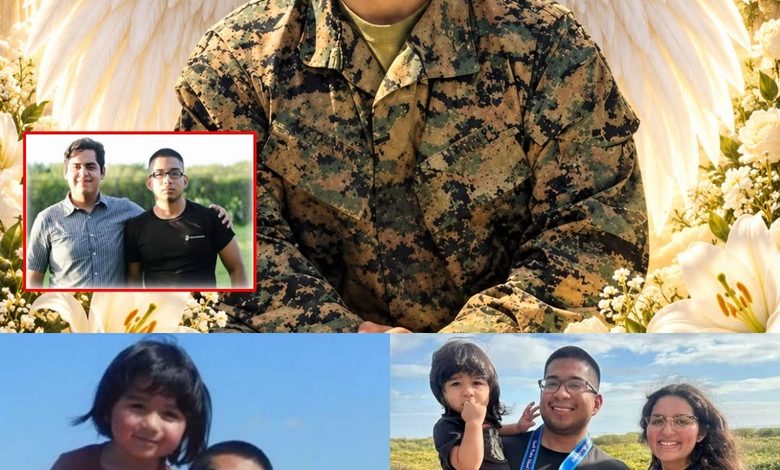
For ten years, Caleb Medrano wore the uniform of a United States Marine, building a life around discipline, strength and service. But to the people who loved him most, the titles that mattered were much simpler: husband, son, brother and dad. Now, at only 28 years old, Caleb is gone, and his 2-year-old son Moisés faces a future his family never imagined.
The tragedy unfolded during the quiet hours of September 8, when Caleb got out of bed during the night to use the bathroom. According to his aunt, Aurora Sáenz Medrano, he suddenly collapsed inside the home he shared with his wife, Linda, and their little boy. Within moments, an ordinary night had become the beginning of an unimaginable family nightmare.
Linda immediately called 911, desperately hoping emergency responders could save her husband. But despite the efforts to help him, Caleb could not be saved, according to his family. He died at around 1:30 that morning, leaving those closest to him stunned by how quickly everything had changed.
Caleb was just 28, an age when most people imagine decades of life still waiting ahead. His family says they were told it appeared he may have suffered a stroke, though they are still trying to understand how someone so young and active could be gone so suddenly. For those who knew him as a strong Marine who enjoyed working out and lifting weights, the shock has been especially difficult to process.
There had been no expectation that this would be their final night together. There was no time for his wife to prepare for goodbye, no opportunity for his parents and siblings to imagine that their next conversations about Caleb would be spoken in the past tense. Most painfully, there was no way for 2-year-old Moisés to understand that his father would not be coming home.
At two years old, a child is only beginning to discover the world around him. He should have had years of ordinary moments with his father ahead — bedtime stories, birthdays, scraped knees, first days of school and countless evenings spent together as a family. Instead, Moisés will now grow older carrying a connection to his father through photographs, videos and the memories preserved by those who knew Caleb best.
That is the part of this loss that Caleb’s aunt Aurora says hurts especially deeply. Moisés is still too young to fully understand what has happened or why the familiar presence of his dad is suddenly missing. One day, however, he will begin asking questions, and his family will have an enormous collection of stories to tell him.
They will tell him that his father served as a Marine for approximately ten years. They will tell him about Caleb’s discipline, his love of exercise and the hours he spent working out and lifting weights. But they will also make sure Moisés understands that the most important things about his father could never be measured by physical strength or years of military service.
Caleb, his aunt says, was kind, gentle and deeply devoted to the people he loved. He cared about his parents, his brother Josué, his wife Linda and especially his young son. Those relationships, rather than any uniform or achievement, were at the center of the man his family is now mourning.
Aurora described her nephew as the pride of the Medrano De León family. His military service was certainly part of that pride, but it was far from the entire reason. They were proud of Caleb because of the person he became and the way he treated the people around him.
For Linda, the loss means confronting a future dramatically different from the one she and Caleb had expected to share. The person who was supposed to stand beside her as their son grew up is suddenly gone. Every milestone Moisés reaches will now carry both joy and the painful awareness that his father should have been there to witness it.
There will be birthdays when Caleb’s absence feels particularly heavy. There may be school ceremonies, holidays and eventually graduations when his family looks toward the place where they wish he could be standing. Yet those moments will also provide opportunities to remind Moisés that his father’s life continues to matter.
A photograph can capture a face, but a family’s memories preserve something much deeper. Moisés can grow up hearing how his father laughed, what made him happy, how he behaved around the people he loved and what dreams he carried for his family. Through those stories, Caleb can remain more than a name attached to a photograph.
There may come a day when Moisés asks what it meant that his father was a Marine. His relatives will be able to explain the commitment and sacrifice involved in giving a decade of his young life to military service. They can also explain that courage is not limited to uniforms, battlefields or medals.
Sometimes courage is getting up every morning and taking responsibility for the people who depend on you. Sometimes strength means being gentle with your family, remaining loyal to those you love and showing up for the ordinary moments that eventually become precious memories. According to Aurora’s description, those qualities were also part of Caleb’s legacy.
The loss is made even more painful because this family was already carrying another deep wound. Only about a year earlier, they had mourned the death of Caleb’s father, Hilario Medrano. Before they had fully found their footing after one devastating goodbye, they were suddenly being asked to endure another.
Losing a father and then a son within such a short period can transform the emotional landscape of an entire family. Familiar gatherings can suddenly feel different because two voices are missing, and photographs that once represented happy memories can take on new meaning. The Medrano family is now facing that painful reality while trying to support Linda and little Moisés.
For Aurora, disbelief remains mixed with heartbreak. The nephew she remembers as loving and gentle was supposed to have much more time with everyone who loved him. Instead, the family is preparing to say goodbye to a man who had not yet reached his 30th birthday.
Twenty-eight years is far too short to contain everything a person hoped to experience. Caleb should have had more birthdays with his son, more anniversaries with his wife and more opportunities to make memories with his brother and extended family. He should have been able to watch Moisés grow from a toddler into a young man.
He should have been there for the questions children eventually ask their fathers. He should have been able to teach his son lessons that only he could teach and share stories from his own childhood and years of military service. Those possibilities are now among the invisible things his family is grieving.
Yet grief is not only about the future that was lost. It is also evidence of the life that existed and the love that was built while Caleb was here. The depth of his family’s heartbreak reflects how deeply he was woven into their lives.
Aurora’s words repeatedly return to Caleb’s goodness. She does not describe him primarily through accomplishments, possessions or status, but through the way he loved people. That distinction says something powerful about what remains when a life ends unexpectedly.
Jobs eventually change, uniforms are put away and achievements become entries in a biography. But the way someone made another person feel can remain for generations. A little boy can grow up knowing that his father loved him even if his own memories of those early years become faint.
That will now be one of the family’s most important responsibilities. They will become the keepers of Caleb’s story for Moisés, preserving details that may seem small today but could become priceless as he grows older. Every photograph, family video and remembered conversation may someday help the boy understand the father he lost too soon.
They can tell Moisés that Caleb loved staying active and going to the gym. They can describe the dedication that carried him through ten years as a Marine and the pride his family felt watching him build his life. Most importantly, they can tell the little boy how his father looked at him and how much being his dad meant.
Children who lose a parent at such a young age often inherit memories through other people. A grandmother remembers one moment, an aunt remembers another and a sibling may recall something completely different. When those memories are brought together, they can form a portrait far richer than any single photograph.
For Linda, keeping those memories alive may sometimes be both comforting and painful. She knew Caleb not only as the Marine others respected or the nephew Aurora adored, but as the man with whom she built a home and welcomed a child. She carries memories of ordinary moments that nobody else witnessed.
Those quiet memories often become some of the most precious after sudden loss. The conversations before bed, familiar routines, inside jokes and small acts of affection can suddenly feel more valuable than any grand occasion. They are reminders that a life is ultimately made from thousands of moments that once seemed ordinary.
September 8 will now forever divide this family’s story into a before and an after. Before that night, Caleb was a 28-year-old husband and father building a future. After it, his loved ones were left trying to understand how that future disappeared in a matter of moments.
His family says the apparent medical emergency gave them almost no time to comprehend what was happening. One moment Caleb was home with his wife and child, and soon afterward Linda was calling 911 as the situation became critical. By approximately 1:30 a.m., the family was facing news they never expected to receive.
The suddenness is part of what makes the tragedy so difficult to absorb. When someone young, active and apparently full of life dies unexpectedly, the mind naturally searches for explanations. Caleb’s family is still processing what they were told about a possible stroke while confronting the reality that he is gone.
Amid those unanswered questions, however, one fact remains clear to the people closest to him: Caleb mattered. He mattered to the parents who raised him, the brother who shared life with him and the aunt who now wants others to remember his name. He mattered profoundly to Linda and to the little boy whose life will always carry part of him forward.
Moisés may not understand the magnitude of his loss today. At two years old, his world is made up largely of the people and routines immediately surrounding him. As he grows, his understanding of his father’s absence will change, and so will the questions he asks.
There may be a time when he wants to know whether he looks like Caleb. He may wonder whether he inherited his father’s personality, his interests or even the same determination that helped Caleb serve ten years as a Marine. Those questions can become another way for father and son to remain connected across time.
His relatives will likely see pieces of Caleb in him as he grows. Maybe it will be a smile, an expression, a gesture or a way of responding to the world that suddenly brings Caleb back into the room for a moment. Those similarities can hurt, but they can also become gifts.
Caleb’s story also carries a reminder about the unpredictability of life. Families make plans believing there will always be another morning, another conversation and another opportunity to say what matters. Sometimes, without warning, that assumption disappears.
That is why Aurora’s request to share her nephew’s story feels so meaningful. She does not want Caleb to become simply another name attached to a tragedy. She wants people to understand who he was and why his absence has left such a profound space in the lives of those who loved him.
She wants people to remember a Marine who gave ten years of service. She wants them to remember a kind and gentle man whom his relatives proudly called the pride of their family. Above all, she wants people to remember a husband and father whose little boy deserved many more years by his side.
As the family prepares for Caleb’s funeral and burial, the reality of his absence will become even more tangible. Saying goodbye publicly can be one of the hardest stages of grief because it forces loved ones to confront what their hearts may still struggle to accept. Yet it also gives family and friends an opportunity to surround one another and honor the person whose life brought them together.
For a family that buried Hilario only about a year ago, returning to grief so soon feels especially cruel. They are mourning two generations while simultaneously trying to remain strong for the youngest generation. Little Moisés now becomes an especially powerful reason to preserve both his father’s memory and the family stories that came before him.
Someday he will be old enough to understand the photographs and stories people saved for him. He will learn that his father was only 28 when his life ended and that the people around Caleb struggled to understand how someone so young could disappear so quickly. He will also learn that his father’s age at death does not define the value of the life he lived.
Caleb had already built something that survives him. He had created a family with Linda, formed relationships that his relatives clearly treasured and become the father of a little boy who carries his legacy forward. Death ended his physical presence, but it cannot erase those connections.
That may be one of the few sources of comfort available during such an overwhelming loss. Caleb will remain present in family photographs, stories, traditions and perhaps in the characteristics Moisés displays as he grows older. His son will not have to discover who his father was alone.
He will have people around him who remember. They can tell him about the Marine, the gym enthusiast, the brother, the nephew and the husband. Most importantly, they can tell him about Dad.
They can tell him that his father loved him before he was old enough to remember every moment. They can explain that Caleb expected to be there for far more of his childhood than fate allowed. And they can remind him that being separated from someone does not erase the love that existed.
Today, however, those future conversations are still far away. Right now there is simply a devastated family trying to comprehend a sudden loss while preparing to lay a 28-year-old husband and father to rest. There is a wife mourning her partner and a little boy who cannot yet understand why everything has changed.
There is also an aunt asking people not to let her nephew’s story disappear. Aurora wants Caleb remembered for his kindness, his service and the love he showed his family. She wants the world to know why the Medrano De León family called him their pride.
And perhaps that is where Caleb’s story should remain — not solely with the night he collapsed, but with everything that came before it. Twenty-eight years contained a son who was loved, a brother who mattered, a Marine who served, a husband who built a home and a father who adored his little boy. Those are the pieces of Caleb Medrano that his family will carry long after the shock of September 8.
Moisés will grow up without his father physically beside him, but he does not have to grow up without knowing him. Every person who loved Caleb can give the child another piece of his dad through stories, photographs and memories. Together, those pieces can help ensure that Caleb remains part of his son’s life for decades to come.
For now, the Medrano family is asking for something simple: remembrance, compassion and prayer. They are grieving Caleb while still carrying the loss of his father, and they are trying to surround Linda and Moisés with love during a chapter none of them expected. A few words of kindness cannot remove their pain, but they can remind this family that they are not mourning alone.
Caleb Medrano was only 28 years old when his life ended, but his family does not want his final night to become the only thing people remember about him. They want him remembered as the man who served, loved, worked hard and took pride in his family. Most of all, they want his little boy to someday know just how deeply his father was loved.
So when Moisés is old enough to ask who his dad was, there will be an answer waiting for him. He will hear about a Marine named Caleb Medrano, but he will also hear about the kind, gentle young man behind the uniform and the father whose time with him was heartbreakingly short. And through every story his family tells, Caleb’s love for his son can continue long after their final night together.